
A missed passport renewal or a forgotten prescription can turn a good trip into a stressful one. A solid travel checklist catches these problems weeks before departure instead of at the airport counter. This guide breaks the process into documents, packing, technology, money, and a timeline you can follow whether you’re headed to Cancun for a weekend or Tokyo for three weeks.
What Should Be on a Travel Checklist?
A travel checklist should cover five categories: documents, packing, health and toiletries, technology, and pre-departure home tasks. Most guides online only address one or two of these, usually clothing and toiletries, which leaves travellers scrambling for passports, currency, or a house sitter the night before a flight.
Documents come first because they’re the hardest to fix last-minute. Passport applications, if submitted through routine processing, take 6 to 8 weeks to arrive according to the U.S. Department of State. Packing comes second, sorted by trip length rather than a single generic list. A 3-day domestic trip and a 14-day international trip need completely different quantities of clothing, and treating them the same leads to overpacked bags or forgotten items.
Health and technology round out the list because both categories get overlooked until they cause a problem abroad. A traveler without a copy of their prescriptions can lose access to medication at customs. A traveler without an international data plan can lose access to maps, translation apps, and boarding passes the moment they land.
Travel Document Checklist: What to Organize First

Organize your passport, government ID, visa or entry authorization, travel insurance policy, and copies of each before you touch your suitcase. Documents take longer to replace than clothing takes to buy, so they belong at the top of every travel checklist.
Start with your passport. Check the expiration date the day you book your flight, not the week before you leave. Many countries in Europe require six months of remaining validity beyond your travel dates, so a passport that expires in four months can get you denied boarding even though it’s technically still valid. If your passport needs renewal, apply through travel.state.gov and budget 6 to 8 weeks for standard service or 2 to 3 weeks for expedited service.
Next comes identification for domestic flights. As of May 7, 2025, the Transportation Security Administration (TSA) requires a REAL ID-compliant driver’s license or another acceptable form of ID, such as a passport, for domestic air travel within the United States. Check the corner of your driver’s license for a star marking; its absence means your state-issued license may not clear security.
Make three copies of every document: one stays with a trusted contact at home, one travels separately from the original in your bag, and one lives as a photo on your phone. This single habit solves most of the panic that comes with a lost or stolen wallet abroad. Add these items to your document checklist:
- Passport (with 6+ months validity for international travel)
- REAL ID-compliant driver’s license or passport card for domestic flights
- Visa or electronic travel authorization, if required for your destination
- Travel insurance policy number and 24-hour emergency contact
- Copies of prescriptions and a list of medications by generic name
- Proof of onward travel, if entering a country that requires it
- Emergency contact list, including embassy or consulate information
International Travel Checklist: Passport, Visa, and STEP
Register with the Smart Traveler Enrollment Program (STEP) before any international trip, then confirm entry requirements for your specific destination. STEP is a free U.S. Department of State service that sends security alerts and helps the nearest embassy reach you during an emergency.
Entry requirements vary by country and change without much warning. A visa that wasn’t required last year can become mandatory this year, and some countries require an electronic travel authorization that must be approved before you board your flight, not after you land. Check the Travel Advisories section of travel.state.gov for your destination, which lists the current advisory level from 1 (exercise normal precautions) to 4 (do not travel).
If you’re driving abroad, most countries won’t accept a standard U.S. driver’s license on its own. An International Driving Permit (IDP), available through AAA or the American Automobile Touring Alliance for around $20, translates your license into multiple languages and is required in many countries alongside your original license.
Vaccine requirements deserve a check as well. Some countries require proof of yellow fever vaccination for entry, particularly if you’re arriving from a country where the disease is present. The Centers for Disease Control and Prevention (CDC) publishes destination-specific health guidance that updates more frequently than most blog posts do.
Packing List by Trip Length
Pack one pair of underwear and socks per day regardless of trip length, then scale outerwear and shoes based on trip duration rather than daily counts. A 4-day trip and a 10-day trip don’t need proportionally more shirts if you’re willing to do laundry or repeat outfits.
For trips under 5 days, one to two versatile outfits, one pair of shoes beyond what you’re wearing, and a single jacket or layer usually covers it. A traveler heading to Chicago for a 4-day business trip in October, for example, needs one suit, two casual outfits, one pair of dress shoes, and a mid-weight coat, not a full week’s rotation.
For trips over a week, plan for laundry rather than volume. Two to three pairs of shoes, four to five mix-and-match tops, and a travel-sized laundry kit will outlast a suitcase packed with fourteen individual outfits. Pack neutral colors that combine into multiple outfits instead of one outfit per colour.
Weather changes the math more than duration does. A ski trip in January calls for thermal layers, waterproof gloves, and snow boots rated to at least 0°F (-18°C), while a beach trip to the same destination in July needs none of that. Match your packing list to the forecast for your specific dates, not the destination’s general climate.
Carry-On Essentials Checklist
Pack your ID, medications, one change of clothes, chargers, and any irreplaceable valuables in your carry-on, never in checked luggage. Checked bags get delayed or lost more often on connecting flights, and the items above are the ones you genuinely cannot function without if that happens.
Prescription medications belong in their original labeled containers, along with a printed list of generic drug names in case you need a refill abroad. A traveler with a checked bag lost on a layover can survive a missing sweater; losing a week’s supply of insulin is a different situation entirely.
Beyond the essentials, comfort items make long flights easier: noise-canceling headphones, a neck pillow, an eye mask, and an empty reusable water bottle you can fill after airport security. TSA allows liquids in containers of 3.4 ounces (100 milliliters) or less, all fitting into a single quart-sized bag, so pack travel-sized toiletries specifically for the carry-on rather than transferring from full-sized bottles at the gate.
- Government-issued ID and boarding pass (digital or printed)
- Wallet with cash, cards, and a copy of your passport
- Phone, charger, and a portable battery pack
- One full change of clothes
- Prescription medications in original containers
- Empty water bottle and light snacks
- Headphones, a book, or a downloaded show for entertainment
Toiletries and Health Checklist
Pack toiletries in travel-sized containers under 3.4 ounces (100 millilitres) for carry-on bags, and include a basic first aid kit regardless of destination. Skipping this step means either buying replacements at inflated airport or hotel prices, or discovering at security that a full-sized bottle has to be tossed.
A basic first aid kit covers more ground than most travelers expect. Bandages, antiseptic wipes, pain relievers, motion sickness tablets, and insect repellent handle the majority of minor issues that come up on the road. A traveler heading to a tropical destination should add a DEET-based repellent rated for at least 6 hours of protection, since mosquito-borne illness risk rises sharply in humid climates.
Health prep goes beyond the physical kit. Confirm whether your destination requires specific vaccinations, and carry a printed copy of your prescriptions with the generic drug name listed, since brand names vary by country and some medications legal in the United States are restricted or banned elsewhere.
- Toothbrush, toothpaste, and floss
- Travel-sized shampoo, conditioner, and body wash
- Sunscreen (SPF 30 or higher)
- First aid kit: bandages, antiseptic, pain reliever, motion sickness tablets
- Prescription medications with a printed list of generic names
- Hand sanitizer and a few disposable masks
- Insect repellent, if traveling to a tropical or wooded destination
Tech and Electronics Checklist
Bring a universal power adapter, a portable charger rated for at least 10,000 mAh, and either an international data plan or an eSIM activated before departure. Losing access to maps, translation tools, or your digital boarding pass mid-trip causes more daily friction than a forgotten sweater ever will.
An eSIM, a digital SIM card that activates through your phone’s settings rather than a physical chip, lets you buy local data plans in dozens of countries without swapping hardware or hunting for a phone shop after landing. Providers like Airalo and Holafly sell destination-specific eSIM plans that activate before your flight leaves the ground, which matters if you land at 11 p.m. local time and need a rideshare app working immediately.
Backup power matters more on longer travel days. A portable charger rated at 10,000 mAh will typically get a smartphone through two to three full charges, enough to cover a delayed flight and a long taxi from the airport without hunting for an outlet.
- Universal power adapter (check plug type for your destination)
- Portable charger, 10,000 mAh or higher
- eSIM or international data plan, activated before departure
- Offline maps downloaded for your destination city
- Backup copies of documents saved to your phone or cloud storage
- Noise-canceling headphones and charging cables
Pre-Departure Home Checklist

Stop your mail, arrange for a house sitter or plant care, and set your thermostat before locking the door for a trip longer than 5 days. Skipping this step doesn’t ruin a trip, but it turns the first day home into cleanup instead of unpacking.
The U.S. Postal Service (USPS) offers a free hold mail service for stays up to 30 days, requestable online up to 30 days in advance. A stack of mail visible through a mail slot signals an empty house to anyone walking by, so holding delivery matters as much for security as for convenience.
Set your thermostat to an energy-saving range rather than turning it off completely, particularly in winter, since pipes can freeze in homes left below 55°F (13°C) for extended periods. Unplug small appliances that draw standby power, and confirm someone has a spare key in case of an emergency at home while you’re away.
- Hold mail through USPS or ask a neighbor to collect it
- Arrange plant watering or pet care
- Set thermostat to an energy-saving range (not off, in winter)
- Unplug non-essential appliances
- Leave a spare key with a trusted neighbor or family member
- Confirm home security system or cameras are active
Travel Budget and Money Checklist
Notify your bank of travel dates, carry two payment methods, and exchange a small amount of local currency before departure. A card frozen for suspected fraud, triggered by an unexpected charge in a foreign country, causes more trip disruption than most travellers plan for.
Carrying two separate payment methods, such as a credit card and a debit card from different banks, protects against a single lost or compromised card leaving you without access to funds. A traveller whose wallet is stolen on day 2 of a 10-day trip needs a backup card already packed separately, not one ordered for overnight delivery to a hotel that may not accept it.
Exchange $50 to $100 in local currency before you leave if your destination uses a different currency, since airport exchange counters typically charge 5% to 10% more than banks or ATMs. Research typical tipping norms for your destination as well; a 20% tip expected in the United States can read as excessive, or insulting, in countries where tipping isn’t customary.
- Notify your bank and credit card company of travel dates
- Carry two separate payment methods
- Exchange a small amount of local currency before departure
- Research ATM fees and daily withdrawal limits at your destination
- Note the exchange rate to estimate costs on the ground
- Check tipping customs for your destination
Travel Checklist Timeline: 8 Weeks to Departure Day
Start document checks 8 weeks before departure, pack 1 week before, and make final confirmations the day before you fly. Spacing tasks across a timeline prevents the last-minute scramble that causes most items to be forgotten.
At 8 weeks out, check passport expiration and apply for a visa if required. At 4 weeks out, book any required vaccinations and confirm your travel insurance policy. At 2 weeks out, activate an eSIM plan and notify your bank of travel dates. At 1 week out, start packing and confirm your pre-departure home checklist. The day before departure, print boarding passes, charge all devices, and set out your carry-on essentials so nothing gets left on a counter in the morning rush.
Domestic vs. International Travel Checklist Differences
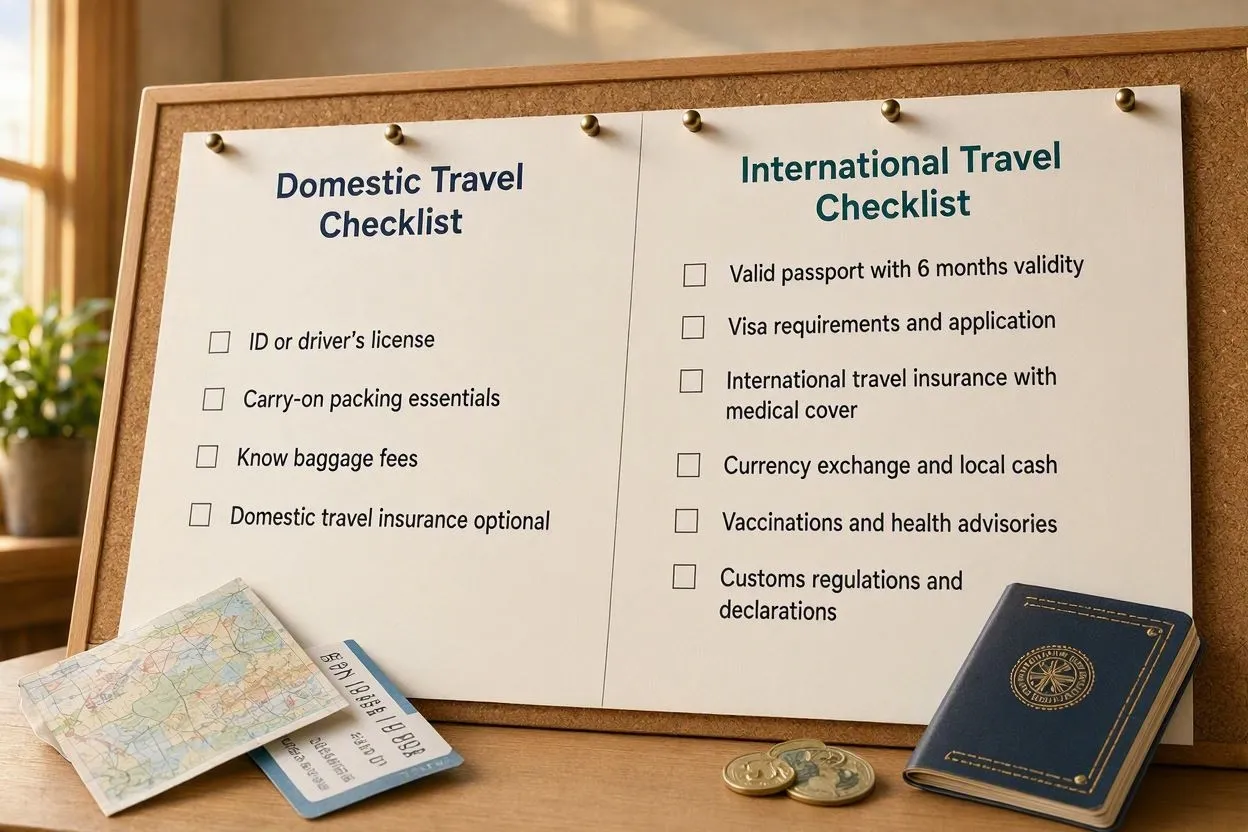
Domestic travel checklists focus on REAL ID compliance and TSA carry-on rules, while international travel checklists add passport validity, visas, and destination-specific health requirements. Treating a weekend trip to Denver the same as a two-week trip to Vietnam either overprepares for the domestic leg or underprepares for the international one.
A domestic trip within the United States requires a REAL ID-compliant license or passport, standard TSA carry-on compliance, and little else beyond normal packing. An international trip adds passport validity checks, visa or entry authorization research, an International Driving Permit if you plan to rent a car, and destination-specific vaccine or health documentation. A traveler flying from New York to Los Angeles needs a valid ID and a boarding pass; a traveler flying from New York to Hanoi needs all of that plus a visa, a yellow fever vaccination record if connecting through certain countries, and STEP enrolment.
Conclusion
A working travel checklist covers documents, packing, technology, money, and the home you’re leaving behind, not just a stack of folded shirts. Build the list around your specific trip length and destination rather than copying a generic template, and start the document checks 8 weeks out if international travel is on the calendar. The traveller who checks a passport expiration date in January avoids the one who’s rebooking a flight in a consulate waiting room in March.