
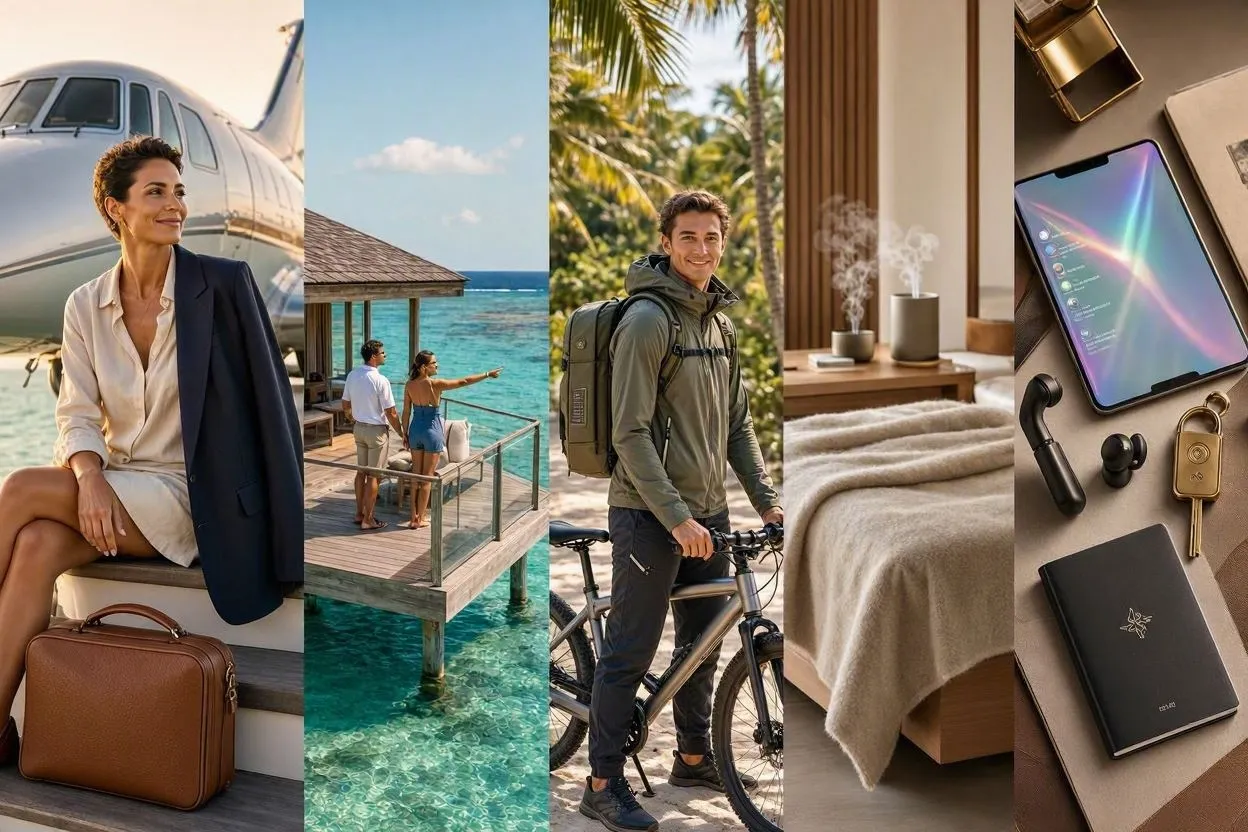
Affluent travelers are booking fewer trips, but longer and pricier ones, built around wellness, privacy, and access rather than status symbols. That shows up everywhere, from how hotels lay out their suites to which destinations travel advisors push first. The pattern holding across this year’s luxury travel trends: high-net-worth travelers want depth over spectacle, and they’ll pay for it.
What Are the Top Luxury Travel Trends Right Now?
Five trends define luxury travel right now: wellness-driven itineraries, private aviation growth, solo female travel, villa-based stays, and shoulder-season booking. The numbers back it up. Advisors at Virtuoso’s 2026 Travel Week reported that bookings with average daily rates above $1,500 grew 37%, roughly double the growth rate across all Virtuoso hotel bookings, and cruise bookings priced at $50,000 or more rose 49% over the same stretch. Destination managers and concierge teams have been saying this anecdotally for months. Now there’s data behind it: the top of the luxury market isn’t just holding steady, it’s outpacing everything below it.
Six sub-trends show up across the data and expert commentary consistently:
| Trend | What’s Driving It |
| Wellness and medical tourism | Recovery-focused itineraries, medical retreats, and sound healing replacing the standalone spa visit |
| Private aviation and yacht travel | Branded jets and superyachts turning the journey into part of the stay, not a hurdle before it |
| Solo female travel | One of the fastest-growing booking segments, reshaping room placement and concierge service |
| Private membership clubs | Access to invitation-only events and appointments individual travelers can’t book alone |
| Villa and vacation-rental stays | Group and multi-generational trips that have outgrown the single hotel room |
| Shoulder-season booking | Peak-destination access without peak crowds, pricing, or heat |
They all trace back to one idea. Luxury travelers now measure value in time, privacy, and personal meaning, not thread count or square footage.
Why Is Wellness Travel Leading Luxury Travel Trends?
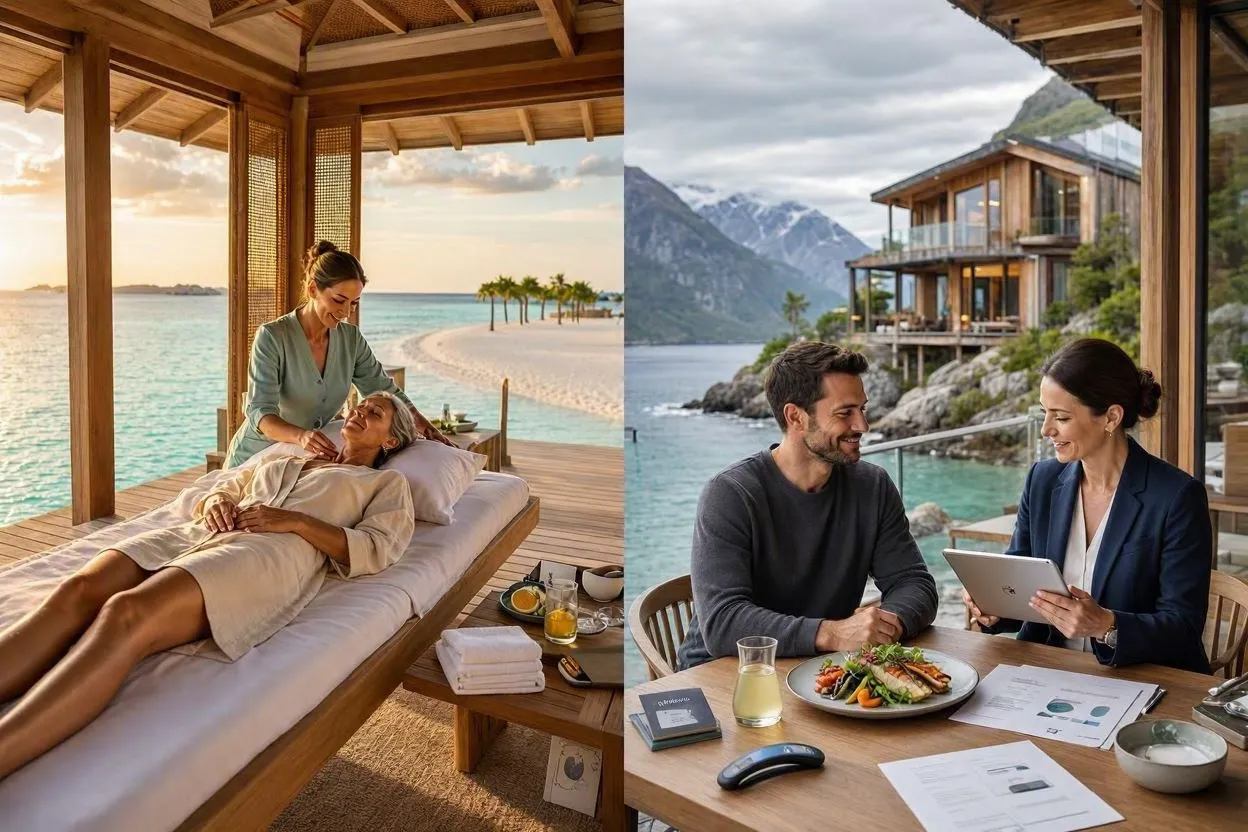
A hotel spa used to be an add-on. Now it’s often the whole reason for the booking. Affluent travelers treat physical and mental recovery as the point of the trip, not a bonus tacked onto the itinerary, and resorts in the Maldives and Norway have rebuilt entire stays around that shift, pairing ocean-view massage treatments with structured sleep and nutrition programs instead of one 60-minute service.
Medical wellness retreats are growing right alongside the traditional spa. Clinics in Switzerland and South Korea now pair diagnostics, IV therapy, and preventative screening with five-star hospitality once reserved for beach resorts. Sound healing, once a fringe offering, has become one of the most-requested amenities at five-star properties worldwide, and hormone-informed retreats and nervous-system-focused therapies are catching up fast.
Book a wellness trip in 2026 and you’re more likely to walk away with a personalized recovery plan than a spa menu to pick from. That distinction matters for how properties market themselves, and for how anyone writing about wellness travel should frame the keywords.
How Is Private Aviation Changing Luxury Travel?
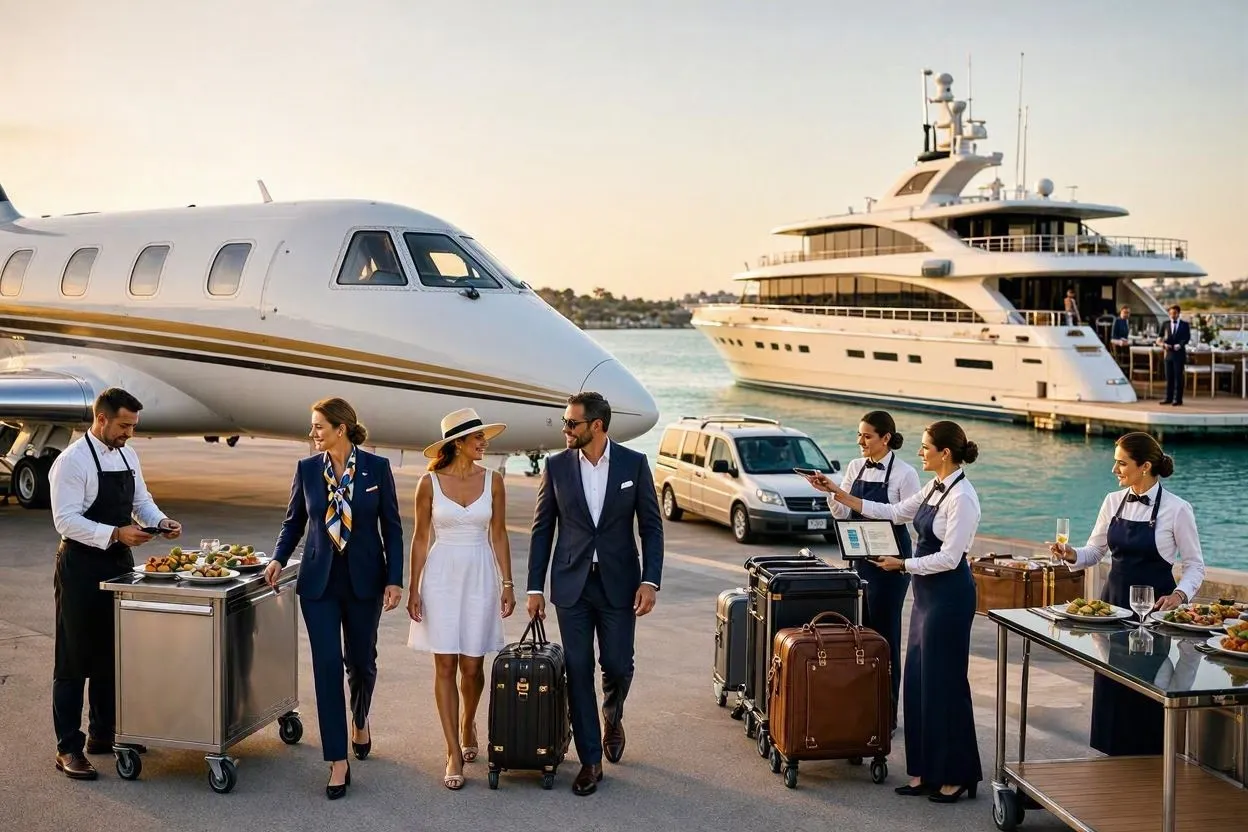
The flight itself is becoming part of the vacation instead of the hurdle before it. Three shifts are driving that change:
- Branded jets and superyachts. Four Seasons runs branded private jets that carry guests between properties as one continuous stay. Ritz-Carlton operates three superyachts with curated food and beverage programs at sea. Neither company treats these as optional add-ons; both build them into the core guest experience.
- Boat travel replacing island-hopping by plane. Chartered yachts and small-ship cruises let travelers hop between islands without repacking, timing arrivals around tides and weather instead of a fixed flight schedule. A week pairing a private villa with a chartered boat is edging out the older city-to-city hotel-hopping model, and for someone covering roughly 800 kilometers (about 500 miles) across a chain of islands, that flexibility saves real time, not just discomfort.
- Neo-nomad living. Wealthy travelers now string together private aviation and mobile residences to work and live across multiple locations without ever fully unpacking. Movement itself has become the lifestyle, not a string of separate trips.
Why Are Solo Female Travelers Driving Luxury Travel Trends?
This is one of the fastest-growing booking segments in luxury travel, and hotels know it. Independence, safety, and discretion top what these travelers ask for, so properties are responding with strategic room placement, vetted local guides, and wellness programming built for one guest rather than a couple.
India leads the destination list, mostly on the strength of the Golden Triangle route through Delhi, Agra, and Jaipur. Vietnam isn’t far behind, prized for tourist infrastructure that’s safe and easy to navigate solo. Croatia, Iceland, Thailand, and Scotland’s Isle of Skye round out the top picks. Notably, it’s older women, not university-age travelers, leading this growth, thanks to more flexible schedules and bigger discretionary budgets.
The hotels that win this audience share one habit: they anticipate needs before a guest has to ask. A concierge who already knows a solo guest’s dietary restrictions and preferred pace beats one that treats every request like it’s the first time anyone’s asked.
What Role Do Private Membership Clubs Play in Luxury Travel?
Access, not ownership, is what these travelers are paying for now. Private membership clubs get high-net-worth travelers into destinations, events, and itineraries the general public simply can’t book, pairing hyper-personalized trip planning with entry to private resorts and invitation-only events. Exclusivity has become worth more than the price tag attached to it.
Two things are pushing this trend forward. Wellness and medical tourism keep raising membership demand, since clubs can lock in appointments and access individual travelers can’t get on their own. Exclusive event access, closed-door dinners, private art previews, is a comparable draw. Clubs that offer both are seeing the fastest membership growth in the sector this year.
How Is Villa Travel Replacing Hotel Stays?
Group and multi-generational trips have outgrown the hotel room. One villa company alone operates more than 150 properties across 15 destinations, and demand for that inventory has climbed every year since 2019.
Group size explains most of it. A family of eight booking a hotel ends up scattered across floors with no shared space to actually be together. A villa with four or five bedrooms puts the same group under one roof, kitchen, pool, and outdoor entertaining area included. That structural difference, more than price, is why villas keep pulling ahead of hotels among group travelers.
Longer stays follow from there. Advisors managing these bookings say groups that rent a villa for ten straight nights, instead of splitting a week across two hotels, deal with fewer logistics headaches and spend more actual time together.
Why Is Shoulder Season Travel Growing Among Luxury Travelers?
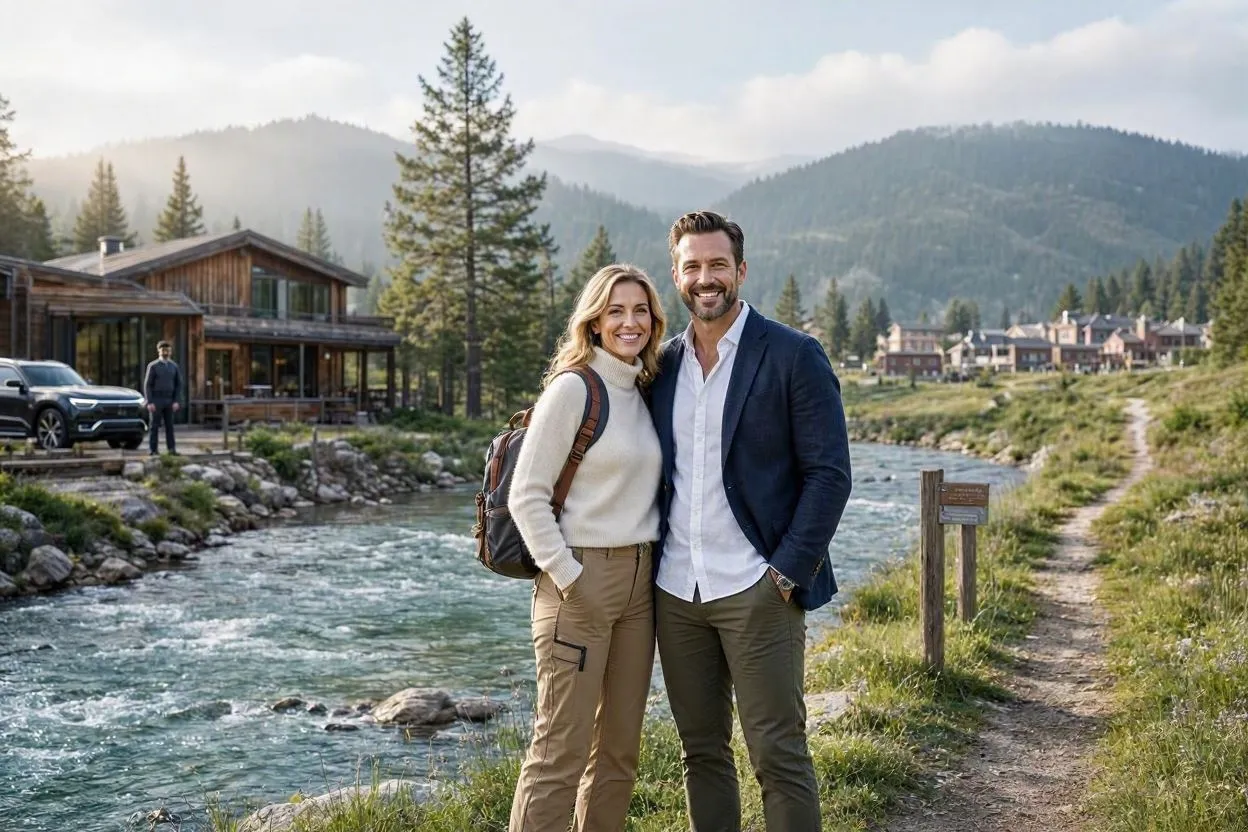
Same destinations, none of the crowds, pricing, or heat that make peak season a grind. Virtuoso reported Fall 2026 bookings up 59% year over year, with sales up 69% over the same period. September bookings alone climbed 55%, sales up 77%. November grew 70% in both categories.
Advisors have their favorite windows. Early summer in Colorado means freshly opened trails and rivers running full, before the towns fill up. Spring in Los Cabos holds ocean temperatures around 24°C (75°F) with quiet beaches and whale sightings still possible late in the season. May in St. Barths brings calmer roads and dinner reservations that are nearly impossible to land in winter. September in Tuscany lines up with grape harvest, daytime temperatures dropping into the low 20s Celsius (upper 60s to low 70s Fahrenheit), perfect for long vineyard lunches.
Sometimes it only takes a few degrees of temperature difference between peak and shoulder season to move an entire booking pattern.
| Destination | Best Window | Temperature |
| Colorado | Early summer | Trails and rivers at full flow before peak crowds |
| Los Cabos | Spring | Around 24°C (75°F) |
| St. Barths | May | Calmer roads, easier dinner reservations |
| Tuscany | September | Low 20s Celsius (upper 60s to low 70s Fahrenheit) |
How Much Are Ultra-High-Net-Worth Travelers Spending?
Roughly double the growth rate of the broader luxury segment. Bookings with an average daily rate above $1,500 grew 37%, against standard growth across all Virtuoso hotel bookings. Trips priced at $50,000 or more rose 47%, and cruise bookings in that same bracket grew 49%.
That spending is flowing straight into hotel-within-a-hotel setups. Even at five-star properties they’ve stayed at before, ultra-high-net-worth travelers are opting for private wings, dedicated check-in, and separate pool access over the standard luxury room. Private clubs with direct hotel ties are capturing a growing slice of that spend too, blending luxury-hotel service with members-only exclusivity.
What Do Luxury Travelers Want From Culinary and Cultural Experiences?
They want the people behind the food and culture, not a tour that keeps them at arm’s length. Culinary travel has moved past restaurant tourism into what advisors call maker proximity: cooking alongside chefs, visiting the farms that supply the produce, asking about technique instead of just ordering off a menu.
Cultural immersion works the same way. Ras Al Khaimah, for instance, is building its identity around unspoiled scenery and a genuine sense of place rather than manufactured attractions. In Riyadh, a wave of new restaurant openings is reshaping Saudi Arabia’s dining scene into something closer to the centerpiece of the trip than a break between sightseeing stops.
Advisors at Virtuoso’s 2026 Travel Week have a name for a related habit: city-maxxing, stringing multiple cities into one trip, and roughly half of those itineraries now cross a border. Country coupling works the same angle, pairing neighbors like France and Italy. The one warning advisors keep repeating: don’t overpack the stops. Six cities in fourteen days tends to leave people exhausted, not satisfied.
How Is Artificial Intelligence (AI) Affecting Luxury Travel?
Mostly behind the scenes. AI is handling scheduling, billing, and email outreach, but trip planning and the on-the-ground relationships still run through a human advisor. The split advisors described at recent industry events was blunt: automate the back end, protect the front end. Clients still want someone who personally knows a hotel general manager or a specific guide, and no algorithm does that yet.
That doesn’t mean AI’s role is shrinking. Advisors expect it to keep growing, especially for the administrative work that used to eat up hours every week. The firms gaining ground are the ones using AI to buy back time for deeper client relationships, not the ones trying to automate those relationships away.
What Luxury Travel Trends Are Being Overlooked?
Digital detox retreats, longevity clinics, and carbon-offset travel programs get almost no direct coverage, even though wellness, private aviation, and solo travel are covered everywhere. Five areas in particular keep getting skipped:
Digital detox and no-screen retreats Longevity and biohacking-focused clinics Regenerative and carbon-offset tourism Travel insurance and trip protection for high-value bookings Space tourism and astrotourism
Travel insurance is the biggest gap. Melissa Krueger of Classic Vacations says bookings rise and fall with the daily news cycle, and clients increasingly worry about getting stranded mid-trip. Nobody ranking at the top is writing a real conversation about trip protection for five- and six-figure bookings, and that’s a hole worth filling.
Conclusion
The common thread through this year’s luxury travel trends: money is moving toward privacy, wellness, and direct access, not visible status. Villas keep outpacing hotel rooms for group trips. Shoulder season bookings are growing faster than peak season. Solo female travelers are reshaping how properties build their services from the ground up. And advisors handling six- and seven-figure client relationships keep saying the same thing: people are paying for a human who knows the destination personally. No booking platform has matched that yet.