
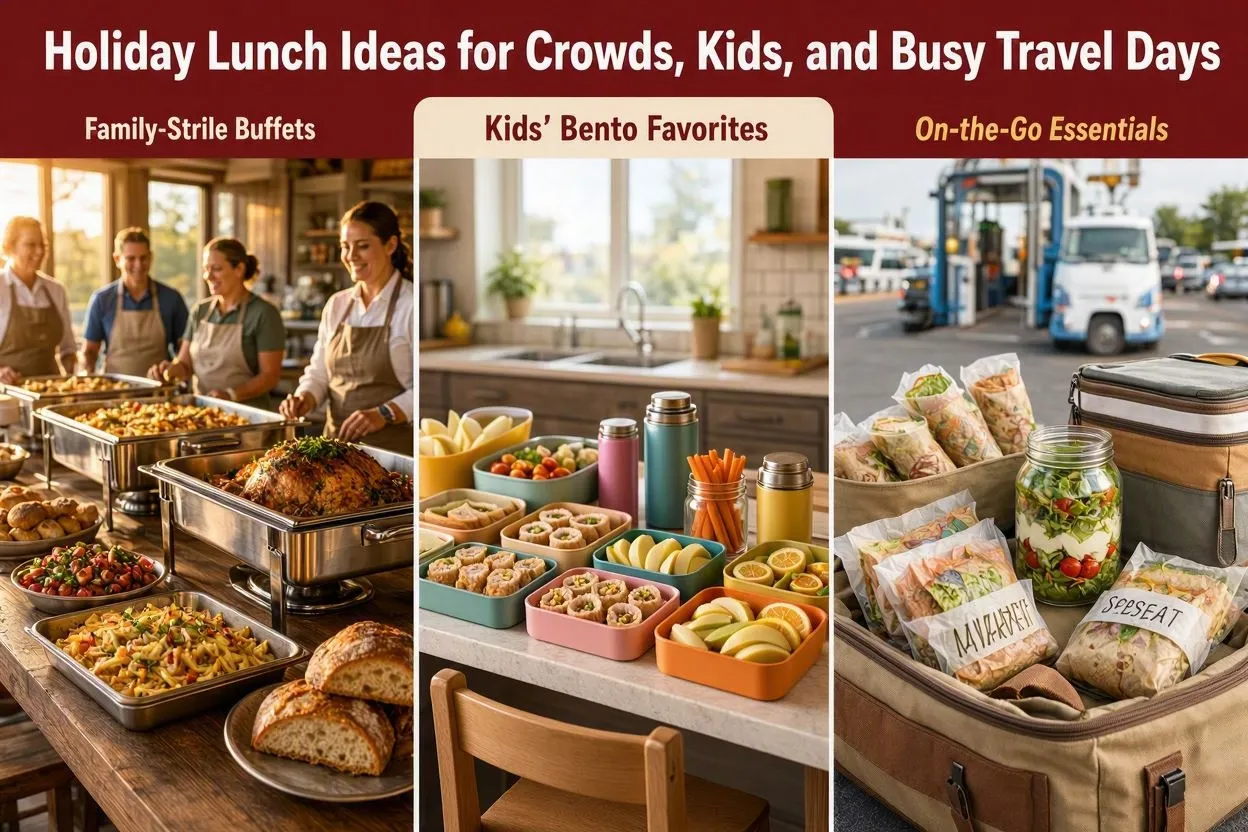
Nobody plans lunch. The big dinner gets a menu and a timeline, breakfast is coffee and whatever’s on the counter, and lunch just sort of happens. That’s fine for one day. It stops being fine when relatives are staying five nights, or when school lets out and someone needs feeding at noon for two straight weeks.
All 35 ideas are numbered below, grouped by the problem they solve: make-ahead dishes for a crowd, cold spreads that keep the kitchen free, food kids will actually eat, and lunches that survive a car trip. Pick three or four that suit this year’s schedule.
A holiday lunch, for the purposes of this list, is any midday meal during a festive stretch, school break, or travel day that has to feed a group without stealing attention from the main event. Christmas Day, Boxing Day, Thanksgiving week, New Year’s: they all leave the same hole in the schedule.
Holiday Lunch Ideas by Occasion (Ideas 1–4)
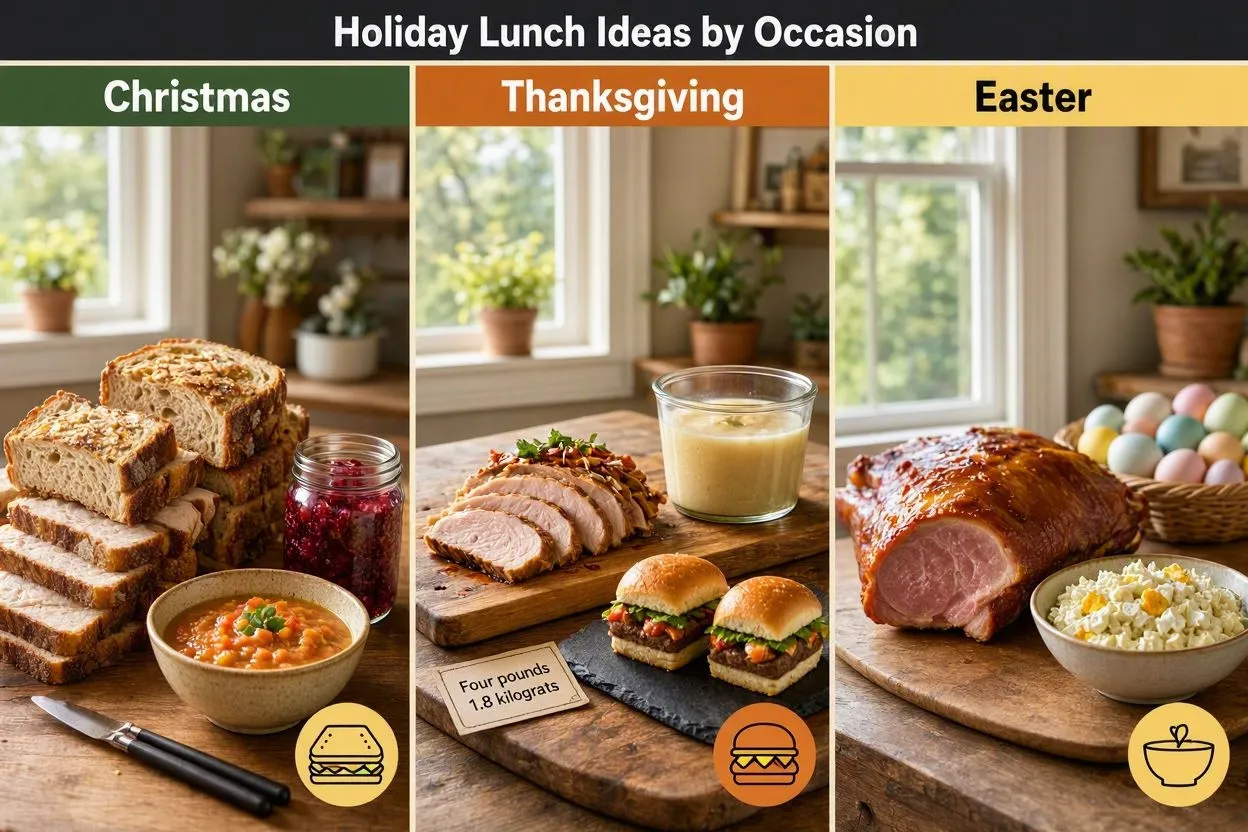
Christmas, Thanksgiving, and Easter lunches differ mainly in what’s already sitting in the fridge, not in which format works.
Christmas and Thanksgiving both leave meat behind, so sandwiches, sliders, and soup make sense from the day after onward. Four pounds (1.8 kilograms) of leftover turkey covers five lunches for four people before the rest needs freezing. Easter tips toward eggs and ham instead, and New Year’s Day is the one holiday where almost nobody wants a second heavy meal at noon.
- Boxing Day turkey sandwich board. Sliced leftover meat, good bread, mustard, cranberry sauce, pickles. No cooking at all.
- Deviled egg platter. The Easter default, and it doubles as an appetizer if there are leftovers.
- Ham and cheese quiche. Covers the protein and the traditional Easter ingredients with no extra shopping trip.
- New Year’s Day soup and salad. After a late dinner and a night of picking at snacks, this lands better than another rich spread.
Make-Ahead Holiday Lunch Ideas for a Crowd (Ideas 5–11)
The real time saving comes from cooking the base one or two days ahead and assembling in under 15 minutes. Casseroles are built for this: layer, refrigerate, then bake straight from cold, adding 10 to 15 minutes to the stated cook time if the dish goes in chilled rather than at room temperature.
- Baked ziti, assembled the night before and refrigerated.
- Lasagna, same method, better for a crowd you want to impress.
- Slow-cooker pulled pork, started in the morning and held on warm through lunch.
- Three-cheese stovetop macaroni and cheese, finished in 20 minutes.
- Chicken gnocchi soup, made ahead and reheated in one pot.
- Sausage and potato soup, about an hour to make, freezes for up to three months.
- French onion soup. The best of the make-ahead options: it keeps for three days in the fridge and needs nothing on the day but a pass under the broiler to melt the cheese.
Hosting for five days straight? Batch two or three of these on a single prep day and the daily cooking pressure basically disappears.
Leftover Turkey and Ham Lunch Ideas (Ideas 12–15)
Shred the meat, bind it with a sauce or dressing, and put it on bread, in a wrap, or over greens. That’s the whole method. None of these tie up the oven for more than 15 minutes, which is the point on a day when it’s already full.
- Turkey cheddar ranch sliders. Mix 2 cups of shredded turkey with cooked bacon, red onion, shredded cheddar, mustard, and ranch dressing, spoon it into soft dinner rolls, and bake at 350°F (175°C) for 12 minutes.
- Ham and vegetable quiche. Diced and folded into a quiche base with cheese, 1 cup of leftover meat becomes six servings.
- Cobb-style pasta salad with turkey, bacon, hard-boiled eggs, and avocado. Stretches furthest of the four, since the pasta and vegetables carry most of the volume.
- Turkey noodle soup from the carcass. Free stock, and it freezes.
No-Cook Holiday Lunch Ideas (Ideas 16–20)
Pre-cooked, cured, or fresh ingredients, assembled cold. The kitchen stays free for whatever else is happening that week.
- Cheese fondue. The one exception worth making. It needs a stovetop, but everything around it (bread cubes, apple slices, cured meats, raw vegetables) needs nothing at all.
- Charcuterie board from sliced deli meats, three or four cheeses, and crackers.
- Italian sandwich platter layered with capicola, mortadella, Genoa salami, and provolone.
- Avocado corn couscous salad with pearl couscous, roasted corn, and bocconcini.
- Dessert cheese plate with chocolate and dried fruit, for a sweet-savory lunch.
A board for eight needs roughly 1.5 pounds (680 grams) of assorted meat and 1 pound (450 grams) of cheese across three or four varieties.
Holiday Lunch Ideas for Kids and School Breaks (Ideas 21–24)
Familiar shapes, colors, and finger foods beat adult-style plated meals every time. School breaks mean five or more consecutive lunches with no cafeteria to fall back on, so rotate these rather than repeating one. Kids stop eating lunch by day three if it’s identical every day.
- Bento-style tray with cut fruit, cheese cubes, crackers, and a protein like rotisserie chicken.
- Peanut butter, apple matchstick, and granola wrap. Under five minutes to assemble. Sunflower seed butter swaps in directly for nut-free schools, with no change to prep.
- Toasted sandwich, the Wednesday reset when the cold formats stop landing.
- Snack plate with apple chips, cheese cubes, and finger vegetables.
Keep five days of components on hand (bread, two proteins, three fruits, one dip) and the daily “what’s for lunch” question mostly answers itself.
Grazing Board Holiday Lunches (Ideas 25–26)
A grazing board holds up as a full lunch when it covers a protein, a starch, a dairy component, and fresh produce in roughly equal proportions. It also solves the most annoying problem in holiday hosting, which is that guests never arrive together. A board sits out comfortably for two hours. A plated meal has to be timed to a single moment, and someone is always late.
- The classic meat-and-cheese board.
- The Mediterranean version, built around marinated feta, fried halloumi, and hummus. Works better for guests who don’t eat pork or cured meat.
How Much to Put on a Grazing Board
For ten to twelve people, either version needs:
- 2 pounds (900 grams) of mixed cured meats, or the equivalent volume of marinated vegetables and dips
- 1.5 pounds (680 grams) of cheese across four varieties
- 3 cups of olives, pickles, or marinated vegetables
- 2 loaves of crusty bread, or two boxes of crackers
- 2 pounds (900 grams) of fresh fruit, sliced or whole
The Two-Hour Rule
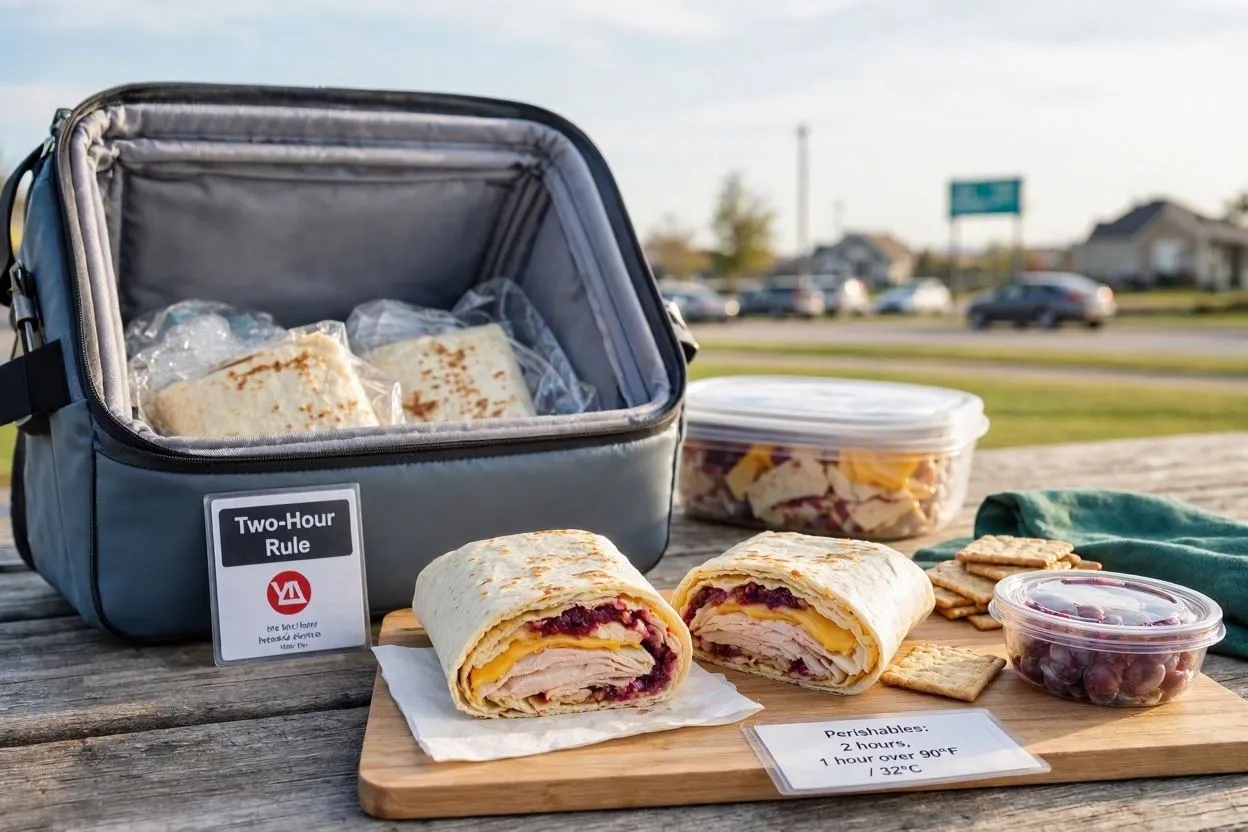
Perishable items shouldn’t sit out longer than two hours (one hour if the room is above 90°F / 32°C), which is the USDA guideline. For a longer window, put out half the board and refill from the fridge rather than doubling what’s on the table.
Holiday Lunch Ideas for Travel Days and Road Trips (Ideas 27–29)
Travel food has to pack flat and hold up in a cooler bag. Most recipe roundups skip this entirely.
- Turkey, cheddar, and cranberry wrap. Travels better than a mayo-based chicken salad, and doesn’t go soggy.
- Cooler box of cut vegetables, whole fruit, and individually portioned cheese sticks.
- Flight kit: a solid sandwich, cut fruit, and a bag of trail mix.
Keeping Cooler Food Safe
The safety rule is the same one that governs the grazing board: perishable food is good for two hours out of refrigeration, one hour above 90°F. In a car in summer, assume the shorter window. Pack an ice pack and the two-hour clock effectively resets, since anything held below 40°F (4°C) stays safe.
What changes without refrigeration is quality, not the rules. Hard cheese, cured meat, and hummus hold their texture better than mayonnaise-based fillings, which turn unpleasant well before they turn unsafe.
Flying With Lunch: TSA Rules
Flying changes the packing list. <cite index=”8-1″>TSA’s 3-1-1 rule is still in effect: liquids, gels, and pastes only in containers of 3.4 ounces (100 milliliters) or less, all inside one quart-sized bag per passenger.</cite> That rules out soup and most dips. Two useful details: <cite index=”6-1″>a liquid frozen solid at the time of screening counts as a solid</cite>, so a fully frozen gel pack goes through, and <cite index=”7-1″>the newer CT scanners at some checkpoints change whether you have to pull the bag out, not the size limit itself.</cite>
Holiday Lunch Ideas for Overnight Guests (Ideas 30–31)
Three or four nights of house guests works out to nine or twelve extra lunches. Cooking each one individually is how a host ends up exhausted before the actual holiday meal. Assemble-yourself formats are the answer.
- Build-your-own station: bread, two spreads, sliced meat, cut vegetables. People eat whenever they surface, which matters when everyone wakes at a different hour.
- A pot of soup on the stove. One pot serves six to eight and reheats in single portions as people drift through the kitchen.
A slow cooker of pulled pork (idea 7) left on warm from 11 a.m. to 2 p.m. covers the same window with nobody standing at the stove.
Budget Holiday Lunch Ideas (Ideas 32–35)
Build on pasta, rice, beans, or bread, and treat meat and cheese as accents rather than the main volume. A pantry-based casserole runs roughly a third the per-serving cost of a meat-forward slider spread.
- Tuna noodle casserole with canned tuna, frozen peas, and pantry pasta.
- Vegetable-heavy pasta salad. One pound (450 grams) of pasta serves eight.
- Bean chili. The cheapest way to feed six to eight from one pot.
- Vegetable frittata. Eggs are usually among the cheapest proteins per serving, though prices swing with avian flu cycles, so check before you plan a week around them.
Two habits that cut the bill further: buy cheese, deli meat, and crackers in bulk from a warehouse club rather than in single packs at a standard grocery store, and use frozen vegetables in winter. Frozen costs less than out-of-season fresh and performs identically in soups, casseroles, and quiche fillings.
Dietary Swaps for Holiday Lunches
Substitute the base ingredient, not the whole dish. Every idea above stays on the list with one swap, which is what lets a mixed table eat from one menu.
Swapping the Base Ingredient
The charcuterie board (17) goes vegan by trading cured meat for marinated tofu strips and roasted chickpeas, keeping the same cheese-and-cracker layout for everyone else, or dairy-free by building around hummus and olives instead of brie. Gluten-free lunches lean on rice, corn, or gluten-free pasta: a rice bowl with roasted vegetables and shredded chicken covers the same ground as a sandwich. Sunflower seed butter replaces peanut butter in wraps and desserts with no difference in texture or shelf life.
Labeling for Mixed Tables
One more thing that costs nothing: label each dish with its dietary category on a small card. At a gathering of ten or more with unfamiliar faces, it saves everyone the round of asking.
How Much Food to Plan Per Person
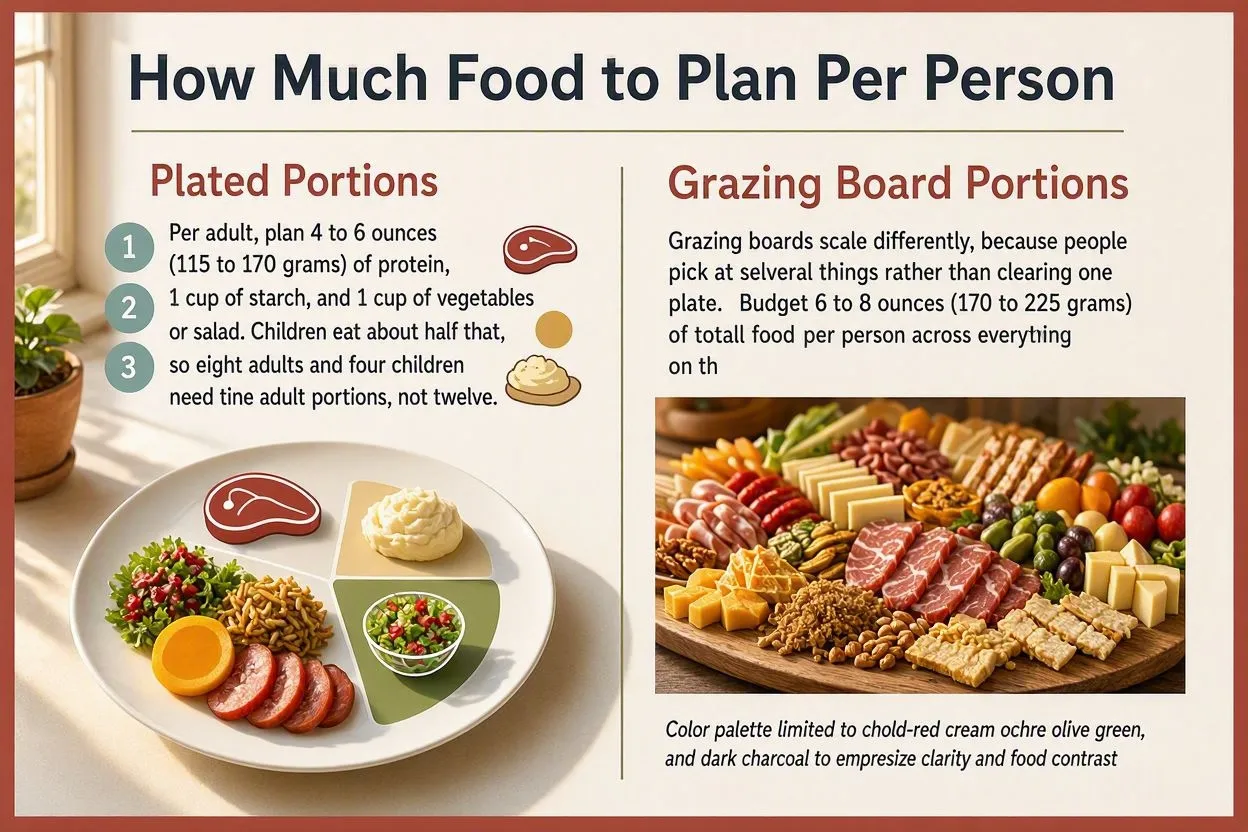
Plated Portions
Per adult, plan 4 to 6 ounces (115 to 170 grams) of protein, 1 cup of starch, and 1 cup of vegetables or salad. Children eat about half that, so eight adults and four children need ten adult portions, not twelve.
Grazing Board Portions
Grazing boards scale differently, because people pick at several things rather than clearing one plate. Budget 6 to 8 ounces (170 to 225 grams) of total food per person across everything on the board, meat, cheese, bread, and produce combined, for a two-hour window.
Drinks
Drinks are a separate sum. Allow 12 to 16 ounces (350 to 475 milliliters) per person for a two-hour lunch, split between water, something cold, and coffee or tea for anyone skipping alcohol at midday. A pitcher of infused water and a pot of coffee covers most groups. Save the full bar setup for dinner.
Choosing the Right Format
Match the format to the day. A crowd wants a grazing board. A travel day wants sandwiches that survive the car and an ice pack that keeps them legal. Five days of hosting wants a self-serve station, not five separate cooked meals.
Pick three or four from the 35 above, prep whatever can be made ahead, and lunch stops competing with the meal that actually matters.