

Planning a wedding takes months of decisions about flowers, seating charts, and menus. A honeymoon deserves the same attention, yet most couples start researching it two weeks before the flight. This honeymoon guide walks through the timeline, budget, destination options, and logistics newlyweds need so the trip gets booked with the same care as the wedding itself.
What Is a Honeymoon Guide, and Why Do Couples Need One?

A honeymoon guide is a structured plan covering timing, budget, destination, and logistics for the first trip a couple takes as spouses. Newlyweds who skip this planning stage tend to search dozens of scattered blog posts, compare conflicting reviews, and end up either overspending or settling for a trip that doesn’t match either partner’s travel style. One couple might spend three weeks reading Reddit threads about Bali versus Bora Bora before realizing neither destination fits their actual budget of $4,000. A single reference point, this honeymoon guide, replaces that scattered research with a sequence: set the budget, pick the season, choose the destination, then handle the paperwork.
When Should You Start Planning Your Honeymoon?
Start honeymoon planning 6 to 9 months before the wedding date. Popular destinations such as the Maldives, Bora Bora, and Santorini often sell out their best rooms during peak booking windows, and airfare to international destinations climbs by 20% to 40% within 60 days of departure. If the wedding date sits fewer than four months away, the couple should skip the research phase and move straight to comparing three to five destinations against their budget.
A practical timeline looks like this:
- 9 to 12 months out: Research destinations and set a budget range.
- 6 to 8 months out: Book flights and accommodations, especially for peak-season travel.
- 3 to 4 months out: Reserve tours, excursions, and any special experiences like private dinners.
- 1 to 2 months out: Buy travel insurance, arrange airport transfers, and finalize a packing list.
- 2 weeks out: Confirm every reservation and notify the credit card company of travel dates.
Couples who marry during their destination’s off-season gain flexibility here. A November wedding heading to the Caribbean, for instance, can book as late as three months out without losing availability, since hurricane season keeps demand lower.
How Much Does a Honeymoon Cost?
The average honeymoon costs between $5,000 and $15,000 for a 7- to 10-day trip, including flights, accommodations, food, and activities. Costs shift heavily by destination: a domestic mountain getaway in Colorado can run $2,500 for a week, while an overwater bungalow in French Polynesia easily exceeds $12,000 for the same length of stay. Five categories make up nearly every honeymoon budget:
- Travel: Flights, airport transfers, and any rental car or local transportation.
- Accommodations: Hotel, resort, or villa costs, often the single largest line item.
- Food and beverage: Daily meals, factoring in whether the resort is all-inclusive.
- Activities: Excursions, spa treatments, tours, and experiences booked in advance.
- Essentials: Passport fees, visas, travel adapters, and any gear specific to the destination.
If the wedding budget is already stretched thin, couples can cut costs by choosing shoulder-season travel or a domestic destination instead of reducing the trip length, since shorter honeymoons often cost nearly the same per day as longer ones once flights are factored in.
How Do You Choose a Honeymoon Destination?
Choose a honeymoon destination by matching both partners’ answers to four questions: activity level, accommodation style, climate preference, and budget ceiling. A couple where one partner wants five hikes a day and the other wants a lounge chair by the pool needs a destination offering both. Costa Rica’s Pacific coast, for example, pairs rainforest zip-lining with beachfront resorts within a 90-minute drive. Skipping this alignment step is the most common honeymoon planning mistake, since it produces a trip built around one partner’s preferences instead of both.
Best Honeymoon Destinations by Travel Style
- Beach and relaxation: Turks and Caicos, the Maldives, and St. Lucia offer overwater bungalows and all-inclusive resorts built for couples who want to unplug.
- Adventure and nature: Costa Rica, Patagonia, and New Zealand combine zip-lining, hiking, and wildlife encounters with scenic accommodations.
- Culture and cuisine: Japan, Greece, and Morocco give couples immersive food, history, and architecture without a resort-only itinerary.
- Budget-conscious travel: Thailand and Portugal deliver strong exchange rates, letting a $5,000 budget stretch into a 10 to 12 day trip.
- Domestic and short-haul: Hawaii, the Colorado Rockies, and coastal Georgia cut flight time and jet lag while still delivering a distinct honeymoon feel.
Is Peak Season or Shoulder Season Better for a Honeymoon?
Shoulder season offers better value for most honeymoons, with rates 30% to 50% lower than peak season and noticeably smaller crowds. Weather during shoulder months carries more variability, though. A September trip to the Caribbean risks tropical storms, while a late-October honeymoon to the Greek Islands might hit cooler evenings than a July trip would. Couples chasing guaranteed sunshine and full resort amenities should book peak season and expect to pay for it; couples prioritizing value and quieter beaches should target the four to six weeks bordering peak season instead.
Booking during peak season also requires more advance notice, often six months or more for popular resorts, while shoulder-season rooms can sometimes be secured with only 8 to 10 weeks of lead time.
Should Newlyweds Book Through a Travel Advisor or Plan It Themselves?
Booking through a travel advisor costs nothing extra in most cases and often unlocks perks unavailable through direct booking, including room upgrades, resort credits, and welcome amenities. Travel advisors work through negotiated partnerships with hotel chains, and those relationships place their clients ahead of walk-in bookings for complimentary upgrades. A couple booking directly with a resort has no such leverage, since the front desk has no incentive to bump a solo reservation to a suite.
DIY planning still makes sense for couples with a narrow, well-researched destination in mind and a comfort level with managing flight changes or cancellations independently. If the itinerary spans multiple countries or includes complex logistics like a multi-stop safari-and-beach combination, a travel advisor’s local contacts typically save more in avoided mistakes than the couple would save by skipping advisor fees, which many advisors don’t even charge on leisure bookings.
What Should Go on a Honeymoon Packing List?
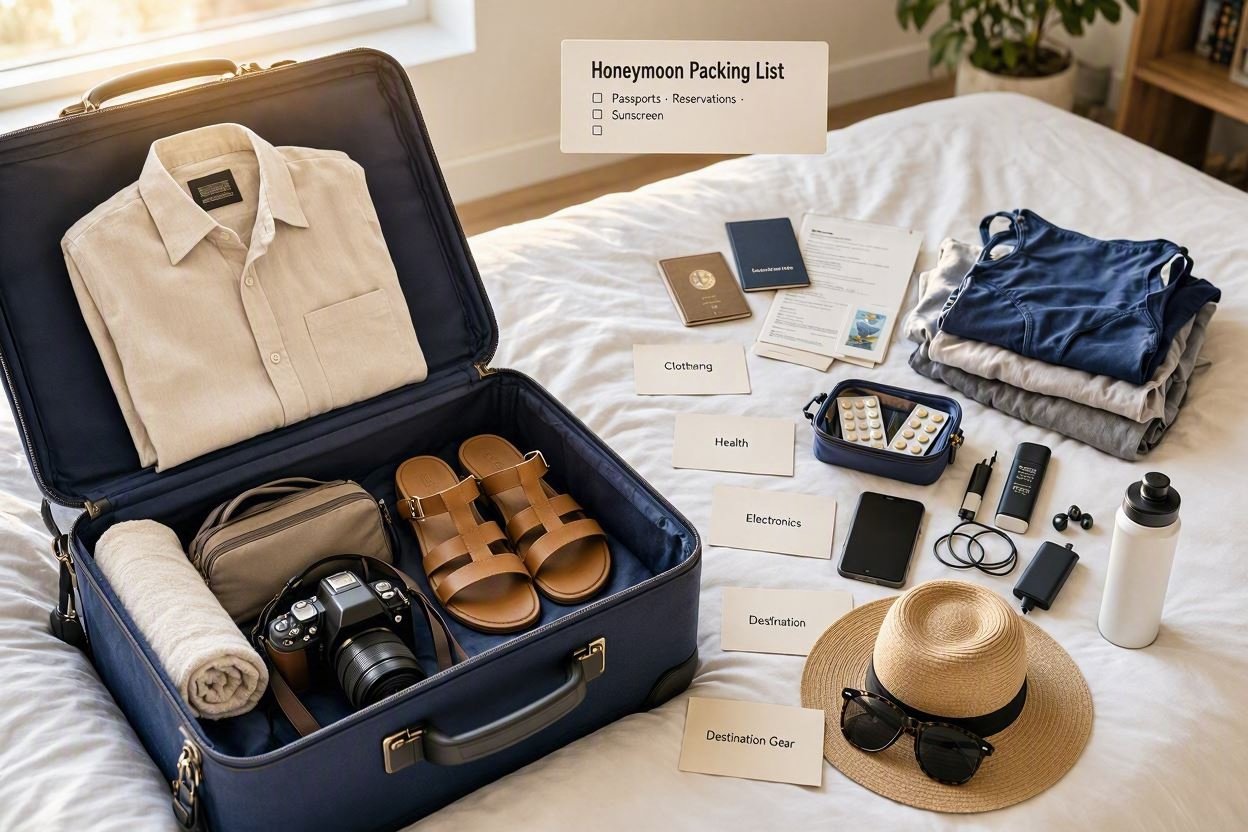
A honeymoon packing list should cover five categories: documents, clothing, health items, electronics, and destination-specific gear. Missing one of these categories causes the most common honeymoon-day problems: a passport left in a home safe, or sunscreen forgotten for a beach trip where the nearest pharmacy sits 40 minutes away.
- Documents: Passports, printed reservation confirmations, travel insurance policy numbers, and a copy of the marriage certificate if the destination requires proof for hotel bookings.
- Clothing: Weather-appropriate outfits, one dressier outfit for a special dinner, and comfortable walking shoes.
- Health items: Sunscreen, insect repellent, prescription medications in carry-on luggage, and a basic first-aid kit.
- Electronics: Phone chargers, a portable battery pack, and a universal power adapter for international outlets.
- Destination-specific gear: Snorkel gear rental info for beach trips, hiking boots for adventure destinations, or a light jacket for higher-altitude locations.
Do You Need Travel Insurance for a Honeymoon?
Yes, travel insurance is worth purchasing for any honeymoon costing more than $2,000, since a single trip interruption can cost more than the policy itself. A hurricane that cancels a Caribbean flight without insurance often leaves travelers with an airline voucher instead of a refund, plus $1,000 or more in new flight costs. With insurance, that same cancellation gets covered, including rebooking fees and any non-refundable resort deposits.
Four scenarios make insurance worth the cost on nearly every honeymoon: flight cancellations, lost or delayed baggage, medical emergencies abroad, and trip cancellation before departure due to illness or a family emergency. Standard US health insurance plans rarely cover treatment outside the country, so medical evacuation coverage matters even more for adventure destinations like Patagonia or remote parts of New Zealand.
What Passport and Name-Change Rules Apply to Honeymoon Travel?
Passport names must match flight booking names exactly, so newlyweds should book travel under their pre-marriage legal name until the passport itself reflects the new name. Airlines deny boarding when a boarding pass name doesn’t match the passport, and rebooking under a new name after check-in can cost several hundred dollars in change fees. A passport update typically takes 6 to 11 weeks through standard processing, which rules out a name change before most honeymoons that happen within weeks of the wedding.
Passport validity carries its own rule: most countries require at least 6 months of validity remaining beyond the planned return date. A passport expiring in April won’t clear immigration for a honeymoon departing in December of the same year, even for a one-week trip, since several countries deny entry outright under that 6-month threshold.
How Long Should a Honeymoon Last?
Most honeymoons last between 7 and 10 days, long enough to justify international travel costs without requiring more than one week away from work. Couples with flexible schedules or remote jobs sometimes extend to 2 or 3 weeks, particularly for multi-country itineraries across Europe or Southeast Asia where travel time between stops eats into a shorter trip. A 4 to 5 day mini-moon works for couples with limited vacation time, taken either immediately after the wedding or saved for a longer trip 2 to 6 months later once work schedules settle.
Timing the trip itself splits into three common patterns: leaving within days of the wedding, waiting 2 to 4 weeks to recover and handle post-wedding tasks, or delaying 2 to 6 months to catch a destination’s ideal season. Each pattern carries trade-offs: an immediate departure keeps the celebratory momentum going but arrives with both partners exhausted from the wedding itself.
How Do Couples Pay for a Honeymoon?

Couples fund honeymoons through a combination of dedicated savings, honeymoon registries, and skipping a traditional gift registry in favor of cash contributions. Honeymoon-specific registry platforms let wedding guests fund a specific line item, such as a snorkeling excursion, a couples massage, or one night at the resort, rather than contributing to an undefined fund. This approach works particularly well for couples who already own household items and don’t need a traditional registry of kitchenware.
A joint honeymoon savings account, opened as soon as the engagement happens, spreads the cost over 6 to 12 months instead of requiring a lump-sum payment close to the wedding date. Couples setting aside $500 a month for 10 months reach a $5,000 honeymoon budget without touching wedding savings at all.
Conclusion
A honeymoon guide only works if it gets followed in order: set the budget first, lock the timeline second, then let the destination follow from both partners’ actual travel preferences rather than Instagram inspiration alone. Couples who plan 6 to 9 months out, budget realistically for their chosen destination, and handle passport and insurance details early avoid the last-minute scramble that turns an exciting trip into a stressful one. The couple who books that Costa Rica trip 8 months ahead, insures it for under $200, and packs according to a clear list arrives relaxed, which is the entire point of a honeymoon in the first place.