

Hotel concierge services are the personalized assistance a hotel’s front office team provides to guests, covering local recommendations, reservations, transportation, and special requests, both before arrival and throughout a stay. The concierge desk sits in the lobby, usually near the front desk, and staff there act as the connection point between a guest and the surrounding city. A guest asks for a table at a fully booked restaurant, tickets to a sold-out show, or a same-day gift delivery, and the concierge handles each request through established vendor relationships built over years of working in one market.
Concierge services differ from front desk services in scope and purpose. Front desk staff manage check-in, check-out, room assignments, and billing. Concierge staff manage requests that fall outside standard room operations, including everything a guest wants to do, see, or obtain during a stay. Both roles sit inside the front office department, though the two jobs require different training, different vendor networks, and different daily routines.
The hospitality industry in the United States built the modern concierge role around a single goal: solving a guest’s problem faster than the guest could solve it independently. A traveler unfamiliar with a city gains a decade of local knowledge the moment a concierge picks up the phone.
What Do Hotel Concierge Services Include?
Hotel concierge services fall into five core categories: guest welcome, recommendations, reservations, special requests, and transportation. Each category demands a different set of vendor relationships and a different pace of response.
Guest Welcome and In-Suite Check-In
Luxury hotels increasingly offer in-suite check-in, where a concierge or guest relations manager completes registration inside the room instead of at a lobby counter. Rocco Forte Hotels applies this model across its suite tiers, pairing in-suite check-in with a personalized amenity programme and a welcome gift selected to match a guest’s stated preferences. A wardrobe concierge service frequently accompanies this welcome, handling packing, unpacking, garment pressing, shoe shining, and minor sewing repairs during a stay. Properties offering this tier of service typically reserve it for suite guests, though some extend a lighter version of the welcome to all guests during peak occupancy periods.
Local Recommendations
A concierge builds local area knowledge over years of working in one city, then applies that knowledge to match a guest’s interests with specific venues, such as a rooftop bar for a couple celebrating an anniversary or a quiet park for a family traveling with toddlers. Recommendations shift based on budget, mobility, dietary restrictions, and season, and an experienced concierge adjusts suggestions within seconds of hearing a guest’s constraints. A concierge who has worked the same three-block radius for ten years often knows which restaurant tables face a window, which museum days draw the smallest crowds, and which taxi stands move fastest during rush hour.
Reservations Management
Concierge staff handles restaurant bookings, event tickets, spa appointments, golf tee times, and tour reservations. Reservations management depends on direct relationships with local vendors, since a concierge with an established relationship at a restaurant secures a table that a guest could not book independently through a public reservation platform. A guest calling a restaurant directly waits on a list; a concierge calling the same restaurant often confirms a table within minutes because the restaurant depends on hotel referrals for a steady stream of high-value customers.
Special and VIP Requests
Concierge teams plan proposals, anniversaries, birthdays, and other milestone events inside a guest’s room or at an outside venue. Requests in this category include flower arrangements, custom cakes, private chefs, photographers, and coordinated surprise deliveries. Five-star hotels train concierge staff specifically to handle VIP guest requests with discretion and short notice, since a proposal planned six hours before dinner requires the same precision as one planned six weeks in advance. Rocco Forte’s Journal content documents several of these requests directly, including private ones. cooking lessons arranged inside a guest’s suite and custom art tours built around a guest’s stated interests.
Transportation Arrangements
Airport transfers, private car service, chauffeur bookings, and public transit directions all fall under concierge transportation duties. Rocco Forte’s Forte Suite tier includes a return airport transfer as a standard benefit, while its standard suite tier includes a one-way transfer only. A concierge arranging transportation confirms flight numbers, tracks delays in real time, and adjusts pickup schedules without requiring a guest to call and update the request manually.
Who Works at the Concierge Desk?
Concierge staff typically hold a high school diploma at minimum, though most luxury properties require a hospitality degree or certificate plus two to five years of front-line guest service experience. Candidates commonly start as a front desk agent or bellhop, advance to assistant concierge, and reach full concierge status after demonstrating strong local knowledge and vendor relationships over that period.
The most recognized professional credential in the field comes from Les Clefs d’Or, French for “The Golden Keys,” an international association that certifies concierges who meet strict experience and peer-review standards. A concierge wearing crossed gold keys on a jacket lapel has typically passed this certification process, which requires documented years of service and endorsement from existing members. The American Hotel & Lodging Educational Institute (AHLEI) offers hospitality certifications that many U.S. concierge staff complete during onboarding and ongoing training.
Core Concierge Skills
- Customer service and empathy
- Multilingual communication
- Local area knowledge
- Reservation and vendor coordination
- Discretion under pressure
- Multitasking across simultaneous requests
- Problem-solving during unexpected schedule changes
Concierges rely on a mix of interpersonal skills and operational precision. A guest measures a concierge’s value not by friendliness alone but by whether a reservation actually holds, a package actually arrives, and a car actually shows up on time.
How Much Do Hotel Concierge Services Cost?
Hotel concierge services cost nothing to access at most U.S. hotels, since the service comes included in the room rate, though specific bookings the concierge arranges, such as tickets or private transportation, carry their own separate charges. A four-night stay in a suite-tier room may include concierge access as a standard benefit, while a standard room at the same property still allows a guest to approach the concierge desk with requests. Loyalty program members frequently receive concierge-adjacent perks layered on top of standard access, including priority booking windows, complimentary experiences, and room upgrades that reduce the number of paid add-ons a guest needs.
Independent concierge services, separate from hotel-based ones, operate on a different pricing model. A personal or property concierge, such as the Amsterdam-based service run by Bjorn Soeteman, charges an hourly or retainer fee for ongoing tasks like home management, errand running, and travel coordination since that model serves a private residence rather than a hotel guest.
How Much Should You Tip a Hotel Concierge?
Guests typically tip a hotel concierge $5 to $20 for a standard request, such as a dinner reservation or directions, and $20 to $50 or more for a complex request, such as securing sold-out tickets or arranging same-day private transportation. Tip in cash at the time the concierge completes the request rather than waiting until checkout if the request happens mid-stay. A larger tip of $50 to $100 applies when a concierge coordinates a multi-part request, such as a full anniversary surprise involving flowers, a private chef, and a photographer working together on the same evening.
Currency and rates above apply to U.S. properties. Guests should convert amounts for concierge tipping etiquette abroad, since 1 USD equals roughly 0.80 GBP or 0.92 EUR, depending on current exchange rates, and local customs in some countries discourage tipping altogether.
Hotel Concierge vs. Guest Services: What Is the Difference?
Hotel concierge staff handle outside-the-hotel requests, such as restaurant bookings and transportation, while guest services or guest relations staff handle inside-the-hotel issues, such as room complaints, housekeeping requests, and billing questions. Some smaller properties combine both roles into a single guest services representative, a structure common across the limited-service and boutique hotel segments in the United States. Larger luxury properties, such as those operated by Kempinski Hotels and Viceroy Hotels & Resorts, staff dedicated concierge desks separate from front desk and guest relations teams since guest volume at those properties justifies a specialized division of labor.
A butler differs from both roles again. A butler serves one room or suite exclusively and handles in-room tasks directly, such as unpacking luggage or drawing a bath, while a concierge serves every guest in the hotel from a shared desk and coordinates services located outside the building.
Digital and App-Based Concierge Services in 2026

Text-based and app-based concierge services now run alongside traditional desk service at many U.S. hotels. A guest sends a text message requesting a late checkout, extra towels, or a dinner reservation, and hotel staff respond through the same channel rather than requiring an in-person visit to the lobby. This model works well for travelers who prefer asynchronous communication and for requests that need a quick yes-or-no answer rather than a conversation.
App-based systems do not replace a human concierge for complex, high-touch requests, such as planning a private event across multiple vendors on short notice. Hotels running both channels typically route simple requests through the app and escalate detailed or VIP requests directly to concierge desk staff, since a text thread cannot negotiate a last-minute reservation the way a phone call to a restaurant manager can.
Concierge Services for Business Travelers and Families
Business travelers rely on concierge staff for meeting room bookings, printing and document services, ground transportation between meetings, and restaurant reservations suited to client entertaining. A concierge familiar with a city’s business district often recommends venues based on noise level and privacy rather than ambiance alone, since a client’s dinner requires different conditions than a leisure meal.
Families traveling with children request different services entirely: babysitting referrals, stroller rentals, kid-friendly restaurant suggestions, and activity bookings timed around nap schedules. Rocco Forte Hotels markets a dedicated family program alongside its suite benefits, extending concierge-arranged experiences to children as well as adults. A concierge working with a family adjusts pacing and recommendations throughout a stay as a child’s tolerance for activity changes day to day.
Concierge Support for International Guests
International travelers arriving in the United States rely on concierge staff for services a domestic guest rarely needs, including currency guidance, translation help, and directions written in a guest’s native alphabet for taxi drivers. Multilingual communication ranks among the core concierge skills at properties serving a global clientele, and larger hotels staff concierge desks with speakers of Spanish, Mandarin, French, and Arabic during peak seasons.
A concierge working with international guests also explains local customs that differ from those in a guest’s home country, such as tipping norms, dress codes at certain restaurants, and closing times that vary by neighborhood. A guest unfamiliar with these norms avoids an awkward moment simply by asking the concierge desk before heading out for the evening.
Common Mistakes Guests Make When Using a Concierge
Guests often wait until the last minute to request a reservation that requires advance planning, then expect the same outcome a concierge could have delivered with more notice. A request submitted 48 hours ahead succeeds far more often than the same request submitted the same afternoon, particularly for high-demand restaurants or sold-out events.
Guests also under-communicate context. A concierge asked simply for “a good restaurant” delivers a generic answer, while a concierge told the budget, group size, and occasion delivered a match suited to the actual evening planned. Skipping the tip, or tipping only at checkout for a request handled days earlier, weakens the relationship a guest builds with concierge staff for the remainder of a stay.
How to Use a Hotel Concierge: A Step-by-Step Guide
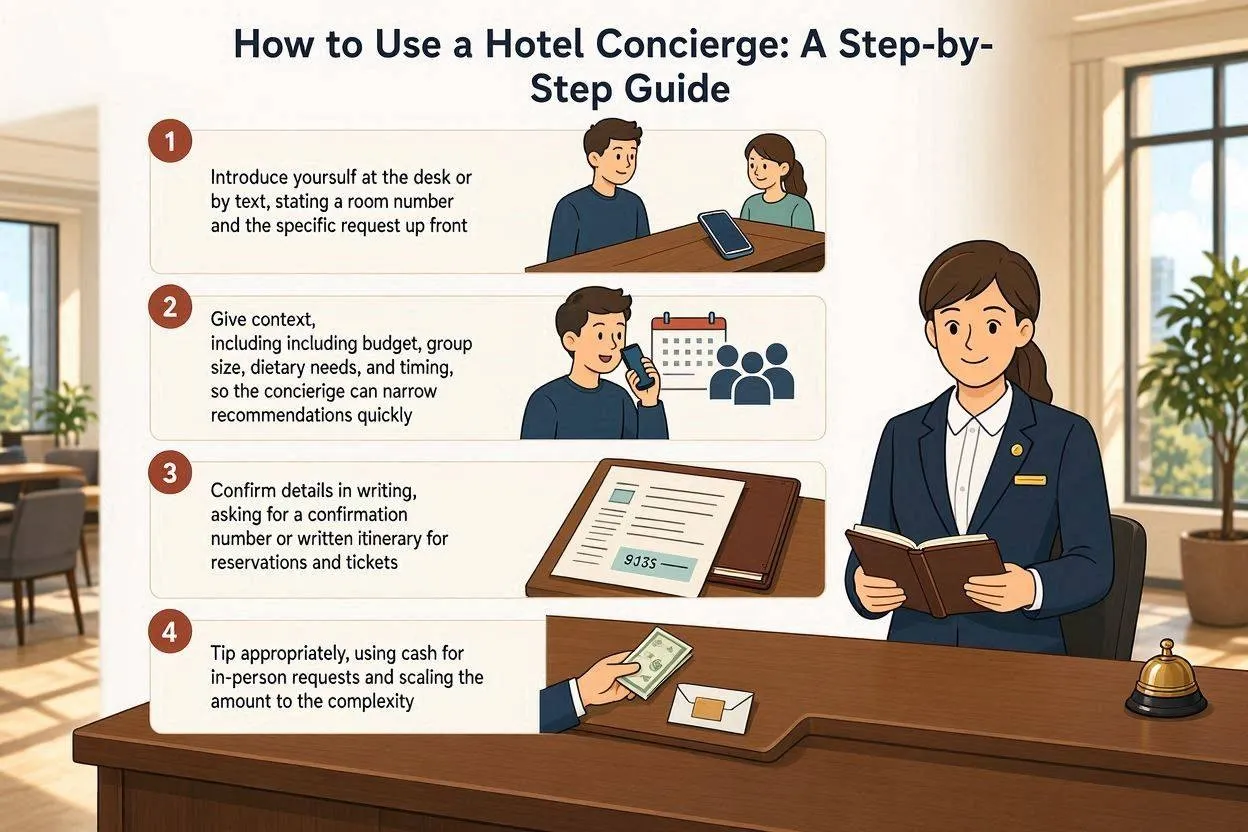
- Introduce yourself at the desk or by text, stating a room number and the specific request up front.
- Give context, including budget, group size, dietary needs, and timing, so the concierge can narrow recommendations quickly.
- Confirm details in writing, asking for a confirmation number or written itinerary for reservations and tickets.
- Tip appropriately, using cash for in-person requests and scaling the amount to the complexity of the task.
- Follow up before departure, checking that transportation, luggage handling, and any pending requests are finalized.
Loyalty Programs and Concierge-Level Perks
Hotel loyalty programs increasingly bundle concierge-adjacent perks into higher membership tiers. Viceroy’s DISCOVERY loyalty program, part of the Global Hotel Alliance (GHA) network, awards members room upgrades, late check-out, and welcome amenities as they advance from Silver to Titanium status. Titanium status arrives after 30 nights, 15,000 USD in spend, or stays across three GHA-affiliated brands, whichever a member reaches first. Kempinski runs a comparable structure through Kempinski Discovery, layering member-only savings on top of standard offers such as its long-stay discount of up to 25% for bookings of three nights or more.
None of these programs replaces a dedicated concierge desk. The tiered perks reduce the number of requests a guest needs a concierge to arrange manually, such as room upgrades or early check-in, freeing concierge time for the reservations, tickets, and special requests a loyalty tier cannot deliver automatically.
Choosing a Hotel Based on Concierge Quality
Reviews on independent travel sites mention concierge performance far more often than official hotel marketing pages do, since guests describe specific outcomes, such as a hard-to-get reservation or a same-day gift delivery, that marketing copy rarely details. A property listing Les Clefs d’Or-certified staff signals a stronger concierge team than a property that lists concierge services without naming a credential.
Guests booking a stay around a specific event, such as a proposal or a milestone celebration, benefit from contacting the concierge desk directly before arrival rather than waiting until check-in. A concierge given three weeks of notice for an anniversary dinner delivers a stronger outcome than one given three hours, and most hotels welcome pre-arrival emails addressed directly to the concierge team.
Property size affects concierge quality as well. A 40-room boutique hotel often assigns one or two staff members to concierge duties full-time, building deep relationships with a small number of local vendors, while a 500-room convention hotel spreads concierge coverage across shifts and relies more heavily on standardized vendor lists. Neither model outperforms the other automatically; a traveler seeking a highly specific, off-the-beaten-path recommendation often does better at a smaller property, while a traveler needing fast, high-volume ticket bookings during a citywide event benefits from a larger team’s broader vendor network.
Guest reviews mentioning a concierge by name, rather than describing the desk generically, indicate a property that retains experienced staff over multiple seasons. Staff turnover at a concierge desk breaks the vendor relationships that took years to build, so a hotel with the same lead concierge listed across two or three years of reviews signals consistency a guest can rely on for a future stay.
Conclusion
Hotel concierge services combine local expertise, vendor relationships, and personalized attention to handle everything from dinner reservations to full VIP event planning. Guests get the most value from the service by stating specific requests early, tipping according to the complexity of the task, and confirming details in writing before relying on a booking. Whether a hotel routes requests through a desk, a smartphone app, or both, the same core skill set behind the request stays constant: local knowledge, discretion, and the ability to solve a guest’s problem faster than the guest could solve it alone.