
Picking one destination out of hundreds of palm-fringed coastlines is the hardest part of planning any trip south. A diver wants reef walls and visibility past 100 feet (30 meters). A honeymooner wants an overwater bungalow and a bottle of champagne waiting on arrival. A family of four on a budget wants direct flights and a pool that doesn’t cost extra. This guide sorts 15 tropical vacation ideas by travel style, season, and cost, so the decision takes minutes instead of weeks. Each entry covers where to stay, what it costs, and when to book the flight.
Prices and flight times below reflect typical rates as of mid-2026 and shift with season and demand — check current rates before booking.
| # | Destination | Best For | Nightly Rate (2 people) | Flight Time from US |
| 1 | Turks and Caicos | Beach lovers | ~$500+ | Under 4 hrs (Miami/NY/Toronto) |
| 2 | Grand Cayman | Beach lovers | $300–$600 | ~4 hrs (with connection) |
| 3 | Zanzibar | Beach lovers | $300–$600 | 18–22 hrs |
| 4 | Maldives | Honeymoons | $800–$1,200+ | 16+ hrs (via Doha/Dubai) |
| 5 | Bora Bora | Honeymoons | $800–$2,000+ | ~8 hrs (via LA/Tahiti) |
| 6 | Moorea | Honeymoons | Less than Bora Bora | Same as Tahiti + 30-min ferry |
| 7 | Seychelles | Honeymoons | $800–$2,000+ | 15+ hrs (via Europe/Middle East) |
| 8 | Puerto Rico | Budget travelers | ~$120+ | 3–4 hrs, no passport |
| 9 | Riviera Maya | Budget travelers | ~$150+ per person | 2–3 hrs |
| 10 | Koh Lipe | Budget travelers | $30–$60 | 2+ days (via Bangkok) |
| 11 | Palau | Divers | Dive: $150–$200/trip | 15+ hrs (via Guam/Manila) |
| 12 | Fiji | Divers | $300–$600 | ~10 hrs (via LA) |
| 13 | The Whitsundays | Divers | Snorkel trips: $150–$220 | ~15 hrs (via Cairns) |
| 14 | Aruba | Families | $300–$600 | ~2.5 hrs |
| 15 | Maui | Families | Varies (Hawaii resort rates) | ~5.5 hrs (from LA), no passport |
What Makes a Destination Tropical?
Technically, a destination counts as tropical if it sits within or near the Tropic of Cancer and the Tropic of Capricorn, where average temperatures stay above 64°F (18°C) year-round. That band covers the Caribbean, most of Southeast Asia, the South Pacific, and coastal East Africa. Some popular picks, like the Bahamas or Queensland’s coast, sit just outside that line but still deliver the same climate. In practice, most travelers go by coral reefs and a wet-dry seasonal pattern, not a latitude chart.
Tropical Vacation Ideas for Beach Lovers
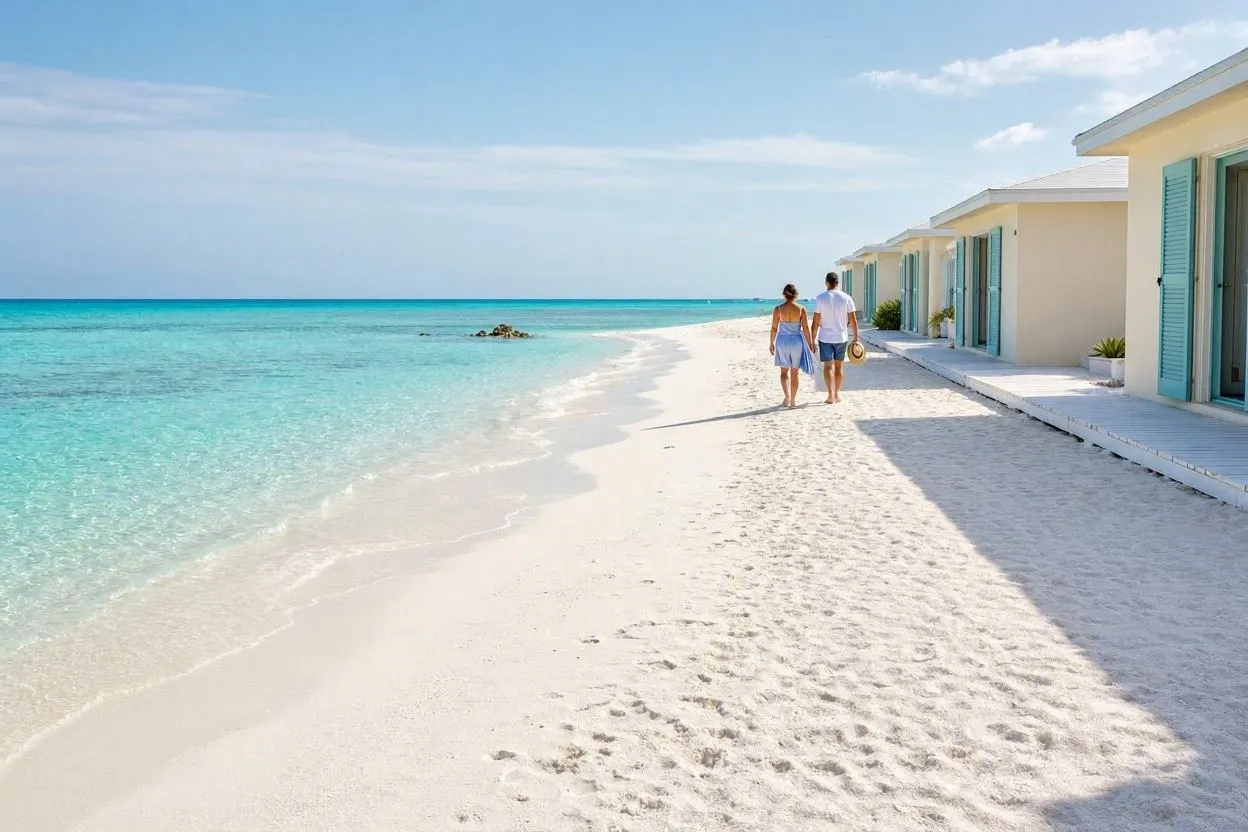
Beach-first travelers care about sand quality, water clarity, and how far the walk is from the room to the shoreline.
Turks and Caicos has Grace Bay, one of the most frequently ranked beaches in the Caribbean: a 12-mile (19-kilometer) stretch of powder-fine sand with almost no seaweed. Providenciales, the main island, doesn’t get direct flights from most of Europe, but it connects easily from Miami, New York, and Toronto in under four hours. Grace Bay Club and The Palms Turks and Caicos both sit right on the beach, with rates typically starting near $500 a night in peak season. A barrier reef sits close enough to the shore that snorkeling straight off the beach is possible at several points along Grace Bay.
Grand Cayman offers a different kind of beach experience:
- Seven Mile Beach: west coast, lined with resorts, restaurants, and dive shops
- Stingray City: a sandbar where visitors wade with wild southern stingrays in three feet of water, one of the Caribbean’s most booked excursions
- George Town: duty-free shopping, a walkable cruise port, free resort shuttles after sunset
Zanzibar trades Caribbean familiarity for East African texture:
- Nungwi Beach: warm, shallow water, swimmable even at low tide
- Stone Town: a UNESCO World Heritage Site, 45 minutes away, steeped in Swahili, Arab, and Indian trading history
- Flight time: 18–22 hours from the US, connecting through Doha, Dubai, or Amsterdam
- Spice tour: $25–$40 per person, covering active cinnamon, clove, and vanilla plantations
Tropical Vacation Ideas for Honeymoons and Romance
The Maldives is still the top honeymoon pick among tropical destinations, and almost every element of the trip is built around private overwater bungalows and one-resort-per-island seclusion. Couples fly into Malé, then take a seaplane or speedboat to the resort itself. That transfer tends to become part of the experience rather than a hassle. The W Maldives and Soneva Fushi both offer overwater villas with direct lagoon access, with rates commonly starting at $800 to $1,200 a night. Sunset dolphin cruises run most evenings for little beyond the resort’s standard excursion fee.
Bora Bora, in French Polynesia, pairs the same overwater-bungalow format with scenery few places can match. Mount Otemanu rises 2,385 feet (727 meters) straight out of the lagoon, visible from nearly every resort deck on the island. Sunset lagoon tours here often stop at a private motu, a small islet reachable only by boat.
Moorea costs noticeably less than Bora Bora while offering comparable snorkeling, since it sits just 12 miles (19 kilometers) from Tahiti by a 30-minute ferry rather than a separate international flight.
- Distance from Tahiti: 12 miles (19 kilometers), a 30-minute ferry ride
- Resorts: Hilton Moorea Lagoon Resort, Sofitel Moorea, both opening directly onto the lagoon’s shallow, coral-lined water
- Wildlife draw: manta ray encounters near Moorea’s pass are common enough that several dive shops guarantee a sighting, or offer a second trip free
Seychelles rounds out the honeymoon shortlist, and it doesn’t look like anywhere else on this list:
- Signature beach: Anse Source d’Argent on La Digue island, framed by massive granite boulders that create natural windbreaks and shaded coves found nowhere else in the tropics
- Notable stay: North Island, where Prince William and Kate Middleton honeymooned in 2011
- Local transport: bicycles, the primary way to get around La Digue since motor vehicles are restricted across most of the island
Tropical Vacation Ideas for Budget Travelers
Palm trees and turquoise water don’t require a five-figure budget.
Puerto Rico is probably the lowest-cost tropical option for US travelers. No passport required, and nightly hotel rates in San Juan start around $120. Flights from most East Coast cities run three to four hours and often come in under $300 round-trip if booked six weeks out. Condado Beach sits within walking distance of San Juan’s restaurant district, and El Yunque National Forest adds a rainforest day trip without needing a rental car. Public buses, called guaguas, connect most tourist zones for under a dollar a ride.
Riviera Maya, on Mexico’s Yucatán Peninsula, competes closely on price. Playa del Carmen and Tulum both have all-inclusive resorts starting near $150 a night per person, and cenote tours (freshwater sinkholes used for swimming and diving) cost as little as $15 to $20 for entry. Flights from Texas and Florida gateway cities run two to three hours. Colectivo vans, shared minibuses that run along the coastal highway, move travelers between towns for less than $3 a trip.
Koh Lipe, in southern Thailand, costs less once you’re actually there, but it takes longer to reach. Guesthouses on the island run $30 to $60 a night, though getting there means a long-haul flight to Bangkok, a domestic connection, and a ferry, which adds two full travel days each way. Once you’re on the island, walking street food stalls sell full meals for $2 to $4, well below Caribbean averages.
Tropical Vacation Ideas for Divers and Adventure Travelers
Serious divers judge a destination by visibility, marine biodiversity, and how untouched the reef still is.
Palau has some of the clearest water and healthiest coral reef systems left in the Pacific, with visibility regularly exceeding 100 feet (30 meters) at sites like Blue Corner. Jellyfish Lake, a marine lake cut off from the ocean for thousands of years, lets swimmers float among millions of stingless golden jellyfish. There’s genuinely nothing else like it on Earth. A two-tank boat dive out of Koror runs $150 to $200, gear rental included.
Fiji’s Mamanuca and Yasawa island groups pull divers away from the main island of Nadi, where most of the large resorts sit. The soft coral formations here rival anything in the South Pacific, and dive operators run trips daily from Port Denarau at $120 to $180 per two-tank dive. Liveaboard boats extend the range further, reaching sites too remote for a day trip.
The Whitsundays, off Australia’s Queensland coast, sit at the southern edge of the Great Barrier Reef, combining 74 islands with direct access to the reef itself. Whitehaven Beach, made of 98% pure silica sand, actually stays cool underfoot even in full sun, which most tropical beaches can’t claim. Flights connect through Cairns or Hamilton Island, and the reef is reachable by boat within an hour of most resorts. Half-day snorkeling trips typically run $150 to $220 per person.
Tropical Vacation Ideas for Families
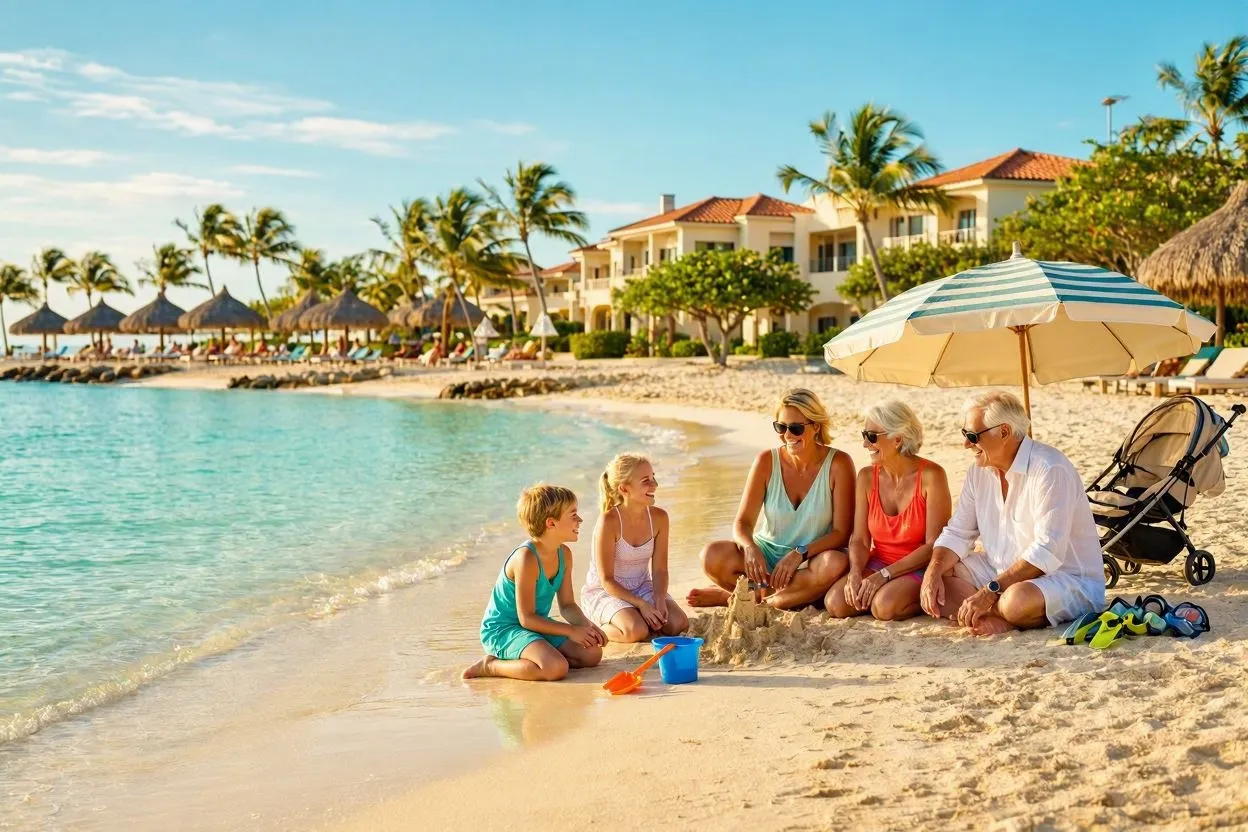
Aruba and Maui are the top family-friendly picks on this list, since both offer calm swimming water, short flight times, and resorts built around multi-generational groups. Aruba sits outside the main hurricane belt, below 12 degrees north latitude, which keeps storm risk low even during peak Atlantic hurricane months. Eagle Beach, ranked among the top family beaches in the Caribbean, has almost no surf and a wide stretch of packed sand that’s ideal for young kids. Divi Aruba and the Renaissance Aruba both run supervised kids’ clubs included in the room rate, and flights from Miami take roughly two and a half hours.
Maui skips the passport requirement entirely for US citizens and adds volcanic scenery the Caribbean simply can’t match. The Road to Hana, a 64-mile (103-kilometer) coastal drive lined with waterfalls, doubles as a full-day family activity with built-in stops for swimming. Ka’anapali Beach fronts a row of family resorts with calm, reef-protected water, and direct flights from Los Angeles run about five and a half hours.
Which Tropical Destinations Are Closest to the US and Canada?
Puerto Rico, Turks and Caicos, and the Cayman Islands sit closest to major US and Canadian gateway cities, all reachable in under four hours. Miami reaches Providenciales in roughly two hours, and Toronto gets to Grand Cayman in about four with one connection. For West Coast travelers, Hawaii is the fastest tropical option at five to six hours from Los Angeles or San Francisco, with no passport needed for US citizens.
When Is the Best Time to Take a Tropical Vacation?
In the Caribbean and most of the Atlantic, the best window falls between December and April, outside the June-to-November Atlantic hurricane season. Storm risk peaks between mid-August and mid-October, when insurance costs rise and cancellation policies tighten across most Caribbean resorts. Pacific and Indian Ocean destinations run on different calendars. The Maldives sees its driest stretch from January through March, while Fiji and the Whitsundays are safest from cyclone activity between May and October. Shoulder-season travel, in May or November for the Caribbean, often cuts nightly rates by 20% to 35% compared to peak winter pricing, with only a modest bump in rain. Aruba stands apart from this calendar entirely, since its position south of the hurricane belt keeps conditions steady across all twelve months.
How Much Does a Tropical Vacation Cost?
A one-week tropical vacation for two typically runs $1,800 to $3,500 in the budget tier, $4,000 to $7,000 at mid-range resorts, and $9,000 or more at luxury overwater properties. Flights account for the widest swing in that total: a round-trip fare from the US East Coast to the Caribbean runs $250 to $600, while a fare to the Maldives or Seychelles can reach $1,500 to $2,500 per person. Food costs vary just as sharply. An all-inclusive resort in Riviera Maya bundles meals into the nightly rate, while a la carte dining in French Polynesia can add $150 to $250 per couple, per day. Travel insurance, often skipped by first-time bookers, typically runs 4% to 8% of the total trip cost and covers hurricane-related cancellations that standard resort policies exclude.
| Budget Tier | Nightly Rate (2 people) | Best-Fit Destinations |
| Budget | $120–$250 | Puerto Rico, Riviera Maya, Koh Lipe |
| Mid-Range | $300–$600 | Cayman Islands, Fiji, Aruba, Zanzibar |
| Luxury | $800–$2,000+ | Maldives, Bora Bora, Seychelles |
What to Pack for a Tropical Vacation
Reef-safe sunscreen, lightweight rain protection, and insect repellent matter more than almost anything else on the list, since these three are the hardest items to source once you’ve actually arrived. Reef-safe sunscreen, free of oxybenzone and octinoxate, is required by law in Hawaii and Palau, and several resorts elsewhere enforce the same rule even where it isn’t legally mandated; some dive shops will confiscate standard sunscreen on the spot. A packable rain jacket earns its space even in the dry season, since tropical downpours arrive fast and usually clear within twenty minutes. Water shoes protect against sharp coral and volcanic rock at beach entries in Hawaii and the Whitsundays, where sand gives way to reef almost immediately.
A few other things worth the suitcase space:
- Dry bag, for boat excursions and beach days
- DEET-based insect repellent, for dusk hours near mangroves or rainforest
- Portable phone charger, since many overwater bungalows have limited outlets near the bed
- Light cotton layers, for air-conditioned resort interiors that run cooler than the outdoor heat
- Printed copies of hotel confirmations, since cell service drops on remote islands like Little Corn or Koh Lipe
How to Choose the Right Tropical Destination
Match the destination to the primary activity first. A diver who books a beach-resort island with no reef access wastes half the trip, and a honeymoon couple who books a family-oriented resort loses the privacy that justified the higher price. Flight time matters too: a four-hour flight to the Cayman Islands makes a five-day trip worthwhile, while an 18-hour trip to Zanzibar makes more sense as part of a 10-day or longer itinerary. Once activity and flight time narrow the list to two or three places, price and seasonal timing settle the rest.
A few quick answers to the questions that tend to come up next:
Conclusion
Fifteen destinations, five travel styles, three budget tiers. It sounds like a lot until the decision comes down to three questions: how many hours of flying feel acceptable, how many dollars per night fit the budget, and what activity matters most once the plane lands. Turks and Caicos and the Cayman Islands answer that fastest for US-based travelers who want beach time without a long-haul flight. Palau and Fiji answer it for divers willing to trade flight time for reef quality. The Maldives and Seychelles answer it for couples who want privacy above everything else, and Aruba and Maui answer it for families who need calm water and a short flight. Whatever combination fits, book flights outside the June-to-November hurricane window for Atlantic destinations, and confirm resort cancellation policies before paying a deposit.