
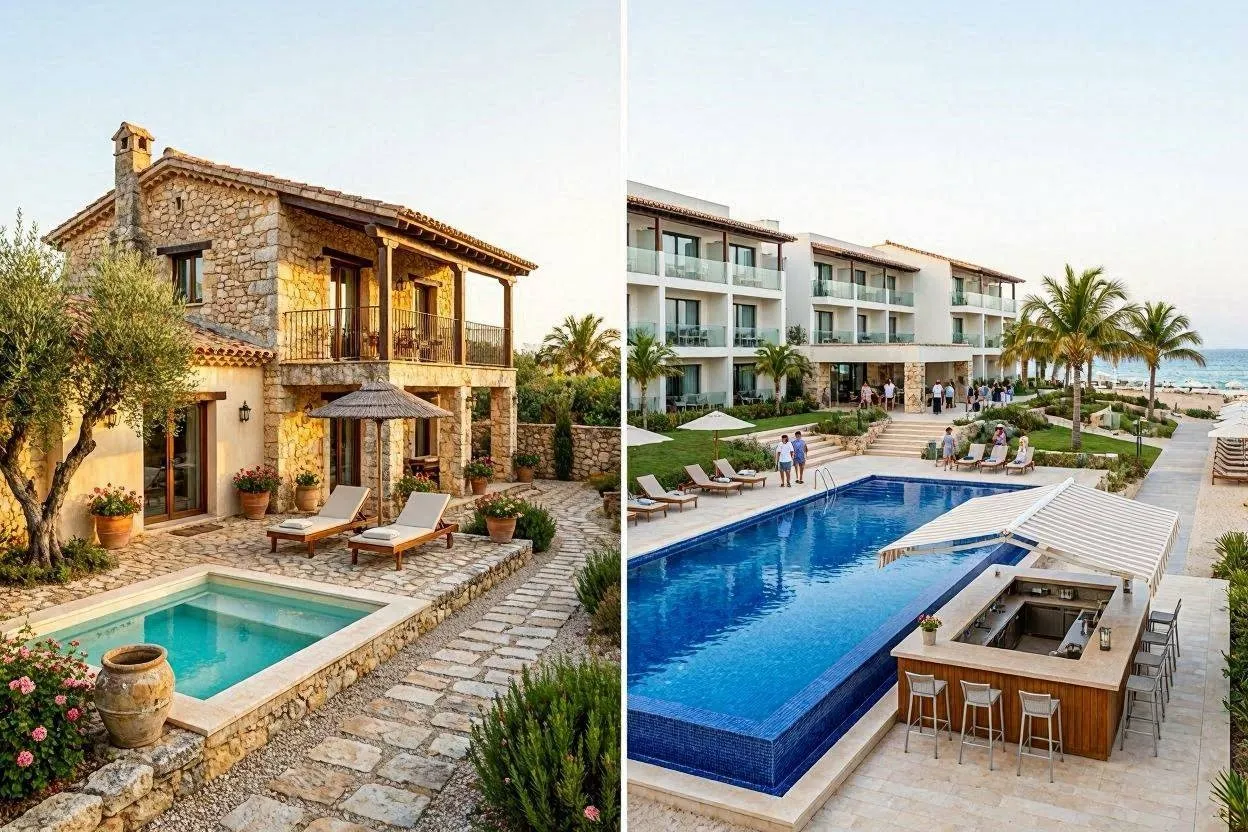
A private villa gives you the entire property — your own pool, a full kitchen, and zero strangers in sight. A resort gives you a complete hospitality ecosystem — multiple restaurants, a world-class spa, a kids’ club, and staff available around the clock. One delivers total exclusivity. The other delivers total convenience. Which one suits your trip comes down to 8 specific factors, and this guide walks through every single one.
Most articles on this topic give vague, surface-level answers. This one doesn’t. It covers real cost comparisons, traveler profiles, side-by-side amenity breakdowns, destination benchmarks, and a hybrid option most guides never mention. By the end, you’ll know exactly which type of stay fits your next trip — and why.
What Is a Villa?
A villa is an entire standalone home reserved exclusively for your group. No shared lobbies, no strangers at the next sun lounger, no waiting for the pool. Most upscale villas include 3 to 8 bedrooms, a full kitchen, generous living areas, a private pool, a garden, and an outdoor terrace. Higher-end properties often come with a dedicated villa manager, a private chef, and round-the-clock concierge support.
This is not the basic short-term rental market. The premium villa segment consists of curated, staffed homes that operate to hotel-level service standards. Nightly rates typically start around $500 and climb past $20,000 for the finest estates in destinations like St. Barts, Tuscany, and the Maldives.
Three main villa types worth knowing:
- Standalone holiday home — an independently owned property booked through platforms like VRBO, Airbnb Luxe, or specialist agencies such as Onefinestay and Luxury Retreats
- Fully staffed villa — comes with a dedicated housekeeper, private chef, on-site concierge, and sometimes a driver or sommelier
- Villa within a resort — a private unit inside a larger resort property, giving you full exclusivity plus access to all resort facilities
What Is a Resort?
A resort is a full-service property where guests book a room, suite, or villa inside a shared environment built around convenience. At the five-star level and above, these properties typically offer several restaurants, a spa, a gym, pools, kids’ clubs, beach clubs, and organized excursions — all within one property. Brands operating at this level include Four Seasons, Aman, Rosewood, One&Only, Six Senses, and Banyan Tree.
Three broad resort categories:
- All-inclusive resort — meals, drinks, and activities are bundled into one nightly rate; ideal for travelers who want a fixed budget with no surprises
- Full-service 5-star resort — rooms are priced separately from dining, spa, and activities; maximum flexibility with maximum variety on-site
- Boutique resort — typically under 50 rooms, with highly personalized service, distinctive design, and a strong sense of place
Villa vs Resort: Quick Comparison Table
| Factor | Villa | Resort |
| Privacy | 100% exclusive — entire property is yours | Shared pools, restaurants, and common areas |
| Space | 3–8 bedrooms, full living areas, garden | One room or suite per booking |
| Cost model | One nightly rate for the whole property | Per room / per person nightly rate |
| Best for | Groups of 5+, families, stays of 7+ nights | Couples, solo travelers, short stays of 3–5 nights |
| Dining | Private chef plus a fully equipped kitchen | Multiple restaurants and room service |
| Amenities | Private pool, terrace, garden, home cinema | Spa, gym, kids’ club, water sports, beach club |
| Flexibility | Total — your schedule, your pace | Fixed meal times and scheduled activities |
| Staff | Dedicated villa team for your group only | Shared hospitality team across all guests |
| Cost per person (group of 8+) | 30–45% less than equivalent resort rooms | Higher per-person cost for larger groups |
| Booking platform | VRBO, Airbnb Luxe, villa agencies, direct | Hotel direct, Booking.com, Virtuoso, Tablet Hotels |
8 Key Differences Between a Villa and a Resort
1. Privacy — Exclusive Space vs a Shared Environment

A private villa gives you 100% exclusive access to the property. Book a villa and every square foot belongs to your group — the pool, the terrace, the garden, the kitchen. No other guests ever step foot on the property. For travelers who find shared pools and crowded breakfast areas at odds with what a premium trip should feel like, this single difference is often enough to settle the decision.
Resorts, by design, operate within a shared environment. Your room or suite is private, but the pools, restaurants, spa, and beach club are open to every guest on the property. At peak season, even the most luxurious resort pool means competing for sun loungers and navigating noise from other guests. Privacy exists, but it is relative — never absolute.
Bottom line: If uninterrupted privacy is a non-negotiable for your trip, a villa wins this outright.
2. Space — A Full Home vs a Single Room
A villa typically offers 3 to 5 times more usable space than an equivalent resort suite. A villa sleeping 10 guests spreads across multiple en-suite bedrooms, a separate dining room, a full kitchen, several living areas, and a generous outdoor terrace. Everyone has room to spread out independently, gather together for meals, or find a quiet corner when they need one.
A resort suite — even a spacious one at 1,000 square feet — is still fundamentally one room and a bathroom. Families with children tend to feel confined after two or three days. Multigenerational groups who want shared evening meals, common lounging space, or just room to breathe need the kind of square footage that only a villa can offer.
Bottom line: For groups of 4 or more, the space advantage of a villa is significant and hard to overstate.
3. Cost — One Property Rate vs a Per-Room Rate
For larger groups, villas are consistently cheaper per person. A resort room at a five-star property typically runs $350 to $800 per night. Book six rooms at those rates and you are looking at $2,100 to $4,800 per night in total. A comparable villa sleeping 12 guests might cost $900 to $2,500 per night — split across 12 people, that works out to $75 to $208 per person, against $350 to $800 per person at the resort.
The math shifts the other way for small parties. A couple booking a resort room at $400 a night pays $200 per person. That same villa at $1,200 a night, shared between just two people, costs $600 each — three times more. The villa pricing model rewards groups; the resort pricing model rewards couples and solo travelers.
Bottom line: Groups of 6 or more almost always save 30 to 45% per person by choosing a villa. Couples and solo travelers usually save by choosing a resort.
4. Amenities — Private Comfort vs Resort-Scale Facilities
Resorts win on sheer volume of what is available; villas win on having everything to yourselves. A top-tier resort can offer multiple signature restaurants, a full spa with 15-plus treatment rooms, a proper gym, a water sports center, a kids’ club, a cinema, a beach club, and a packed calendar of cultural excursions — all on one property, all included in the experience.
A villa takes the opposite approach. Fewer amenities, but every single one belongs entirely to your group. A private pool, an outdoor kitchen, a home cinema, a games room, a gym, a wine cellar — no booking ahead, no waiting, no sharing. For many travelers, having unrestricted access to six amenities feels more valuable than queuing for access to twenty.
Bottom line: Choose a resort if variety matters most. Choose a villa if exclusivity matters most.
5. Dining — Private Chef vs Multiple Restaurants

Resort dining is one of its strongest selling points. A five-star property might include a fine dining restaurant with a Michelin-starred chef, a casual beach grill, a pool bar, an in-room dining menu available at any hour, and specialty cuisines across multiple outlets. Breakfast buffets at top resorts are genuinely impressive — and dinner at a well-run resort restaurant is a highlight in its own right.
Villa dining works differently. A staffed villa with a private chef means meals are cooked to your exact preferences, dietary requirements, and schedule. Want a full Sri Lankan breakfast at 10am? Done. A light mezze by the pool at sunset? Easy. The private chef can also be briefed in advance on allergies, preferences, and special occasion menus. No reservations, no fixed times, no menu limitations.
Bottom line: Resorts offer more variety and culinary range. Villas offer more personalization and total flexibility.
6. Service — A Dedicated Team vs Round-the-Clock Coverage
Villa service tends to feel more personal; resort service tends to be more consistently available. A staffed villa typically comes with a small team — a villa manager, a private chef, a concierge — looking after one or two groups at most. That concierge can arrange a private yacht, secure a reservation at a fully booked restaurant, or organize an experience that is not available to the general public.
Resort concierge teams, by contrast, are managing hundreds of guests simultaneously. Response times are naturally slower and interactions can feel more transactional. That said, a full resort team is genuinely on duty 24 hours a day — which is useful for international trips, late arrivals, or moments when something goes wrong at 3am.
Bottom line: Villas feel more personal. Resorts feel more available. Both have real value depending on what your trip demands.
7. Flexibility — Your Schedule vs a Structured Timetable
A villa runs entirely on your schedule. Breakfast at 11am, a late lunch by the pool, dinner whenever the group is ready — the private chef and villa team work around you, not the other way around. There are no restaurant opening hours to respect, no pool towel reservation systems, no fixed checkout time on the terrace.
Resorts operate on a more structured timetable. Restaurants open and close at set hours. Spa treatments often need to be booked a day in advance. Activities follow a published schedule. This structure genuinely works well for first-time visitors to a destination who want things planned for them, and for travelers who prefer not to make every decision themselves throughout the day.
Bottom line: If total flexibility matters, a villa gives you that without compromise. If you prefer having a rhythm built in, a resort handles it naturally.
8. Experience — Immersive and Intimate vs Social and Curated
Staying in a villa feels like living somewhere rather than visiting it. Morning coffee on a quiet terrace, long dinners with your group under an open sky, no agenda, no performance — just the freedom to let the days unfold however you want. That rhythm, even at a flawlessly run resort, is genuinely difficult to replicate.
Resorts are built to be social environments. Guests meet at the pool bar, cross paths at the beach club, join the same group excursion. For solo travelers and couples who enjoy that kind of energy — plus access to an in-house sommelier, evening entertainment, curated cultural programming, or a hotel’s art collection — a resort offers something a villa simply cannot.
Bottom line: A villa is immersive and intimate. A resort is social and curated. The right choice depends entirely on the kind of energy you want your holiday to have.
Who Should Book a Villa?
A villa makes the most sense if your trip fits any of these:
- Families with children — multiple bedrooms, a private pool, and a full kitchen remove the pressure of restaurant schedules and shared spaces entirely
- Groups of 6 or more — paying by the property instead of by the room cuts per-person costs by 30 to 45%, and shared living areas keep everyone together rather than scattered across separate hotel floors
- Stays of 7 nights or longer — villa life settles into a genuinely comfortable rhythm; even a beautiful hotel suite begins to feel small after five days
- Privacy-first trips — honeymoons, family reunions, milestone birthdays, or high-profile guests where complete exclusivity is non-negotiable
Who Should Book a Resort?
A resort makes the most sense if your trip fits any of these:
- Couples on a short break of 3 to 5 nights — the amenities deliver their best value over a short, intensive stay, and per-room pricing makes financial sense
- Solo travelers — a villa’s space and pricing structure simply do not work for one person; a resort’s social setting, dining options, spa, and organized activities are a far better fit
- First-time visitors to a destination — a resort’s concierge team, on-site programming, and organized excursions take the guesswork out of an unfamiliar place
- Travelers who want everything handled — with an all-inclusive resort, the nightly rate covers dining, drinks, and activities upfront, leaving nothing left to coordinate
The Hybrid Option: A Villa Inside a Resort
There is a way to skip the choice between privacy and full amenities altogether. Some resorts offer private, standalone villa units — complete with their own pool, terrace, and living space — set within the grounds of a larger resort property. You get complete exclusivity inside the villa itself, plus unlimited access to the resort’s restaurants, spa, beach club, and activities whenever you want them.
The best destinations for this type of stay include the Maldives (private pool villas at Soneva Fushi, One&Only Reethi Rah, and Six Senses Laamu), Bali (at Four Seasons Sayan and COMO Shambhala Estate), and the Caribbean (at Rosewood Little Dix Bay and Round Hill Hotel & Villas). These hybrid options typically cost 25 to 40% more than a standard resort suite, but the combination of hotel-grade service and complete privacy is genuinely difficult to match elsewhere.
Top Destinations: Benchmark Nightly Rates
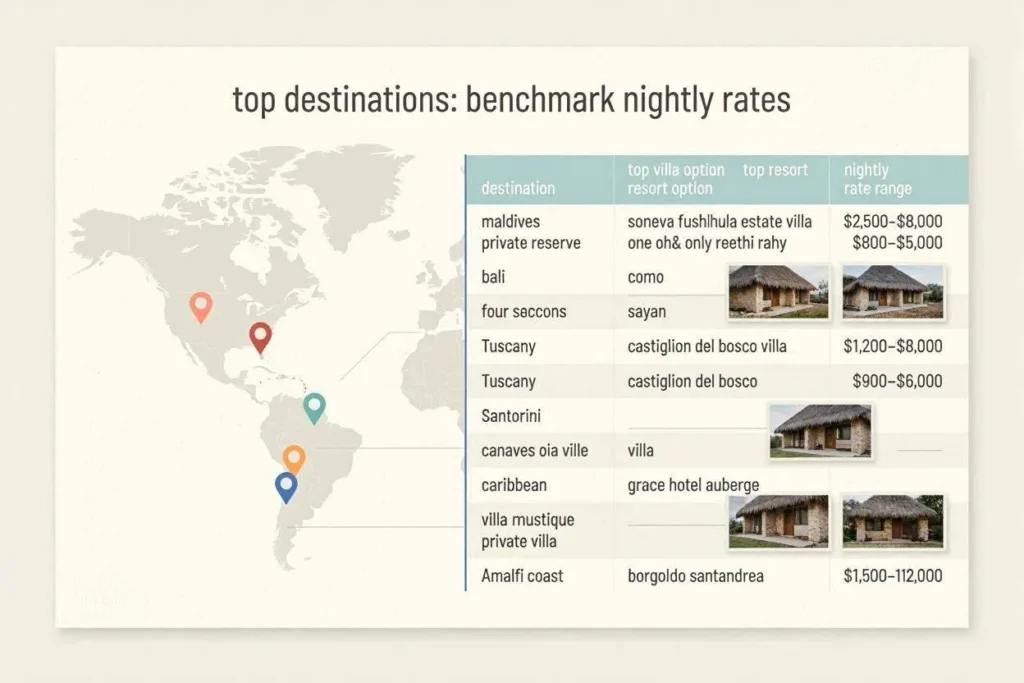
| Destination | Top Villa Option | Top Resort Option | Nightly Rate Range |
| Maldives | Soneva Fushi Private Reserve | One&Only Reethi Rah | $2,500–$18,000 |
| Bali | COMO Shambhala Estate Villa | Four Seasons Sayan | $800–$5,000 |
| Tuscany | Castiglion del Bosco Villa | Rosewood Castiglion del Bosco | $1,200–$8,000 |
| Santorini | Canaves Oia Villa | Grace Hotel Auberge | $900–$6,000 |
| Amalfi Coast | Villa Tre Ville | Borgo Santandrea | $1,500–$12,000 |
| Caribbean | Mustique Private Villa | Round Hill Hotel & Villas | $2,000–$20,000 |
Frequently Asked Questions
Is a villa cheaper than a resort?
For groups of 6 or more, yes — a villa typically costs 30 to 45% less per person per night than booking the equivalent number of resort rooms. For couples or solo travelers, a resort room usually works out more economical, since villa pricing is set per property regardless of how many guests are staying.
Which is better for a honeymoon — a villa or a resort?
A villa suits honeymooners who want complete privacy and a deeply personal experience. A resort suits couples who prefer having everything organized for them. Overwater villas in the Maldives and private pool villas in Bali and Santorini offer a strong middle ground — which is exactly why they remain among the most popular honeymoon destinations worldwide.
How many nights does a villa start to make sense?
Generally from around 5 nights, with the value peaking at 7 nights or more. Setting up a villa — briefing the chef, stocking the kitchen, coordinating with the concierge ahead of arrival — only pays off properly over a longer stay. Groups booking 10 nights or more consistently report the best overall value.
What is a villa inside a resort?
A private, standalone unit — with its own pool, terrace, and living space — located within the grounds of a larger resort property. You get full privacy inside the villa while retaining access to everything the resort offers: restaurants, spa, beach club, and organized activities. Four Seasons, Aman, and Soneva all run programs of this kind across multiple destinations.
Final Verdict: Villa or Resort?
Go with a villa for privacy, space, and group value. Go with a resort for convenience, variety, and shorter stays. Neither option is universally better — the right answer depends on your group size, length of stay, budget, and the kind of experience you are actually after.
Groups of 6 or more, families with children, and anyone staying 7 nights or longer will almost always get more value and a richer overall experience from a villa. Couples on a short trip, solo travelers, and anyone who wants every detail handled will almost always get more out of a five-star resort.
And if you genuinely do not want to choose, a villa inside a resort is the strongest option available. It costs more, but it delivers both — and that combination is hard to argue with.