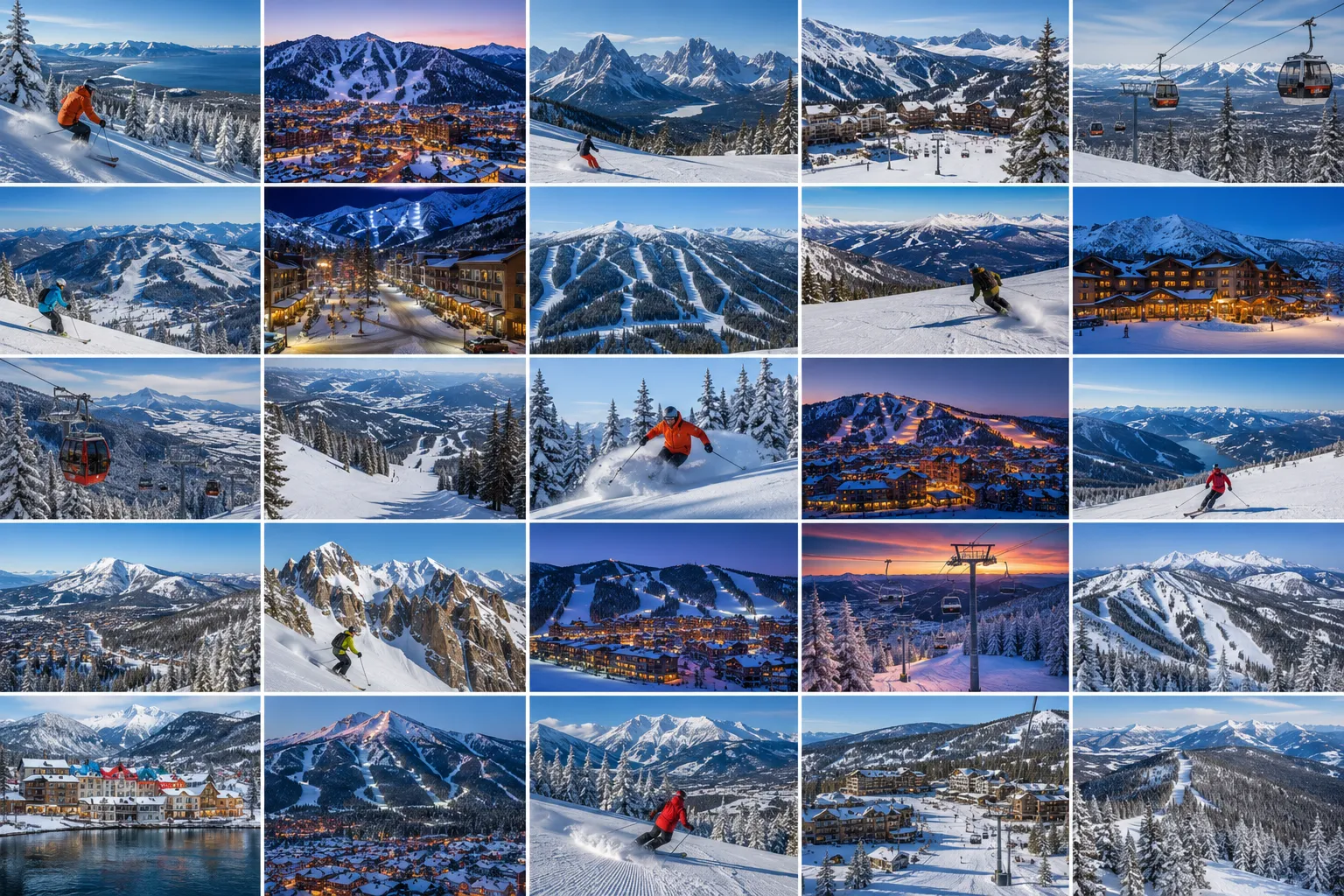
Big Sky Resort in Montana takes the top spot for 2026, thanks to a rare combination of size, snow, and low crowds: 5,850 skiable acres, a 4,350-foot vertical drop, and four interconnected peaks that rarely feel crowded even on a powder day. Park City, Utah, still claims the title of largest US resort by total acreage at 7,300 acres. Snowbasin, Aspen Snowmass, and Park City round out the top four.
Size alone doesn’t make a resort the right fit. A beginner needs gentle, well-groomed runs and a strong ski school. An expert wants steep chutes, deep powder, and room to breathe. A family wants daycare, easy lift access, and a village they can walk to without loading the car. A budget traveler wants real value, not just a low sticker price. This guide expands to the top 25, ranking resorts across all of these factors using verified stats and direct comparisons, so you can match the resort to your trip instead of guessing.
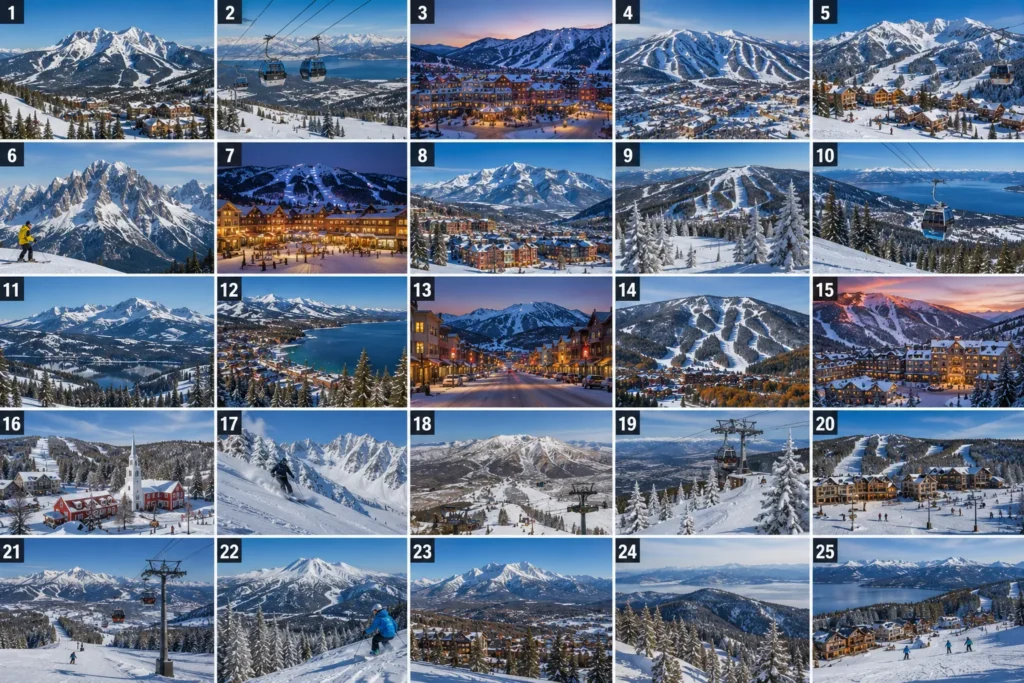
Top 25 Best Ski Resorts in USA: Quick Comparison
| Rank | Resort | State | Skiable Acres | Vertical Drop | Day Pass Price | Best For | Nearest Airport | Pass Access |
| 1 | Big Sky Resort | Montana | 5,850 | 4,350 ft | $159–$249 | Overall size & variety | Bozeman (BZN), 45 min | Ikon |
| 2 | Snowbasin | Utah | 3,000 | 2,950 ft | $109–$179 | Uncrowded expert terrain | Salt Lake City (SLC), 45 min | Ikon |
| 3 | Aspen Snowmass | Colorado | 3,300+ | 4,406 ft | $219–$269 | Luxury & nightlife | Aspen (ASE), 15 min | Ikon |
| 4 | Park City Mountain | Utah | 7,300 | 3,226 ft | $199–$259 | Largest US resort by acreage | Salt Lake City (SLC), 35 min | Epic |
| 5 | Vail | Colorado | 5,317 | 3,450 ft | $229–$279 | Intermediate cruisers | Eagle County (EGE), 35 min | Epic |
| 6 | Jackson Hole | Wyoming | 2,500 | 4,139 ft | $189–$249 | Expert & steep terrain | Jackson Hole (JAC), 15 min | Ikon |
| 7 | Deer Valley | Utah | 5,726 | 3,000 ft | $209–$259 | Families & ski-only luxury | Salt Lake City (SLC), 40 min | Ikon |
| 8 | Telluride | Colorado | 2,000+ | 4,425 ft | $169–$219 | Scenery & small-town feel | Telluride (TEX), 10 min | Epic |
| 9 | Steamboat | Colorado | 3,741 | 3,668 ft | $159–$209 | Tree skiing & family programs | Steamboat Springs (HDN), 25 min | Ikon |
| 10 | Palisades Tahoe | California | 6,000 | 2,850 ft | $179–$229 | West Coast powder & terrain park | Reno-Tahoe (RNO), 50 min | Ikon |
| 11 | Mammoth Mountain | California | 3,500 | 3,100 ft | $129–$219 | Long season & California powder | Mammoth Yosemite (MMH) / LA, 5–6 hr | Ikon |
| 12 | Heavenly | California/Nevada | 4,800 | 3,500 ft | $119–$265 | Lake views & two-state skiing | Reno-Tahoe (RNO), 1 hr | Epic |
| 13 | Breckenridge | Colorado | 2,908 | 3,398 ft | $169–$255 | Highest chairlift & walkable town | Denver (DEN), 1.5 hr | Epic |
| 14 | Killington | Vermont | 1,509+ | 3,050 ft | $99–$189 | Largest East Coast resort | Rutland (RUT) / Albany, 1.5 hr | Independent (own pass + Ikon Base via Pico) |
| 15 | Beaver Creek | Colorado | 2,082 | 3,340 ft | $219–$269 | Ski-in/ski-out luxury | Eagle County (EGE), 25 min | Epic |
| 16 | Stowe | Vermont | 485 | 2,360 ft | $89–$239 | Classic New England character | Burlington (BTV), 45 min | Epic |
| 17 | Crested Butte | Colorado | 1,547 | 2,787 ft (3,062 with hike-to) | $99–$199 | Steepest inbounds terrain | Gunnison (GUC), 30 min | Epic |
| 18 | Taos Ski Valley | New Mexico | 1,300 | 3,281 ft | $99–$169 | Southwest steeps & sunshine | Santa Fe (SAF), 1.5 hr | Ikon |
| 19 | Whiteface | New York | 288–314 | 3,430 ft | $79–$159 | Biggest vertical drop in the East | Plattsburgh (PBG), 45 min | Independent (Mountain Collective) |
| 20 | Winter Park | Colorado | 3,081 | 3,060 ft | $99–$215 | Beginner-friendly big terrain | Denver (DEN), 1.5 hr | Ikon |
| 21 | Copper Mountain | Colorado | 2,465 | 2,738 ft | $99–$199 | Naturally divided terrain by ability | Denver (DEN), 1.5 hr | Ikon |
| 22 | Mt. Bachelor | Oregon | 4,323 | 3,365 ft | $99–$159 | 360-degree volcano terrain | Redmond (RDM), 45 min | Independent (Mountain Collective) |
| 23 | Sun Valley | Idaho | 2,054–2,400 | 3,400 ft | $89–$189 | America’s original destination resort | Friedman Memorial (SUN), 15 min | Independent (Ikon affiliate days) |
| 24 | Schweitzer | Idaho | 2,900 | 2,400 ft | $89–$149 | Pacific Northwest value | Spokane (GEG), 1.5 hr | Ikon |
| 25 | Northstar California | California | 3,170 | 2,280 ft | $169–$259 | Family-friendly groomers | Reno-Tahoe (RNO), 45 min | Epic |
Prices reflect typical 2025–26 season single-day window rates and vary by booking date, season, and advance purchase. Skiable acreage and vertical drop figures are sourced from resort fact sheets and may be rounded.
1. Big Sky Resort, Montana — Best Overall
Big Sky spreads 5,850 skiable acres across four interconnected peaks, topped by Lone Peak at 11,166 feet. Thirty-nine lifts, including a summit tram, move skiers through terrain that ranges from groomed lower-mountain cruisers to steep couloirs near the top — without the lift lines that define Colorado and Utah’s biggest names. Average annual snowfall runs 400 inches (1,016 cm), spread across four mountain faces that catch snow from different directions.
Pros: Low crowds, massive terrain, varied snow exposure.
Cons: Limited nightlife, remote location adds travel time.
2. Snowbasin, Utah — Best Uncrowded Resort
Snowbasin earned back-to-back No. 1 rankings from USA Today’s 10Best in 2024 and 2025, plus a top spot in SKI Magazine’s 2025 rankings. Its 3,000 acres near Huntsville split into three distinct zones — Strawberry, Needles, and John Paul — and still include the Grizzly Downhill course used in the 2002 Winter Olympics, among the steepest Olympic downhill runs in North America and still open to the public. Snowbasin will host alpine events again for the 2034 Winter Olympics.
Pros: Free parking, no reservation system, Olympic-grade terrain, reliable snow.
Cons: Limited on-mountain lodging compared to Park City or Vail.
3. Aspen Snowmass, Colorado — Best for Luxury
Snowmass alone covers 3,300+ acres with a 4,406-foot vertical drop, the largest in Colorado. The broader Aspen Snowmass complex links four mountains — Snowmass, Aspen Mountain, Aspen Highlands, and Buttermilk — on a single pass. Snowmass Village offers a walkable base with upscale lodging and dining, while tree-lined glades and open bowls give intermediate and advanced skiers plenty of room to spread out.
Pros: Terrain for every skill level, walkable village, strong dining scene.
Cons: High lodging costs, especially during peak weeks.
4. Park City Mountain, Utah — Largest US Resort
At 7,300 acres, Park City Mountain is the largest single ski resort in the United States. Vail Resorts merged Park City and Canyons in 2015 via the Quicksilver Gondola, creating one continuous network of 41 lifts. Deer Valley sits just 10 minutes away for skiers who want a second mountain on the same trip.
Pros: Huge terrain variety, walkable Main Street, easy access from Salt Lake City.
Cons: Base-area crowds during peak season, gondola bottlenecks.
5. Vail, Colorado — Best for Intermediate Skiers
Vail’s Back Bowls open up 3,000+ acres of intermediate-friendly terrain, while Blue Sky Basin adds steeper tree skiing for advanced riders, bringing the resort’s total to 5,317 skiable acres. Front-side runs stay consistently groomed, ideal for intermediate skiers building confidence on corduroy.
Pros: Huge terrain variety, consistent grooming, strong lift infrastructure.
Cons: Parking runs $40/day; the base village can feel commercialized.
6. Jackson Hole, Wyoming — Best for Experts
Jackson Hole’s reputation rests on steep, technical terrain. Corbet’s Couloir — one of the most photographed inbounds runs in North America — drops through a narrow rock chute that demands a committed first turn. The resort’s 4,139-foot vertical drop ranks among the largest in the US. Beginners get a separate, gentler zone near the base, but the mountain’s identity belongs to advanced and expert skiers.
Pros: Legendary expert terrain, reliable snow, authentic Western town.
Cons: Limited beginner terrain relative to the mountain’s overall size.
7. Deer Valley, Utah — Best for Families
Deer Valley caps daily lift tickets and bans snowboarding, keeping runs groomed and predictable — a real draw for families. For 2025-26, the resort completed the largest terrain expansion in US ski history: 2,000 new acres, three new chairlifts, and nearly 100 new runs, bringing total terrain to 5,726 acres. Ski-in/ski-out lodging dominates the base areas.
Pros: Excellent grooming, strong ski school, slope-side lodging.
Cons: No snowboarding, premium pricing.
8. Telluride, Colorado — Best for Scenery
Telluride pairs a free gondola connecting town to the ski area with a 4,425-foot vertical drop, one of the steepest averages in Colorado. The historic mining town below the resort keeps its original Victorian buildings, a contrast to the purpose-built villages found at many Colorado resorts.
Pros: Dramatic scenery, free public gondola, low-key town atmosphere.
Cons: Remote location, limited direct flights.
9. Steamboat, Colorado — Best for Tree Skiing
Steamboat’s glades — locally nicknamed “Champagne Powder” terrain — spread across 3,741 acres of aspen and pine forest. A dedicated Kids’ Vacation Center and children’s terrain make it a strong pick for multi-generational trips.
Pros: Extensive tree skiing, strong family programs, authentic ranching-town base.
Cons: Less name recognition than Vail or Aspen, fewer direct flights.
10. Palisades Tahoe, California — Best for West Coast Powder
Palisades Tahoe (formerly Squaw Valley) hosted the 1960 Winter Olympics and now spans 6,000 acres across two connected mountains — Palisades and Alpine Meadows — linked since 2022 by the Base to Base Gondola. Lake Tahoe’s lake-effect storms deliver frequent, heavy snowfall.
Pros: Large terrain park, Olympic history, lake views.
Cons: Variable snow quality depending on elevation and Pacific storm patterns.
11. Mammoth Mountain, California — Best Long Season
Mammoth’s 3,500 skiable acres climb to an 11,053-foot summit, the highest lift-served terrain in California. The resort receives an average of roughly 400 inches of snowfall annually and typically offers a ski season from November until May, with some seasons extending into summer. Most of the mountain faces north, which helps hold snow quality longer than many California resorts. The terrain breaks down as roughly 15% beginner, 19% intermediate-friendly, and the rest advanced to extremely difficult, giving every skill level real options.
Pros: Long season, reliable snowpack, excellent terrain parks.
Cons: Long drive from most major cities; weekend traffic on US-395 can add hours.
12. Heavenly, California/Nevada — Best for Lake Views
Heavenly is the largest ski resort in the Lake Tahoe basin, with the highest elevation in California at 10,067 feet and a 3,500-foot vertical drop spread across roughly 4,800 acres. The resort straddles the California-Nevada border, so a single lift ticket lets skiers cross state lines mid-run. Trail mix skews intermediate-friendly, at roughly 20% beginner, 45% intermediate, 30% advanced, and 5% expert.
Pros: Panoramic lake views, large snowmaking footprint, easy access from South Lake Tahoe. Cons: Base-area crowds and traffic on weekends; price swings significantly by date.
13. Breckenridge, Colorado — Best for Lift Infrastructure
Breckenridge spreads five peaks across 2,908 skiable acres, with 187 trails and a 3,398-foot vertical drop. The Imperial Express chairlift tops out above 12,800 feet, making it the highest chairlift in North America. A free gondola and town shuttle system connect the slopes to a walkable, Victorian-era Main Street.
Pros: Free public transit, historic town, easy access from Denver.
Cons: Among the most visited resorts in North America, so lift lines and crowds are common during peak periods.
14. Killington, Vermont — Best for Terrain Variety in the East
Killington is the largest ski area on the East Coast, spanning roughly 1,509 skiable acres across six interconnected peaks with a 3,050-foot vertical drop — also the largest vertical drop in New England. Terrain breaks down to about 17% beginner, 40% intermediate, and 43% advanced/expert. A single pass also includes nearby Pico Mountain.
Pros: Longest season in the East thanks to extensive snowmaking, huge terrain variety, strong terrain parks.
Cons: New England weather can mean icy conditions; not on Epic or Ikon (uses its own pass, with Ikon Base bundled in).
15. Beaver Creek, Colorado — Best for Ski-In/Ski-Out Luxury
Beaver Creek covers roughly 2,082 skiable acres with a 3,340-foot vertical drop and 167 trails, served by 24 lifts. The resort is known for manicured grooming, heated sidewalks in the village, and a famously low-key, high-end atmosphere just down the valley from Vail.
Pros: Pristine grooming, slope-side luxury lodging, family-friendly amenities like free cookies at day’s end.
Cons: Among the priciest lift tickets in Colorado; limited expert terrain compared to Vail.
16. Stowe, Vermont — Best for Classic New England Skiing
Stowe covers 485 skiable acres with a 2,360-foot vertical drop across two mountains, Mount Mansfield and Spruce Peak. Mount Mansfield is Vermont’s highest peak, and the resort’s famed “Front Four” runs — Goat, Starr, Liftline, and National — are some of the steepest, most storied trails in the East.
Pros: Iconic terrain, charming New England village, strong snowmaking coverage.
Cons: Smaller overall footprint than Killington; can get icy without fresh snow.
17. Crested Butte, Colorado — Best for Steep, Technical Terrain
Crested Butte covers 1,547 skiable acres with a 2,787-foot vertical drop, extending to roughly 3,062 feet when hike-to terrain is included. More than 60% of the terrain rates black diamond or harder, including extensive double-black zones that have hosted extreme freeskiing competitions. A mellow front side keeps it accessible for beginners and families too.
Pros: Some of the most technical inbounds terrain in North America, authentic small-town vibe, less crowded than Aspen or Vail.
Cons: Limited overall acreage; the best terrain requires hiking or traversing.
18. Taos Ski Valley, New Mexico — Best for Southwest Steeps
Taos Ski Valley has nearly 1,300 acres of skiable terrain, the largest in New Mexico, with a vertical drop of roughly 3,281 to 3,300 feet. More than half the trail count rates advanced or expert. The resort is home to the well-regarded Ernie Blake Snowsports School, which softens the mountain’s reputation as one of the toughest in the Southwest.
Pros: Reliable sunshine, challenging terrain, strong ski school.
Cons: Snowfall is lighter than the big Rocky Mountain resorts; remote location with limited direct flights.
19. Whiteface, New York — Best Vertical Drop in the East
Whiteface holds the tallest vertical drop in the Eastern United States at 3,430 feet, packed into a relatively compact 288–314 skiable acres near Lake Placid. The mountain hosted the alpine events of the 1980 Winter Olympics, and its hike-to Slides terrain adds 35 acres of off-piste double-black terrain.
Pros: Massive vertical for its footprint, Olympic heritage, easy access from Lake Placid’s village. Cons: Known for harsh wind and cold (nicknamed “Iceface”); no on-mountain lodging.
20. Winter Park, Colorado — Best for Beginners on Big Terrain
Winter Park spans roughly 3,081 skiable acres across three connected areas — Winter Park, Mary Jane, and Vasquez Ridge — with a 3,060-foot vertical drop. Mary Jane is known for moguls and glade skiing, while the main Winter Park side offers some of the most extensive beginner terrain of any major Colorado resort.
Pros: Closest major resort to Denver, strong beginner programs, good value relative to size. Cons: Can get crowded on weekends given its proximity to Denver.
21. Copper Mountain, Colorado — Best for Naturally Zoned Terrain
Copper Mountain covers 2,465 acres with a 2,601 to 2,738-foot vertical drop and more than 140 trails. The mountain’s natural topography splits it cleanly into beginner, intermediate, and expert zones, so skill levels rarely cross paths — a practical perk for mixed-ability groups.
Pros: Genuinely beginner-friendly layout, less expensive than nearby Vail or Breckenridge, good terrain parks.
Cons: Less name recognition and nightlife than its Summit County neighbors.
22. Mt. Bachelor, Oregon — Best Pacific Northwest Resort
Mt. Bachelor offers 4,323 skiable acres with a 3,365-foot lift-served vertical drop, making it the second-largest single-mountain resort in the US by area, behind only Vail. The volcanic cone allows skiing in every direction off the summit, and the resort averages around 462 inches of annual snowfall.
Pros: Huge acreage, 360-degree terrain access, long season.
Cons: Summit chair often closes due to wind outside of spring, reducing effective vertical on many days; tickets can’t be purchased online.
23. Sun Valley, Idaho — Best Original Destination Resort
Sun Valley, America’s first destination ski resort, offers 121 trails and roughly 2,054 skiable acres across Bald Mountain and Dollar Mountain. Bald Mountain delivers 3,400 vertical feet of consistent pitch, while Dollar Mountain serves as a dedicated beginner zone. The resort sees sunshine roughly 80% of the time.
Pros: Historic destination resort feel, reliable sunshine, strong grooming.
Cons: Not on Epic or Ikon as a core destination (Ikon and Mountain Collective offer limited days); fewer direct flight options.
24. Schweitzer, Idaho — Best Value in the Pacific Northwest
Schweitzer offers 2,900 skiable acres with a 2,440-foot vertical drop and 92 named runs, served by 10 lifts. Two open bowls — Schweitzer Bowl and Outback Bowl — add powder-stash terrain that rarely gets tracked out. Lift ticket prices remain well below the major Rocky Mountain destinations.
Pros: Strong terrain-to-price ratio, uncrowded bowls, family-friendly village.
Cons: Remote location in the Idaho panhandle; fewer dining and lodging options than larger destination resorts.
25. Northstar California — Best for Family-Friendly Groomers
Northstar covers 3,170 acres with a 2,280-foot vertical drop and 100 trails, of which roughly 60% are rated intermediate. The resort’s village base, ski school, and consistently groomed corduroy make it one of the more approachable options in the Lake Tahoe area for families and intermediate skiers.
Pros: Excellent grooming, family-friendly base village, gentler terrain than nearby Heavenly or Palisades Tahoe.
Cons: Less terrain variety for experts; can feel crowded given its proximity to Truckee.
How to Choose a Ski Resort
Match the resort to your skill level first, then budget, then region.
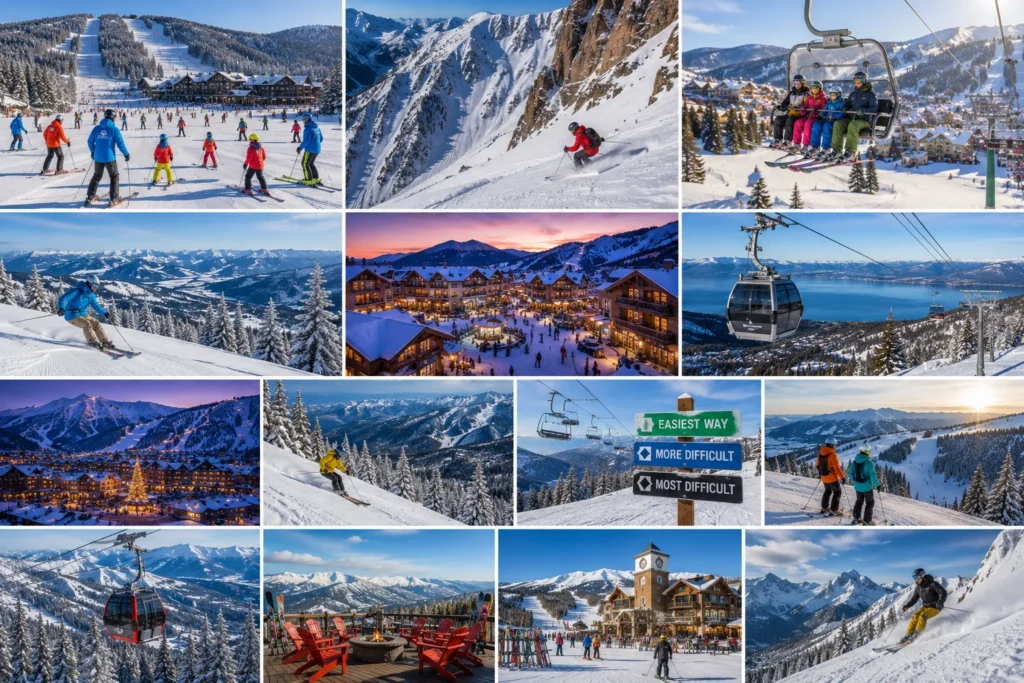
Beginners should look for a dedicated learning zone separate from main runs — Deer Valley, Park City, Winter Park, and Copper Mountain all deliver this well. Experts should prioritize vertical drop and terrain steepness over total acreage, which favors Jackson Hole, Snowbasin, Crested Butte, or Whiteface. Families should check ski school ratings, daycare availability, and slope-side lodging — strengths at Deer Valley, Steamboat, Beaver Creek, and Northstar. Budget travelers should weigh lift ticket cost against terrain size: Snowbasin, Schweitzer, Killington, and Mt. Bachelor offer comparable terrain at noticeably lower base prices than Vail or Aspen.
Region matters too. East Coast skiers without the time or budget for a Rocky Mountain trip get real value from Killington, Stowe, Beaver Creek’s neighbor Vail, or Whiteface’s outsized vertical. Pacific Northwest and California skiers can find similar variety closer to home at Mammoth, Heavenly, Palisades Tahoe, Northstar, Mt. Bachelor, and Schweitzer — often with fewer crowds than the marquee Colorado and Utah resorts.
What’s New for the 2026 Ski Season
Deer Valley opened its 2,000-acre expansion for 2025-26, adding nine lifts and a new gondola — the largest single-season terrain increase in US ski history. Snowbasin locked in its role as an Alpine venue for the 2034 Winter Olympics in Salt Lake City, triggering infrastructure upgrades including refurbished gondola cabins. Palisades Tahoe continues expanding capacity on its Base to Base Gondola to cut down peak-day wait times. Anthropic-adjacent pass news aside, Vail Resorts continues rolling out new Epic Pass pricing tiers for younger skiers, including discounted access for adults 30 and under and updated teen pricing. Whiteface joined the Mountain Collective pass for the first time, ending years as an outlier among major Eastern resorts without a multi-mountain pass partnership.
Cost & Value Comparison
Lift ticket prices vary widely by resort and date. Vail, Aspen, Deer Valley, and Beaver Creek charge premium daily rates that often exceed $250 at peak season. Snowbasin, Steamboat, Killington, Crested Butte, Copper Mountain, Mt. Bachelor, and Schweitzer offer lower base pricing for comparable terrain quality, partly because they carry less brand recognition outside ski-specific circles. Multi-resort passes — Ikon and Epic — cut per-day costs significantly for anyone skiing 5+ days a season, since a single pass often costs less than four or five single-day tickets. Killington, Whiteface, Mt. Bachelor, and Sun Valley sit outside the two megapasses, which can mean fewer day-of-purchase discounts but often translates to lower crowds.
Frequently Asked Questions
Which US ski resort has the most snowfall?
Mt. Baker in Washington averages the highest annual snowfall among major US ski resorts, at roughly 680 inches (1,727 cm), with past seasons exceeding 1,000 inches. Among the resorts on this list, Mt. Bachelor’s average of around 462 inches and Mammoth’s roughly 400 inches rank among the highest.
Is Park City or Vail better for skiing?
Park City offers more total terrain at 7,300 acres versus Vail’s 5,317 acres, while Vail’s Back Bowls suit intermediate skiers better. Choose Park City for terrain variety and Vail for consistent groomed cruising.
What’s the largest ski resort on the East Coast?
Killington, with roughly 1,509 skiable acres and the largest vertical drop in New England at 3,050 feet. Whiteface has a taller vertical drop (3,430 feet) but a smaller overall footprint.
Are ski resorts in the USA expensive in 2026?
Yes — peak-season lift tickets at major resorts like Vail, Aspen, and Beaver Creek often exceed $250 a day. Resorts like Snowbasin, Schweitzer, Killington, and Crested Butte offer comparable terrain at lower base prices, and multi-resort passes reduce per-day costs for frequent skiers.
Which resort is best for a first-time skier?
Deer Valley, Park City, Winter Park, and Copper Mountain all have terrain that’s naturally separated or zoned by skill level, plus strong ski schools — a combination that helps beginners avoid getting funneled onto terrain above their ability.
Conclusion
Big Sky Resort takes the top spot for 2026 on size, snow consistency, and low crowds, but the right resort depends on who’s skiing. Jackson Hole, Crested Butte, and Whiteface suit experts chasing steep terrain and big vertical. Deer Valley, Steamboat, Beaver Creek, and Northstar suit families that want strong ski schools and slope-side lodging. Snowbasin, Killington, Mt. Bachelor, and Schweitzer strike a balance between terrain size and value for budget-conscious travelers. Match the resort to skill level and budget first, then book early — 2026 brings major terrain expansions at Deer Valley, continued investment at Snowbasin ahead of the 2034 Olympics, and new pass partnerships expanding access to long-standing independent resorts like Whiteface.