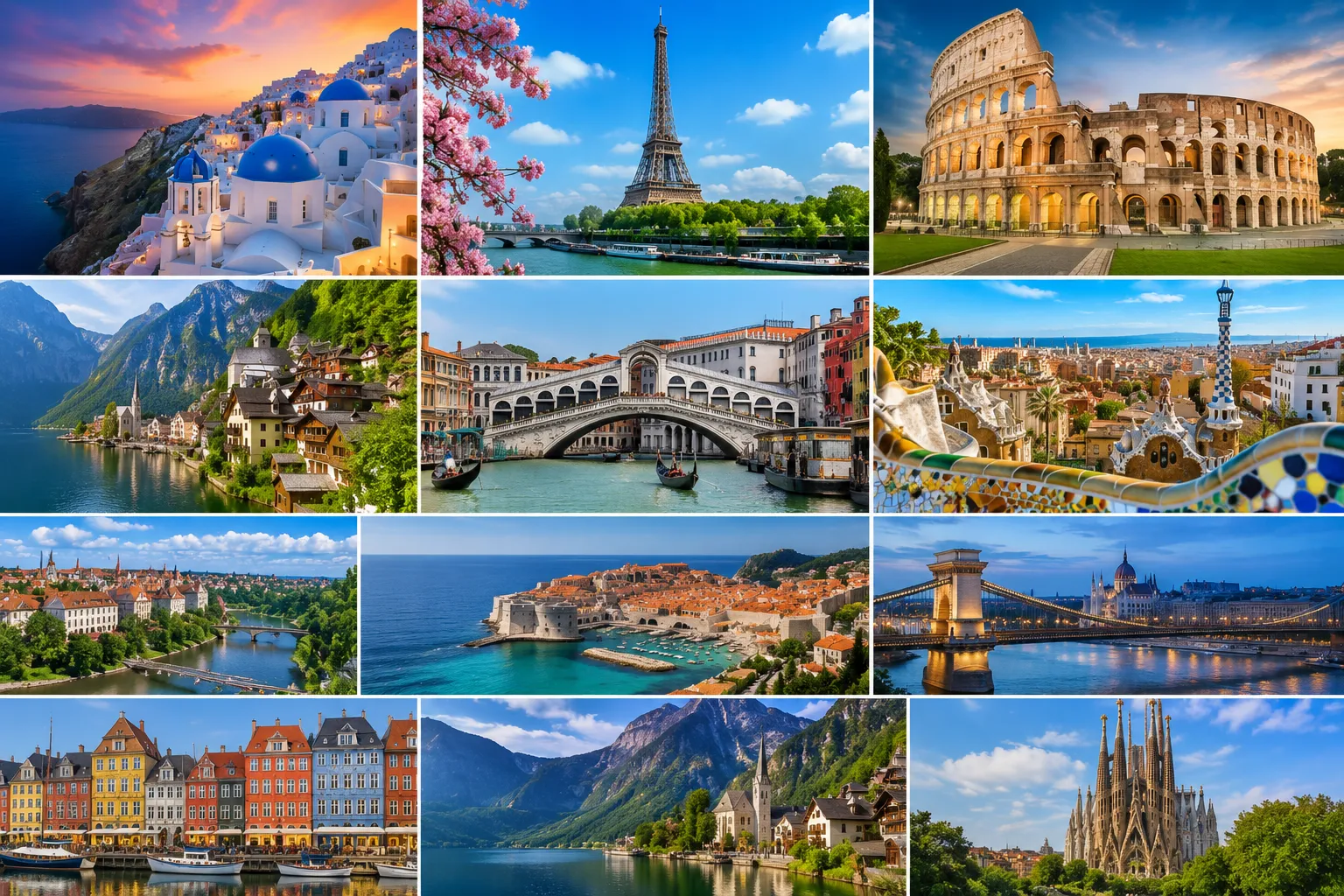
Good places in Europe to visit in 2026 fall into four categories: cities built for first-timers, coastal and island escapes, mountain and lake towns, and underrated stops that outperform the famous names next door. The right destination depends on what the trip is actually for, not which country sounds most familiar. This guide breaks Europe down by travel priority, trip length, daily budget in four currencies, and the new entry rule every US, UK, Australian, and Canadian traveler needs to know before booking.
How to Choose Where to Go in Europe
To pick a destination, match the trip to one priority instead of a country name.
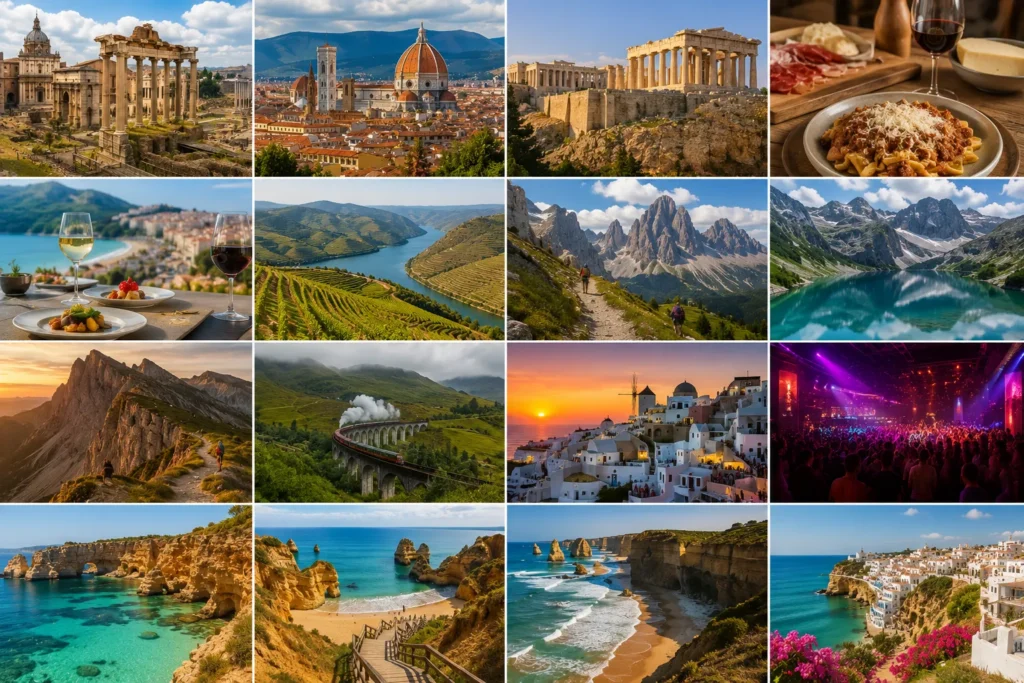
- History and art travelers do best in Rome, Florence, and Athens, cities where ruins, museums, and centuries-old architecture sit within walking distance of each other.
- Food and wine travelers find the best value in Bologna, San Sebastián, and Portugal’s Douro Valley, regions built around one signature dish or wine style.
- Nature and hiking travelers do best in the Dolomites, the Julian Alps, and the Scottish Highlands, landscapes with marked trails and cable-car access for non-hikers too.
- Nightlife and beach travelers find the strongest scene in Mykonos, Ibiza, and Portugal’s Algarve coast, destinations with tourism infrastructure built around exactly that.
Mixing two priorities into one trip works if the chosen cities sit within a three-hour train ride of each other, since longer transfers eat into the trip without adding much value.
Good Places in Europe to Visit, by Type
Historic Capitals Worth the Hype
Rome
Best for: ancient history and walkable sightseeing
Rome packs 2,000 years of history into a center small enough to cross on foot in an afternoon. The Colosseum, completed in 80 AD, once seated roughly 50,000 spectators, and standing inside it still gets people quiet for a second. Skip the menus posted right outside the ruins — the good pizza al taglio is usually three streets back, where locals actually eat.
Paris
Best for: art, food, and a first love affair with Europe
Paris pairs world-class museums with neighborhood bakeries that sell out of croissants by 9 a.m. The Louvre alone displays around 35,000 works at any given time, far more than anyone sees properly in one visit, so most first-timers pick three rooms and let the rest go. That’s not a shortcut — that’s how Paris is meant to be done.
Vienna
Best for: classical music and slowing down
Vienna runs on coffeehouse culture, not hustle. Order a melange, claim a marble table, and stay two hours — nobody rushes you out. The State Opera stages over 50 productions a season, and standing-room tickets often cost less than a movie ticket back home.
Budapest
Best for: thermal baths and nightlife on a budget
Budapest does something few capitals manage: serious history by day, serious fun by night. Soak in the steaming outdoor pools at Széchenyi or Gellért, then head into a ruin bar built inside a half-abandoned building once the sun goes down.
Coastal and Island Escapes
The Amalfi Coast
Best for: cliffside views and slow road trips
Fifty kilometers (31 miles) of coastal road link towns like Positano and Ravello, and every switchback hands over a new view worth stopping for. Rent a scooter if the nerve allows it — the local bus drivers handle the cliffs like they’ve done it a thousand times, because they have.
Santorini
Best for: sunset views and honeymoon budgets
Santorini’s curved caldera exists because of a volcanic eruption around 1600 BC, and the whitewashed villages built along the rim still pull a crowd every evening for sunset. Book a table early — the good viewpoints fill up fast.
Dubrovnik
Best for: walking a real medieval fortress
Dubrovnik’s stone wall circles the entire Old Town for about 2 kilometers (1.2 miles), a full loop most travelers finish in 90 minutes. Go at sunrise if mornings are manageable — the heat and the cruise-ship crowds both arrive by mid-morning.
The Algarve
Best for: beach-hopping without a fixed plan
Southern Portugal’s Algarve coast holds more than 100 beaches, with sea temperatures running 18-22°C (64-72°F) in summer — warm enough to swim, cool enough to actually enjoy it. Pick a different cove each day and nobody runs out of options.
Mountain and Lake Towns
Lake Bled
Best for: one perfect photo and total quiet
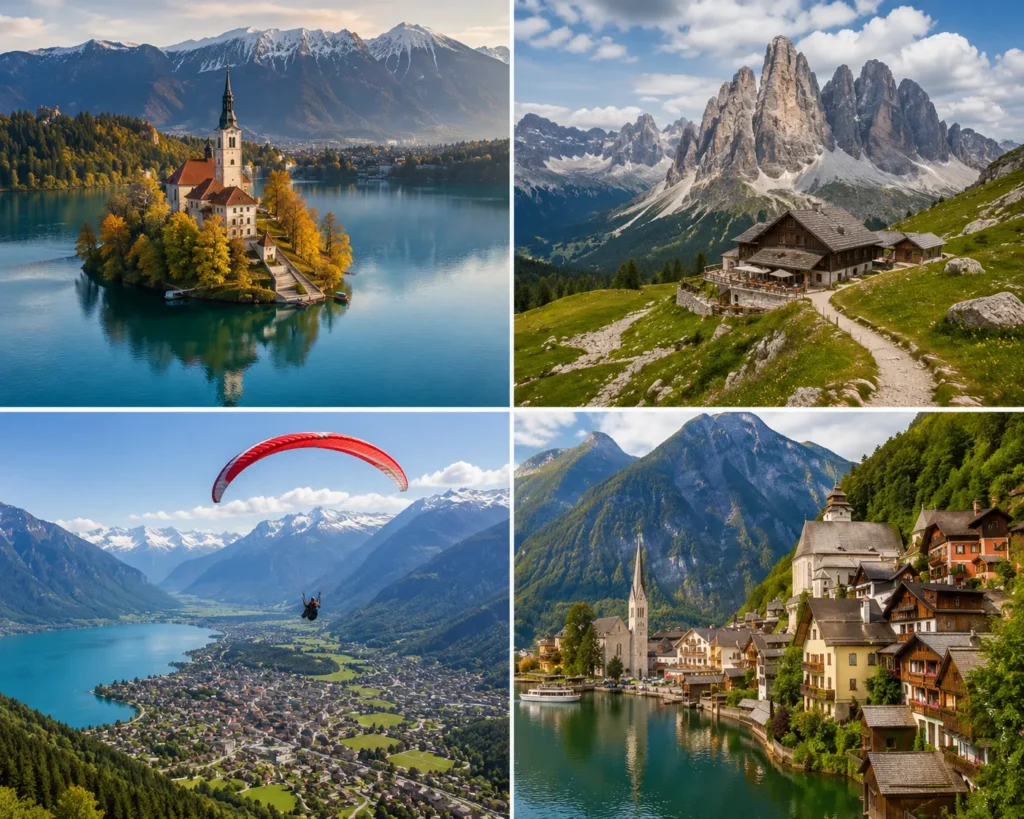
A single church-topped island sits in the middle of Lake Bled, reachable only by traditional wooden boats called pletna. Row out at dawn before the day-trip buses arrive, and the lake belongs to whoever’s already on it.
The Dolomites
Best for: hikers who still want a good lunch
Thousands of marked alpine trails cross the Dolomites, backed by dozens of cable cars for anyone who’d rather skip the climb and keep the view. Most mountain huts serve a full hot lunch, so nobody has to choose between the hike and the meal.
Interlaken
Best for: adrenaline between two lakes
Interlaken sits wedged between two lakes and serves as the launch point for the Jungfraujoch, Europe’s highest railway station at 3,454 meters (11,332 feet). Paragliders launch overhead most clear afternoons, landing in the same meadow where the cows are still grazing.
Hallstatt
Best for: fairy-tale photos, taken early
Fewer than 800 people live in Hallstatt full-time, in a lakeside village so photogenic that a full-scale replica now exists in China. Arrive before 9 a.m. or after 4 p.m. — the village is small enough that midday crowds change the entire feel of the place.
Underrated Towns That Outperform the Big Names
Ljubljana
Best for: Prague’s charm without Prague’s crowds
Ljubljana draws a fraction of Prague’s tourist numbers despite a near-identical mix of riverside cafés, a hilltop castle, and a car-free old town. Anyone who loved Prague a decade ago will recognize that same feeling here, right now.
Porto
Best for: port wine and a slower Lisbon
Porto moves at half the pace of Lisbon and produces the very port wine the city is named after, with cellar tours running right along the Douro riverbank. Order a glass, watch the sun drop behind the Dom Luís bridge, and it’s one of the cheapest great views in Europe.
Sighișoara
Best for: castle history without castle crowds
This 13th-century Romanian citadel is reportedly tied to Vlad the Impaler’s birth, yet draws a tiny fraction of the visitors Transylvania’s main castle circuit sees. Wander the cobbled lanes at dusk and it gets easy to forget what century it is.
Riga
Best for: architecture lovers on a budget
Riga holds one of the highest concentrations of Art Nouveau architecture anywhere in the world, a detail most first-time visitors to Europe never hear before they arrive. Walking the streets here counts as a museum visit, and it’s free.
How Long to Spend in Europe
A 4- to 5-day trip suits one city plus two day trips, such as Paris paired with Versailles and Giverny. A 10- to 12-day trip covers two or three countries, the length most first-time visitors choose to balance cost against coverage. A trip of three weeks or longer allows a full regional loop, like Eastern Europe through Poland, Hungary, and Romania without rushing between stops.
Shorter trips concentrate the budget into fewer cities and cut transit time. Longer trips lower the average daily cost, since flights get split across more days on the ground.
What a Trip to Europe Costs in 2026
Daily spending varies more by travel style than by which country gets chosen. The table below excludes international flights and reflects per-person daily spending in US dollars (USD), British pounds (GBP), Australian dollars (AUD), and Canadian dollars (CAD).
| Travel style | USD/day | GBP/day | AUD/day | CAD/day |
| Budget — hostels, public transit, self-cooked meals | $60-90 | £47-71 | $93-140 | $83-125 |
| Mid-range — 3-star hotels, restaurant meals, occasional tours | $120-180 | £95-142 | $186-279 | $167-250 |
| Luxury — 4- to 5-star hotels, private transport, fine dining | $300+ | £237+ | $465+ | $417+ |
Round-trip flights from the US, UK, Australia, or Canada typically add:
- $500-1,200 USD
- £395-948 GBP
- AU$775-1,860
- CA$695-1,668
The exact cost depends on the departure city and season. Exchange rates shift week to week, so treat these figures as a planning range rather than a fixed quote.
January, February, and November bring the lowest flight and hotel prices. July and August raise every cost category by 20-50% above the shoulder-season average.
New Entry Rules for 2026 and 2027
No, ETIAS is not active yet, but it becomes mandatory in the last quarter of 2026. The European Travel Information and Authorisation System (ETIAS) replaces visa-free entry for citizens of 59 countries, including the United States, United Kingdom, Australia, and Canada.
The European Commission set the ETIAS fee at:
- €20 (official fee)
- $23 USD
- £17 GBP
- AU$36
- CA$32
Travelers under 18 or over 70 are exempt from paying it. Most approvals arrive within minutes of submitting the online form, though a small share of applications take up to 30 days for additional review.
A related system, the Entry/Exit System (EES), already launched in April 2026 and replaced manual passport stamping with fingerprint and photo records at the border. ETIAS depends on EES running smoothly first, which is why an exact ETIAS launch date within the fourth quarter of 2026 hasn’t been confirmed yet.
Travelers booking trips for late 2026 should apply for ETIAS as soon as the official portal opens, since a six-month grace period follows the launch before enforcement gets strict. The only authorized application site runs through the European Commission. Any third-party site charging more than €20, or accepting payment before the official portal opens, is not legitimate.
Good Places in Europe for Families and Limited-Mobility Travelers
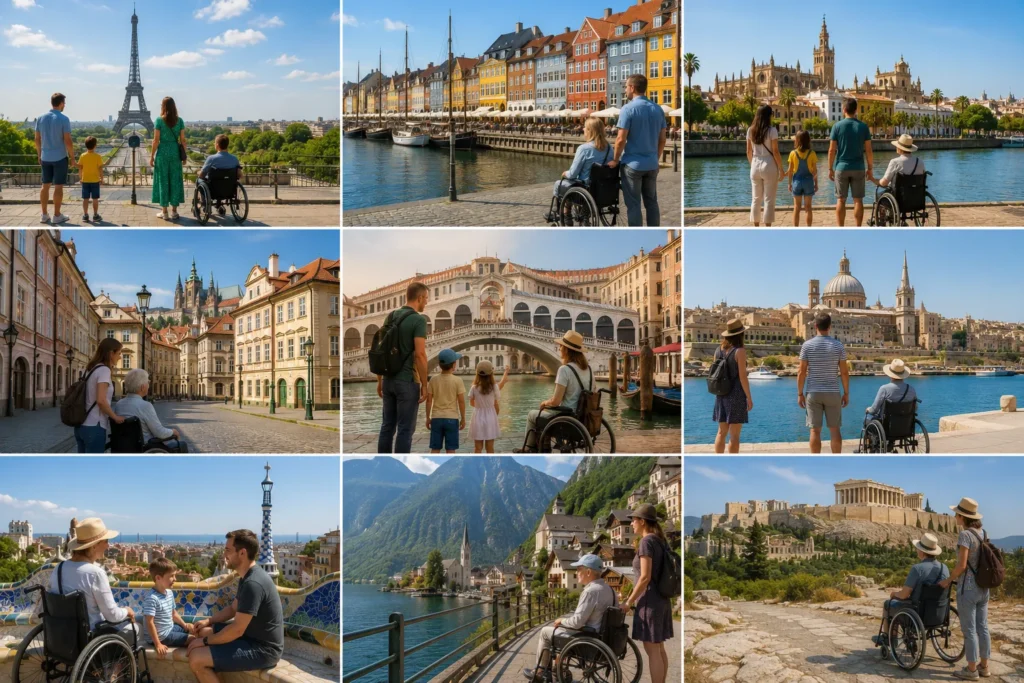
Amsterdam, Copenhagen, and Munich rank among the most stroller- and wheelchair-friendly capitals in Europe, with flat terrain and step-free tram access across most of the city center. Major theme parks across the region, including Legoland Billund in Denmark, increasingly offer sensory-friendly accommodations such as quiet rooms for children with additional needs. Vienna’s public transport runs free for children under 6, with discounted family tickets available for older kids.
Cobblestone-heavy cities such as Prague and parts of Rome present the biggest mobility challenges of any major European destination, since uneven stone surfaces are harder to cross with a stroller or wheelchair than the flat, paved streets common across Northern Europe.
FAQs
Is Europe expensive to visit in 2026?
No, not on every trip. Budget travelers spend $60-90 a day excluding flights, and mid-range travelers average $120-180 a day. Eastern Europe runs 30-40% cheaper than Western Europe for comparable hotel and meal quality.
How many days do I need for a first trip to Europe?
Ten to twelve days covers two or three countries without feeling rushed. A shorter five-day trip works better built around a single city plus nearby day trips.
Do US, UK, Australian, and Canadian citizens need ETIAS to visit Europe?
Not yet. ETIAS becomes mandatory in the last quarter of 2026, with a six-month grace period before enforcement starts. Trips taken before the launch date need only a valid passport.
What is the cheapest time of year to visit Europe?
January, February, and November bring the lowest flight and hotel prices. Shoulder months like May and September balance good weather with savings of 20-30% over peak summer rates.
Which European country works best for a first-time visitor?
Italy offers the strongest mix for first-timers: major landmarks within walking distance, an efficient train network linking Rome, Florence, and Venice, and food that needs no translation. Portugal and Slovenia work well as lower-cost, lower-crowd alternatives.
Plan the Trip Before Prices Rise
Flight and hotel prices climb steadily as departure dates approach, and ETIAS enforcement adds a new booking step starting in late 2026. Pick a priority from the list above, choose a shoulder-season date, and lock in the trip before both the prices and the paperwork get heavier.