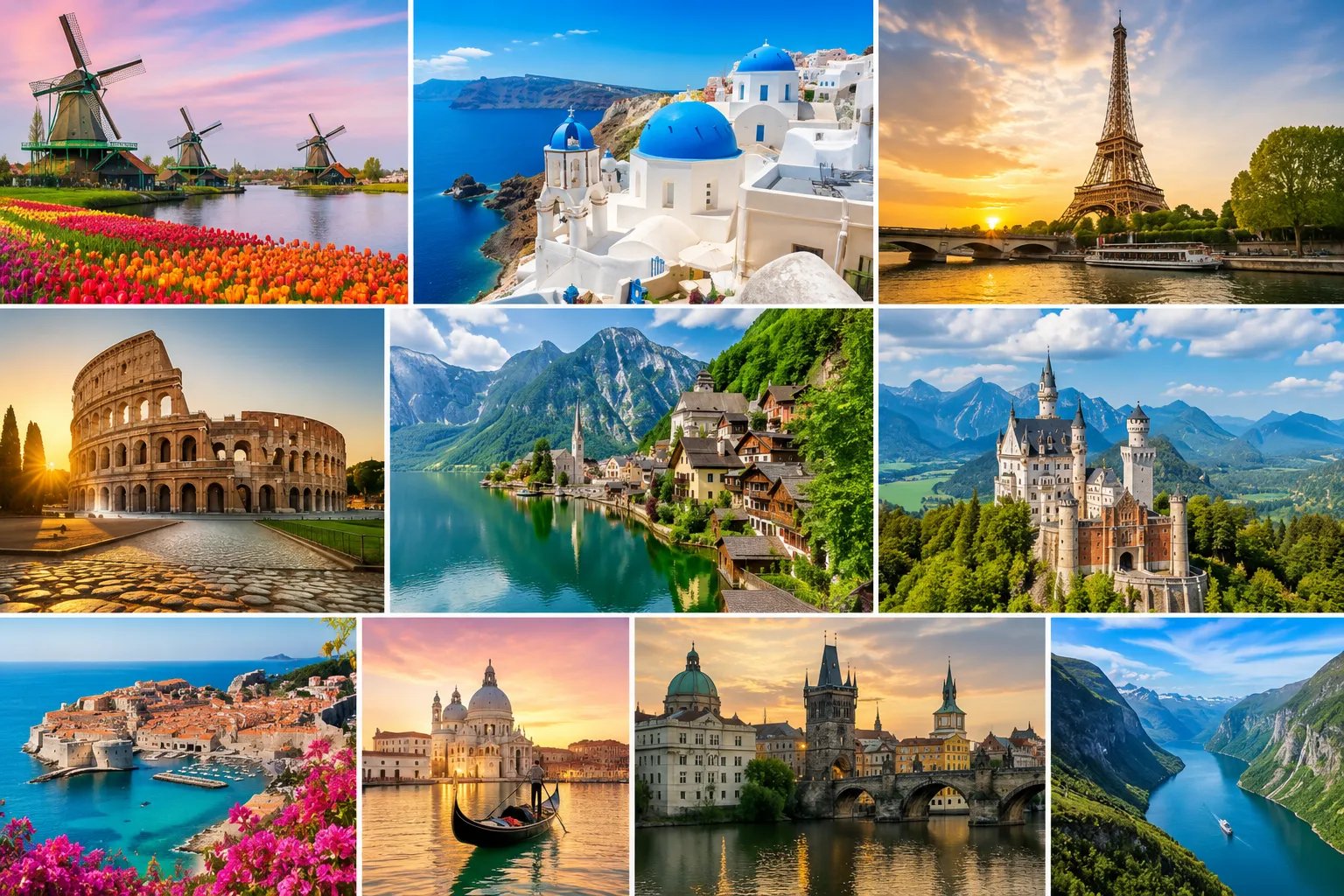
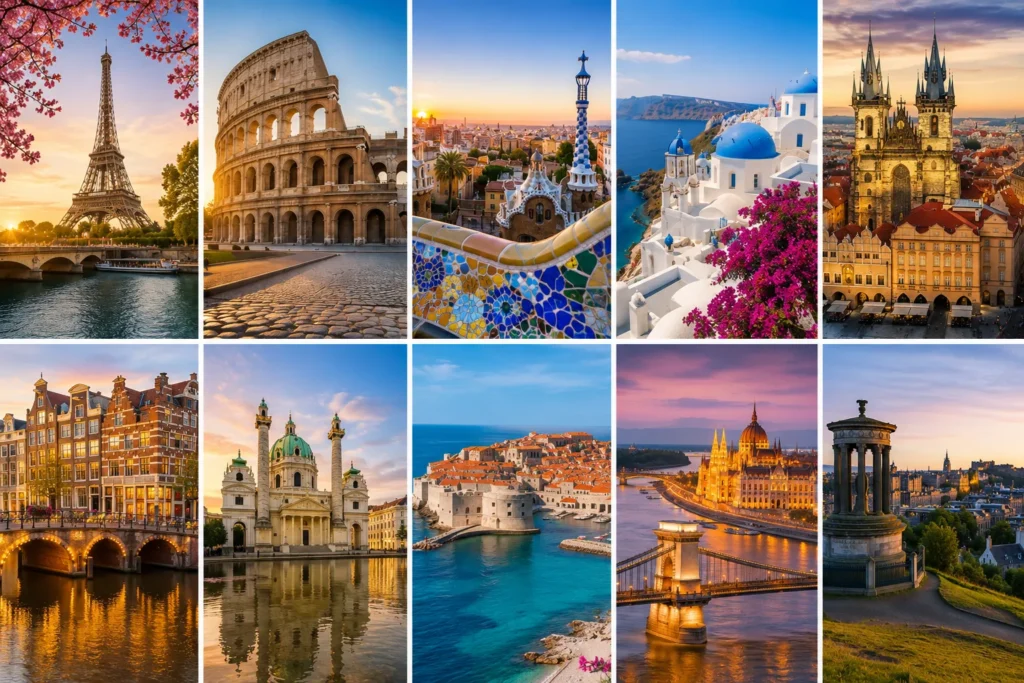
The top 10 tourist destinations to visit in Europe in 2026 are Paris, Rome, Barcelona, Santorini, Prague, Amsterdam, Vienna, Dubrovnik, Budapest, and Edinburgh. This travel guide covers each destination’s must-see tourist attractions and landmarks, the best time for sightseeing, a daily travel budget in euros (EUR) and US dollars (USD), and the 2026 entry rules that changed for travelers from the EU, UK, US, and Australia. Treat it as a practical travelogue for planning real sightseeing days, not just a list of city names.
Currency note: As of mid-2026, 1 EUR ≈ $1.16 USD ≈ £0.86 GBP ≈ AU$1.67. Use these to convert any figure below into your home currency.
2026 Entry Requirements You Need to Know

Nine of these 10 cities sit inside the Schengen Area, a 29-country zone with shared external borders. EU citizens travel freely between all nine with no visa or paperwork. US, UK, and Australian citizens can still enter visa-free for stays under 90 days within any 180-day period, but that’s about to change: the EU’s new ETIAS travel authorization launches in the last quarter of 2026 and will require US, UK, and Australian travelers to apply online before arrival. The fee is expected to be around €7, the application takes about 10 minutes, and approval typically arrives within minutes. ETIAS won’t be mandatory until roughly April 2027, so anyone traveling before then can still enter under the current visa-free rules.
Edinburgh sits outside Schengen, since the UK left the EU. Since February 25, 2026, every visa-exempt visitor — including EU citizens, Americans, and Australians — needs an approved UK Electronic Travel Authorisation (ETA) before boarding any flight, ferry, or train to the UK. The ETA costs £20, takes about 10 minutes to apply for online, and stays valid for 2 years. Airlines now check for it before allowing boarding, so apply at least 3 working days ahead of travel.
One more 2026 change worth knowing: the EU’s Entry/Exit System (EES) went live on April 10, 2026, and now records fingerprints and a facial photo at Schengen borders instead of a passport stamp. No application is needed for EES — it happens automatically at the border.
1. Paris, France
Paris earns its spot as one of Europe’s most visited tourist destinations, packing world-class landmarks into one walkable city. Top tourist attractions for sightseeing include: visit the Louvre, climb the Eiffel Tower, and walk through Montmartre on a single weekend, then add a day trip to the Palace of Versailles if time allows. The best time to visit is April to June or September to October, when the gardens bloom and the crowds thin out. A mid-range daily budget runs €90 to €120 (roughly $105 to $140), covering a 3-star hotel, two sit-down meals, and museum entry. Halal restaurants are common near La Chapelle and Barbès if dietary requirements matter.
2. Rome, Italy
Rome’s history sits at street level, not behind glass, making it one of the world’s richest tourist destinations for ancient landmarks. Must-see tourist attractions: tour the Colosseum, explore the Roman Forum, and see the Sistine Chapel inside Vatican City, all within a 20-minute walk of each other. Visit between March and May or September and October to avoid the 35°C (95°F) summer heat that hits the city in July and August. Expect to spend €80 to €100 daily (around $95 to $115) on food, transport, and entry tickets. Halal kebab restaurants cluster around the Termini and Esquilino districts.
3. Barcelona, Spain
Barcelona pairs Antoni Gaudí’s landmark architecture with a beach that sits 15 minutes from the city center, blending culture and coastline in one tourist destination. Top sightseeing stops: see the Sagrada Família, walk through Park Güell, and relax on Barceloneta Beach in the same afternoon if you start early. May, June, and September bring warm weather without the August crowds that fill Las Ramblas. Daily costs land around €75 to €95 (about $85 to $110) for mid-range travel. The Raval neighborhood has several halal restaurants and grocery stores.
4. Santorini, Greece
Santorini justifies its price tag with a view few tourist destinations can match. Top attractions for sightseeing: watch sunset from Oia, swim at Kamari’s black-sand beach, and tour a volcanic winery for an afternoon that costs under €40 combined. Visit in May, June, or late September if a quieter, cheaper trip matters more than peak summer energy. Daily budgets run higher here, between €100 and €140 (about $115 to $160), since it’s an island with limited competition among hotels. Halal options stay limited outside a handful of Mediterranean restaurants in Fira, so pack snacks if dietary needs are strict.
5. Prague, Czech Republic
Prague delivers fairytale landmark architecture at Eastern European prices. Must-see tourist attractions: cross Charles Bridge, tour Prague Castle, and watch the astronomical clock strike the hour in Old Town Square. April, May, September, and October offer mild weather and shorter lines at the castle. A full day of food, transport, and sightseeing costs €50 to €70 (around $60 to $80), making Prague the most budget-friendly stop on this list.
6. Amsterdam, Netherlands
Amsterdam moves at bicycle speed, and that’s part of its appeal as a tourist destination. Top landmarks and attractions: cycle along the canals, tour the Anne Frank House, and walk through the Van Gogh Museum to cover the city’s three biggest draws in one day. Visit in April for tulip season at Keukenhof Gardens, or July through September for the warmest, driest weather. Daily spending averages €90 to €110 (about $105 to $130). Halal Turkish and Moroccan restaurants are common throughout the city, particularly in De Pijp.
7. Vienna, Austria
Vienna runs on imperial landmark architecture and coffee-house culture. Top tourist attractions: tour Schönbrunn Palace, attend a concert at the Vienna State Opera, and sit for coffee and cake at one of the city’s centuries-old cafés. May, June, and September bring comfortable temperatures for walking the Ringstrasse. Budget €80 to €100 daily (around $95 to $115) for hotels, museum entry, and meals.
8. Dubrovnik, Croatia
Dubrovnik’s walled Old Town, a UNESCO World Heritage Site and one of Croatia’s top tourist destinations, looks the same today as it did 500 years ago, minus the crowds carrying cameras. Top attractions for sightseeing: walk the full 1.2-mile city wall, swim below Fort Lovrijenac, and take a short ferry to Lokrum Island for a quieter beach day. Visit in May, June, or September, since July and August push hotel prices up by 40% or more. Daily costs run €85 to €110 (about $100 to $130).
9. Budapest, Hungary
Budapest splits into two halves connected by the Danube, with thermal baths as the city’s signature tourist attraction. Top landmarks for sightseeing: soak in Széchenyi Thermal Bath, tour the Hungarian Parliament Building, and watch the city light up from Fisherman’s Bastion at dusk. April, May, September, and October bring fewer crowds and lower hotel rates than peak summer. A full day costs €45 to €65 (around $55 to $75), making Budapest the second-cheapest stop on this list after Prague.
10. Edinburgh, Scotland
Edinburgh earns its place among the UK’s top tourist destinations through atmosphere rather than warm weather. Top landmarks for sightseeing: tour Edinburgh Castle, walk the Royal Mile, and hike up Arthur’s Seat for a panoramic view of the entire city in under two hours. May through September brings the mildest weather, with daylight stretching past 9 p.m. in June. Daily budgets run £70 to £90 (roughly $95 to $120). Edinburgh has an established South Asian community, so halal food is widely available throughout the city center.
Compare All 10 Destinations at a Glance
| City | Best Time to Visit | Daily Budget (EUR/USD) | 2026 Entry Rule |
| Paris | April–June, Sept–Oct | €90–120 / $105–140 | Schengen, ETIAS from Q4 2026 |
| Rome | March–May, Sept–Oct | €80–100 / $95–115 | Schengen, ETIAS from Q4 2026 |
| Barcelona | May, June, September | €75–95 / $85–110 | Schengen, ETIAS from Q4 2026 |
| Santorini | May, June, late Sept | €100–140 / $115–160 | Schengen, ETIAS from Q4 2026 |
| Prague | April, May, Sept, Oct | €50–70 / $60–80 | Schengen, ETIAS from Q4 2026 |
| Amsterdam | April, July–Sept | €90–110 / $105–130 | Schengen, ETIAS from Q4 2026 |
| Vienna | May, June, September | €80–100 / $95–115 | Schengen, ETIAS from Q4 2026 |
| Dubrovnik | May, June, September | €85–110 / $100–130 | Schengen, ETIAS from Q4 2026 |
| Budapest | April, May, Sept, Oct | €45–65 / $55–75 | Schengen, ETIAS from Q4 2026 |
| Edinburgh | May–September | £70–90 / $95–120 | UK ETA required now |
Practical Travel Guide Tips
Getting around: Trains connect most of these tourist destinations faster than flights once you factor in airport time, especially between Paris, Amsterdam, Vienna, Prague, and Budapest. Inside each city, a multi-day public transport pass usually costs less than individual tickets if you’re sightseeing for 3 days or more.
Where to stay: Book a hotel or apartment inside or near each city’s historic center — Old Town in Prague, the Gothic Quarter in Barcelona, the Royal Mile area in Edinburgh — to cut taxi costs and walk to most landmarks directly.
Packing tips: Pack layers for Edinburgh and Prague even in summer, since evening temperatures can drop 10°C (50°F) below the daytime high. Santorini and Dubrovnik call for sun protection and comfortable walking shoes for cobblestone streets.
Best booking window: Reserve accommodation in Santorini, Dubrovnik, and Edinburgh 3 to 4 months ahead for summer travel, since rooms in these three tourist destinations sell out faster than in the larger Schengen cities.
How to Combine These Cities in One Trip
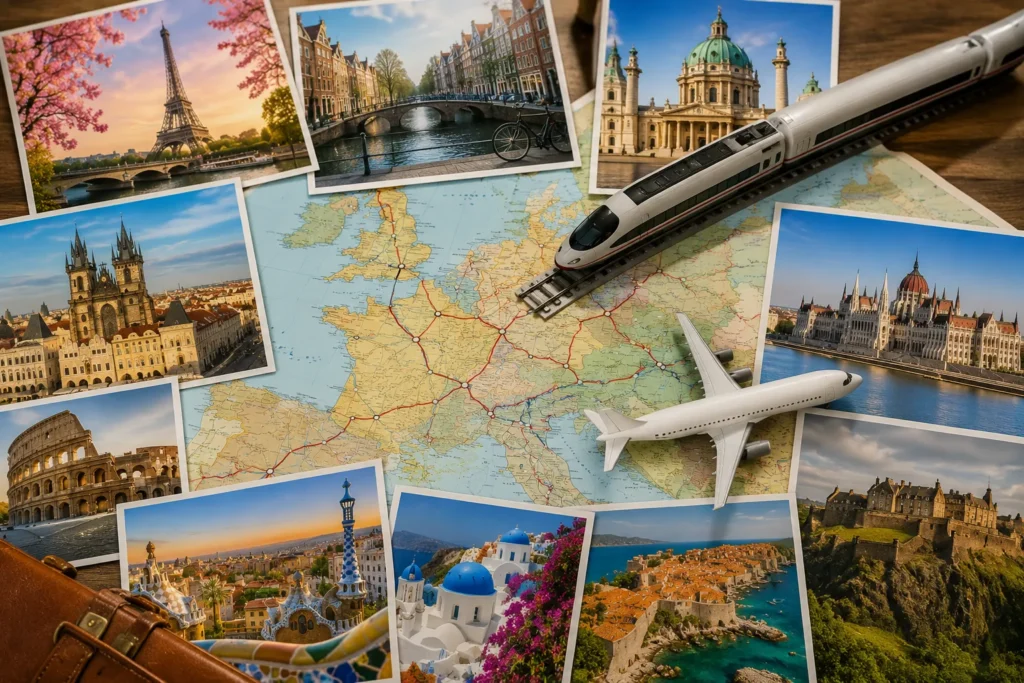
To link Paris, Amsterdam, Vienna, Prague, and Budapest into a single route, use the European rail network rather than booking separate flights for each leg. Paris to Amsterdam takes about 3 hours 20 minutes by direct train. Vienna to Prague runs 4 hours, and Prague to Budapest takes roughly 6.5 hours, both on direct connections. Rome and Barcelona work better as separate add-on trips since they sit far from the central European rail corridor; budget a short flight (under 2 hours) for either one. Santorini, Dubrovnik, and Edinburgh also need a flight to reach from the mainland cluster, so build at least one travel day into the itinerary for each.
FAQs
Do US, UK, and Australian citizens need a visa for the 9 Schengen cities on this list?
No, not currently. Travelers from all three countries can enter visa-free for stays under 90 days, though they’ll need the low-cost ETIAS authorization once it becomes mandatory around April 2027.
Do EU citizens need anything to visit Edinburgh?
Yes. EU citizens need an approved UK Electronic Travel Authorisation, a requirement that became mandatory on February 25, 2026, since the UK sits outside the Schengen Area.
Which city on this list costs the least per day?
Budapest costs the least, at €45 to €65 per day, followed closely by Prague at €50 to €70 per day.
What is the best month to visit most of these cities?
September works best across nearly all 10 destinations, since summer crowds thin out while the weather stays warm enough for walking tours.
How many days does a full trip covering all 10 cities take?
A realistic trip covering all 10 cities takes 25 to 30 days, accounting for train travel between central European cities and short flights to Santorini, Dubrovnik, and Edinburgh.
Conclusion
These 10 tourist destinations cover 9 Schengen cities plus Edinburgh, spanning capital landmarks, one Greek island, and one walled Adriatic town. Paris and Rome suit first-time visitors chasing concentrated, world-famous sights. Prague and Budapest suit budget travelers, with daily costs well below the rest of this list. Santorini and Dubrovnik suit travelers prioritizing coastal views over low prices. Whichever combination you pick, plan around the 2026 entry rules first: ETIAS affects every Schengen city once it launches in Q4 2026, and the UK ETA already applies to Edinburgh. Book Santorini, Dubrovnik, and Edinburgh several months ahead of summer travel, and connect the central European cities by train rather than flight wherever the route allows it.