
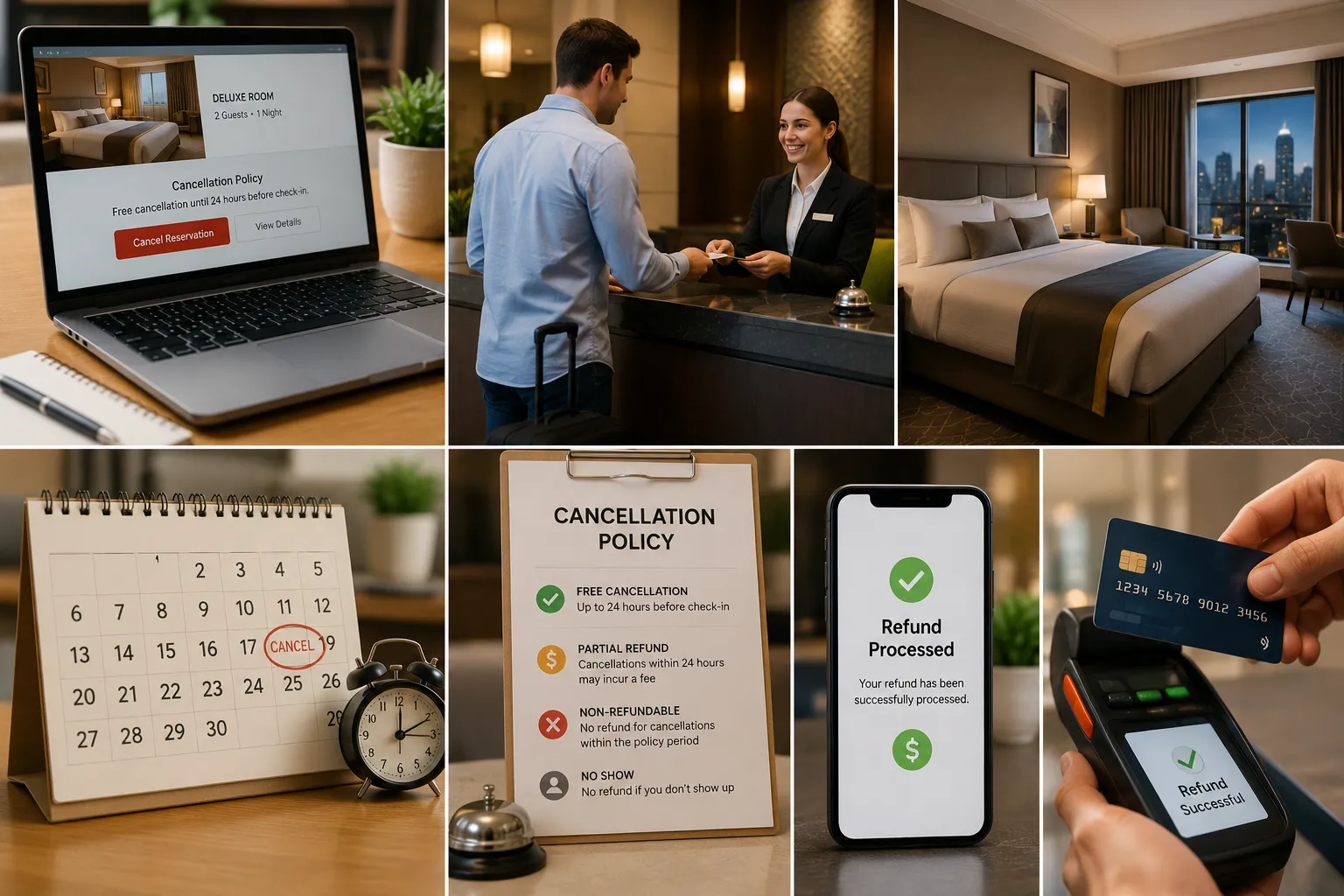
A hotel cancellation policy decides whether you get your money back or lose one night’s room rate the moment travel plans change. Around 20% of US hotel reservations get canceled before check-in, and the rules behind those cancellations changed in 2024 and 2025 through new federal and state laws. This guide covers both sides of the front desk: how guests can cancel a hotel stay without paying a fee, and how hotel owners and innkeepers can write a policy that protects room revenue without scaring bookers away.
What Is a Hotel Cancellation Policy?
A hotel cancellation policy is a set of written rules that states when a guest can cancel a reservation, what fee applies after the deadline, and how refunds are paid. The policy appears during booking, in the confirmation email, and on the hotel’s website — and the same structure applies across every accommodation type, from budget motels and roadside inns to boutique hotels, all-inclusive resorts, and vacation rentals.
Hotels manage these rules through their property management system (PMS), which flags a reservation as cancellable or non-cancellable the moment front-desk staff or a booking engine pulls it up.
Most US hotels, motels, and resorts build their policy around 3 core elements: a cancellation deadline (24, 48, or 72 hours before check-in), a penalty fee (usually one night’s room rate plus tax), and a refund method (credit back to the original payment card). A guest who cancels before the deadline pays nothing. A guest who cancels after the deadline, or never shows up, pays the penalty.
The policy is a legal agreement. You accept the terms when you click “Book Now,” which is why reading the fine print takes 30 seconds but can save $200 or more.
How Does a Hotel Cancellation Policy Work?
The policy works on a countdown: the closer you get to check-in, the harder it becomes to cancel for free. Here is the standard sequence for a US hotel booking in 2026:
- Booking confirmed — the front office holds your card as a guarantee, the same way it holds a card for incidentals at check-in, or charges a deposit.
- Free cancellation window — you can cancel at no cost, typically until 24–72 hours before arrival.
- Deadline passes — cancellation now triggers a fee, most often one night’s room and tax.
- Check-in day — canceling now equals a no-show in most systems, and the full first-night charge applies.
- Refund processed — approved refunds return to your card in 5–10 business days.
Third-party bookings follow different clocks. Expedia and Booking.com display the hotel’s own policy, but the refund passes through the platform first, which adds 3–7 extra days. Prepaid rates booked through an online travel agency (OTA) are often non-refundable from minute one, even when the same room booked directly comes with free cancellation.
7 Types of Hotel Cancellation Policies
Hotels pick from 7 common policy structures. Each one balances guest flexibility against revenue protection differently.

| Policy Type | Deadline | Penalty | Best For |
| Free cancellation | Up to 24–48 hrs before check-in | None | Business hotels, city properties |
| Standard (24-hour) | 24 hrs before check-in | One night + tax | Most US chain hotels |
| Moderate (48–72 hour) | 2–3 days before check-in | One night + tax | Resorts, weekend-heavy properties |
| Strict / 7-day | 7+ days before check-in | 1–2 nights or 50% of stay | Luxury resorts, Ritz-Carlton-tier brands |
| Non-refundable | No cancellation allowed | 100% of booking | Discounted prepaid rates (10–20% cheaper) |
| Group booking | 30–90 days before arrival | Sliding scale (25–100%) | Weddings, conferences, 10+ rooms |
| Force majeure | Case-by-case | Waived | Hurricanes, federal travel bans, declared emergencies |
Non-refundable rates deserve a warning. The 15% discount looks attractive at booking, but 1 in 5 travelers ends up changing plans. Pay the flexible rate if your dates carry any uncertainty, such as work schedules, health issues, or connecting flights.
Hotel Cancellation Policies of Major US Chains in 2026
Brand policies vary by property, rate type, and city, but these are the default windows US travelers see in 2026:
| Hotel Chain | Standard Cancellation Window | No-Show Penalty |
| Marriott (incl. Bonvoy brands) | 48–72 hrs before check-in | One night + tax |
| Hilton (incl. Hilton Honors brands) | 48 hrs; 72 hrs in some resort markets | One night + tax |
| Hyatt | 48 hrs at most properties | One night + tax |
| IHG (Holiday Inn, InterContinental) | 24–48 hrs, varies by property | One night + tax |
| Wyndham | 24–48 hrs, property-set | One night + tax |
| Choice Hotels | 24 hrs at most locations | One night + tax |
Always check the exact policy on your confirmation email rather than the brand’s general page. A Marriott in downtown Chicago and a Marriott resort in Maui can run completely different windows during peak dates, including 7-day cutoffs for holiday weeks like Christmas and July 4th.
These windows sit inside each brand’s broader loyalty program and brand standards manual, alongside blackout dates, elite-tier benefits, and property-level rate plans — general managers can tighten the window during high-occupancy periods but cannot loosen it below brand minimums.
US Hotel Cancellation Laws in 2026 (What They Mean at the Front Desk)
Two laws changed the cancellation game for American travelers, and most hotel blogs still ignore both.
California SB 644 requires hotels and third-party booking sites to give a full refund when a guest cancels within 24 hours of booking, as long as the reservation was made at least 72 hours before check-in. The law took effect July 1, 2024, and applies to every hotel and short-term rental in California. Book a Los Angeles hotel on Monday for a Friday arrival, change your mind Monday night, and the hotel must refund you 100% — even on a “non-refundable” rate.
The FTC’s Rule on Unfair or Deceptive Fees (the “junk fees rule”) took effect May 12, 2025. Hotels nationwide must now show the total price — including resort fees, destination fees, and service charges — upfront in advertised pricing. Hidden fees revealed at checkout violate federal law, which matters for cancellations because penalty amounts must now be calculated on transparent, disclosed totals.
Other states are following California’s lead, so check your state’s consumer protection rules before assuming a non-refundable booking is final. If a hotel refuses a refund that state law guarantees, file a complaint with your state attorney general’s office.
Front-desk staff and reservations teams are the ones enforcing both rules in practice — a guest citing SB 644 or the junk fees rule at check-in is testing whether hotel policy, not just state law, has been updated to match.
How to Avoid Hotel Cancellation Fees
You can avoid most cancellation fees by acting before the deadline, but 6 tactics work even after it passes:
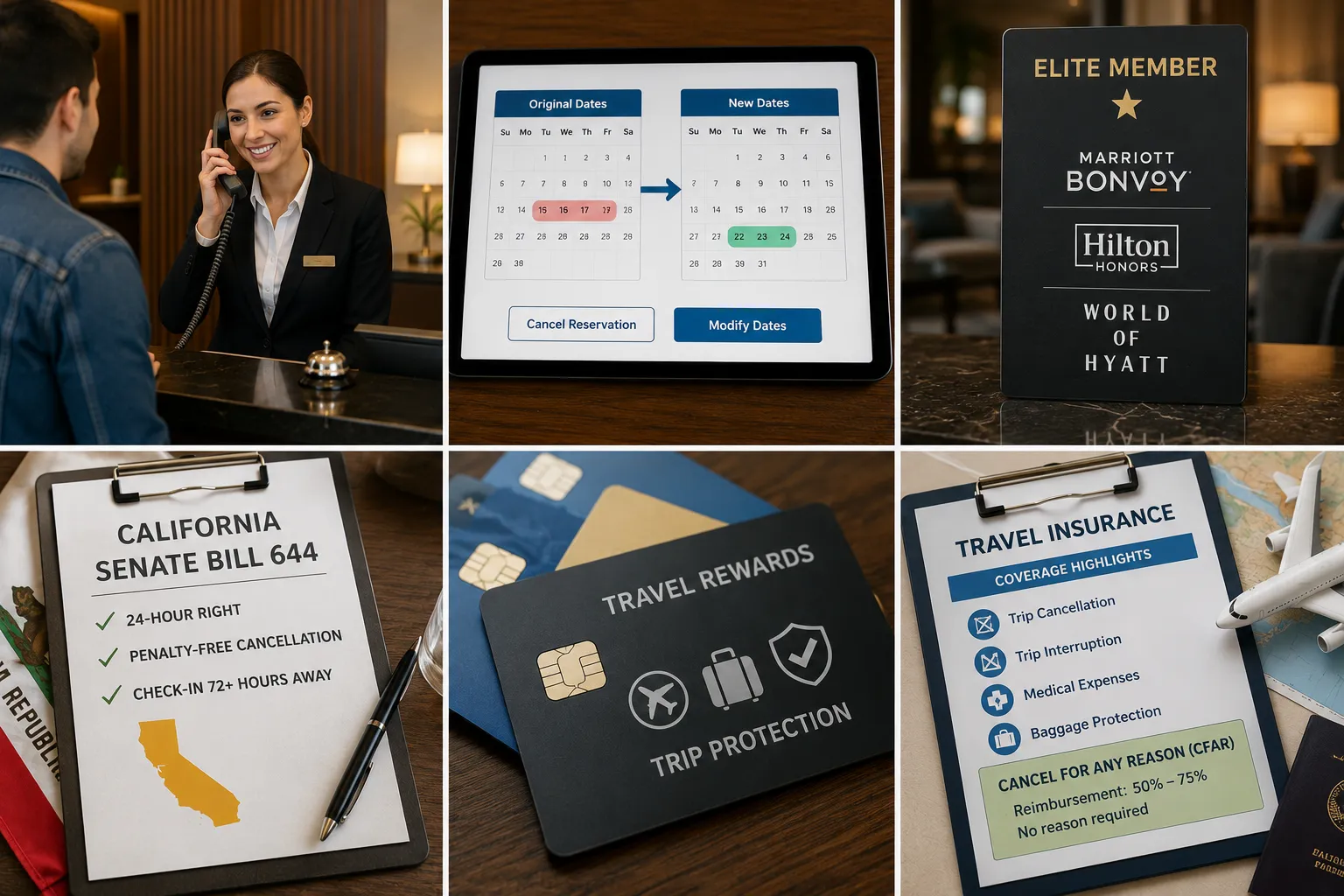
- Call the hotel directly, not the 800 number. Front-desk managers waive fees for polite guests with real reasons, such as illness, flight cancellations, or family emergencies. Success rate drops to near zero through corporate call centers.
- Ask to move the dates instead of canceling. Hotels count a date change as a modification, not a cancellation, so the fee usually disappears. You can cancel the new booking later if it falls inside a free window.
- Use elite status. Marriott Bonvoy, Hilton Honors, and World of Hyatt members at mid-tier status and above get fee waivers as an unpublished courtesy at many properties. Front-desk agents can see elite tier status on the reservation screen before a guest checks in, which is why phrasing the request as a loyalty-member courtesy works better than citing the cancellation policy itself.
- Claim your 24-hour right in California. SB 644 makes the first 24 hours after booking penalty-free when check-in is 72+ hours away.
- Check your credit card’s trip protection. Many travel rewards credit cards reimburse non-refundable hotel costs when covered reasons apply, such as illness or severe weather — check your card’s benefits guide rather than assuming coverage.
- Buy Cancel For Any Reason (CFAR) insurance for expensive stays. CFAR add-ons cost 40–50% more than standard travel insurance but refund 50–75% of prepaid costs with no excuse required.
One tactic to skip: booking a refundable rate you never intend to use just to “hold” a room. Hotels track repeat cancellers, and some now require deposits from accounts with 3+ cancellations in 12 months.
How Long Do Hotel Refunds Take?
Hotel refunds take 5–10 business days to reach your credit card after the hotel approves the cancellation. Debit card refunds run slower at 7–14 business days because banks process them as standard ACH returns rather than card reversals.
The clock has 3 stages: the hotel releases the charge (1–2 days), the card network processes the reversal (2–5 days), and your bank posts it (1–3 days). The hotel’s accounting department releases the charge on its end before the card network processes anything, so a guest services team can usually tell you the release date even before the refund posts. OTA bookings add a middle step — Expedia or Booking.com receives the money first, then forwards it — which stretches the total to 10–15 business days.
No refund after 15 business days? Contact the hotel with your cancellation confirmation number. Still nothing after 30 days? File a chargeback with your card issuer, attach the confirmation email, and let the bank recover the money. US cardholders win the majority of documented hotel chargebacks.
How to Write a Hotel Cancellation Policy (For Hotel Owners)
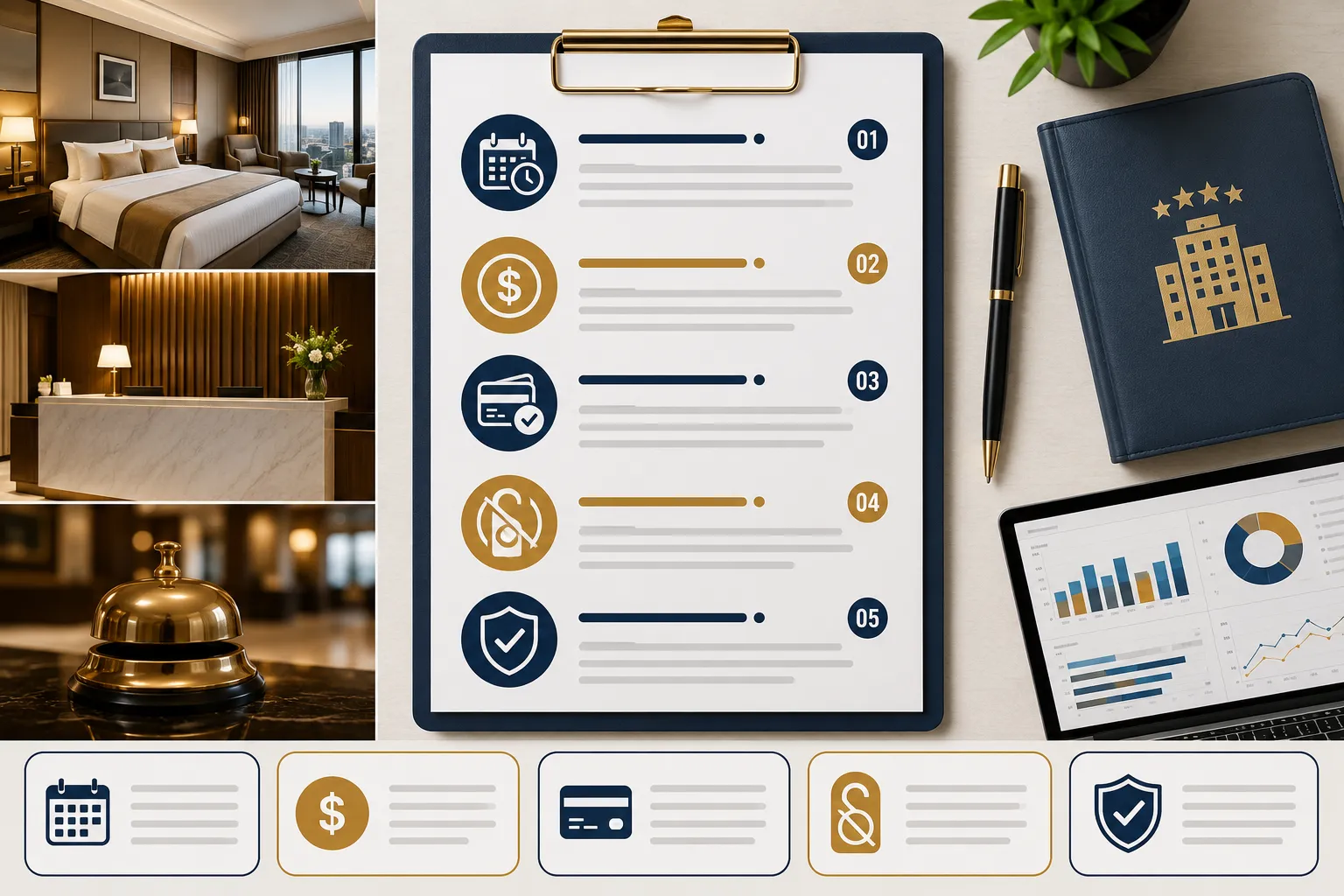
To write a hotel cancellation policy, define 5 elements: the deadline, the fee, the refund method, the no-show rule, and the exceptions. Vague policies create disputes; specific policies prevent them.
Revenue managers set these deadlines using occupancy forecasts and average daily rate (ADR) data — a property running high occupancy for a date range will tighten the window; a property with soft demand will loosen it to protect direct bookings against the channel manager’s OTA feed.
Cover these 5 elements in plain language:
- Deadline — state an exact cutoff: “Cancel by 4:00 PM local hotel time, 48 hours before arrival.”
- Fee — name the amount: “Late cancellations are charged one night’s room rate plus tax.”
- Refund method and timing — “Refunds return to the original payment card within 7 business days.”
- No-show rule — “Guests who do not arrive by 11:59 PM on check-in day are charged the first night, and remaining nights are released.”
- Exceptions — list what qualifies for a waiver, such as declared natural disasters or government travel restrictions.
Sample policy you can copy:
Reservations can be canceled free of charge until 4:00 PM local time, 48 hours before your arrival date. Cancellations after this deadline, and no-shows, are charged one night’s room rate plus tax. Refunds are issued to the original payment method within 7 business days. Bookings for December 20–January 2 require 7 days’ notice. Reservations canceled within 24 hours of booking receive a full refund when the arrival date is 72 or more hours away.
Small properties see 5–12% fewer abandoned bookings after switching from strict to 24-hour policies, because “Free cancellation” acts as a conversion trigger on OTA listings. Test a flexible policy for 90 days, measure direct booking volume against no-show losses, and adjust from the data rather than fear.
Conclusion
A hotel cancellation policy is money in plain sight — read it before booking and you keep that money, skip it and the hotel keeps it. The 2026 rules favor prepared travelers: California’s SB 644 gives you a 24-hour escape hatch, the FTC’s junk fees rule forces honest pricing, and every major US chain still waives fees when you cancel before the 24–72 hour deadline. Choose flexible rates for uncertain dates, call the front desk before accepting any fee, and expect refunds within 5–10 business days.
Hotel owners face the same equation from the other side. A clear policy with 5 defined elements — deadline, fee, refund method, no-show rule, and exceptions — cuts disputes, protects revenue, and converts hesitant bookers who search for “free cancellation” before anything else. For the hospitality industry, the cancellation policy sits next to rate plans and loyalty benefits as one of the top three factors booking engines report guests check before confirming a reservation. The properties winning in 2026 treat their cancellation policy as a marketing tool, not fine print.