
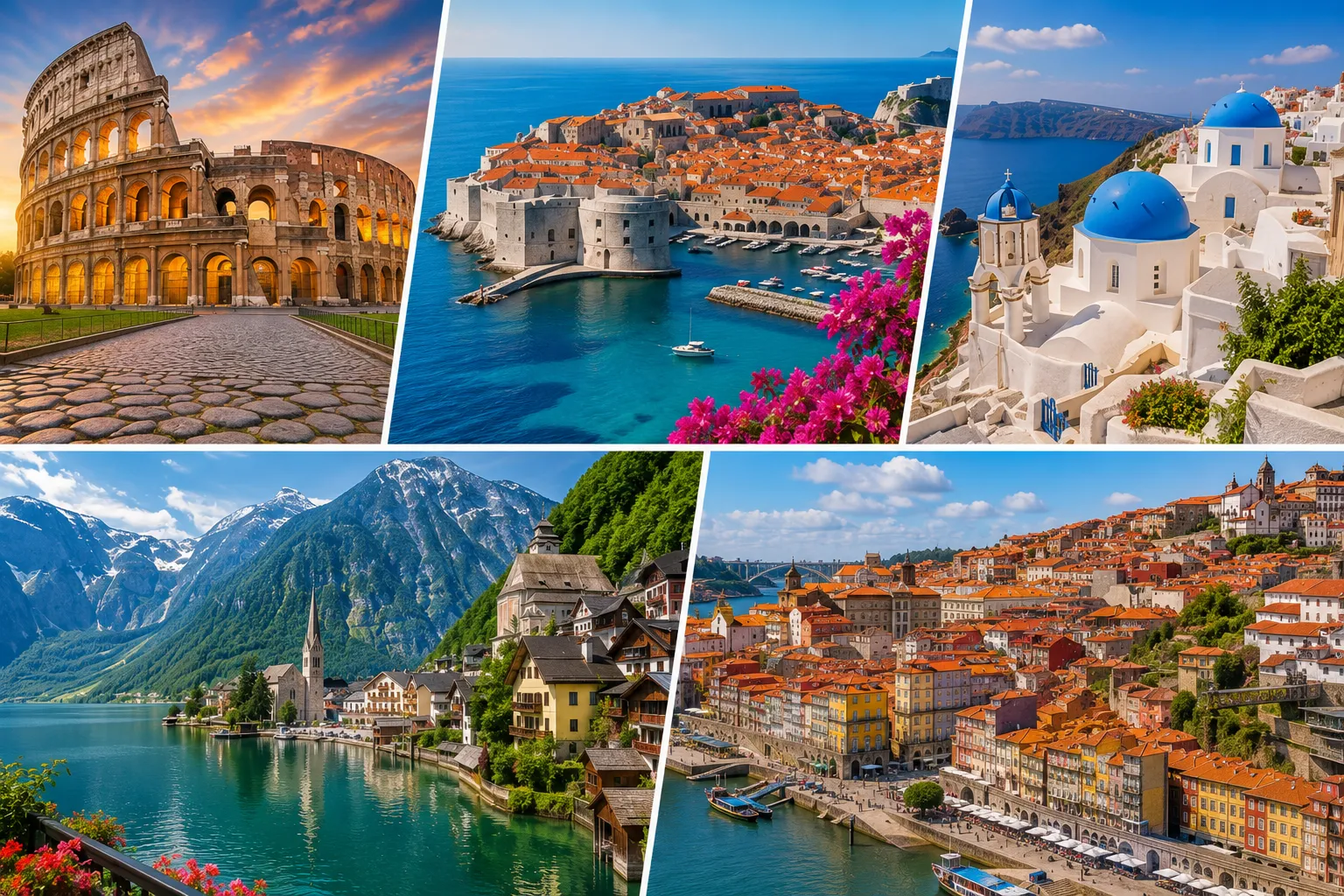
Italy, Croatia, Greece, Switzerland, and Portugal are the top 5 countries to visit in Europe in 2026. Each one solves a different travel problem. Italy delivers art, food, and easy first-trip logistics. Croatia delivers Adriatic coastline at the lowest daily cost on this list. Greece delivers island-hopping layered on top of ancient history. Switzerland delivers mountain scenery and a train network that reaches almost every village. Portugal delivers warm coastal weather and the shortest flight time from the US East Coast.
This list comes from three filters: tourism award recognition in 2025 and 2026, direct or one-stop flight access from New York, London, and Sydney, and a realistic spread of daily budgets from backpacker to luxury. Every cost below uses June 2026 exchange rates and shifts with the market.
Quick Comparison
| Country | Best For | Ideal Trip Length | Daily Budget (EUR / USD) | Best Months |
| Italy | First-time visitors, art, food | 7–10 days | €160 / $186 | Apr–Jun, Sep–Oct |
| Croatia | Budget travel, coastline | 5–7 days | €95 / $110 | May–Jun, Sep |
| Greece | Islands, ancient history | 7–10 days | €120 / $139 | May–Jun, Sep–Oct |
| Switzerland | Mountains, scenic trains | 5–7 days | €250 / $290 | Jun–Sep (hiking), Dec–Mar (skiing) |
| Portugal | Value, coastal weather | 5–7 days | €100 / $116 | Mar–May, Sep–Oct |
1. Italy: Best for First-Time Visitors
Italy placed seven destinations in the top 20 of the 2026 European Best Destinations city rankings, more than any other country. Rome holds the Colosseum and St. Peter’s Basilica. Florence holds Renaissance artwork, including Michelangelo’s David. Venice runs on 150 canals instead of roads, and in 2026 the city charges day-trippers an access fee of €5 ($6 USD, £4.30 GBP) when booked four days ahead, rising to €10 ($12 USD, £8.70 GBP) for late bookings, on 60 selected dates between April 3 and July 26.
Visit between April and June or September and October, when temperatures stay between 18°C and 25°C (64°F and 77°F) and summer crowds thin out. Plan 7 to 10 days to cover Rome, Florence, and one coastal stop such as the Amalfi Coast, which runs 50 kilometers (31 miles) along cliffs above the Tyrrhenian Sea. A mid-range traveler spends around €160 a day ($186 USD, £138 GBP, AU$264) on hotels, meals, and local transport.
New York to Rome takes about 9 hours direct. London to Rome takes about 2 hours 40 minutes. Sydney to Rome takes around 22 hours with one stopover, since no direct flight exists yet.
2. Croatia: Best for Budget Travel
Croatia costs roughly 35% less per day than Italy or Greece, while spreading 1,244 islands along the Adriatic coast. European Best Destinations named Croatia the top country to visit in 2025, based on votes from more than one million travelers across 158 countries. Dubrovnik’s medieval city walls draw photographers from every direction. Split holds Diocletian’s Palace, built over 1,700 years ago and still occupied by shops and homes today. Plitvice Lakes National Park connects 16 turquoise lakes with waterfalls and wooden walkways.
Visit in May, June, or September, when sea temperatures reach 22°C to 24°C (72°F to 75°F) without the July and August crowds that push hotel prices up by 40% or more. Plan 5 to 7 days to cover Dubrovnik, Split, and one island, such as Hvar. A mid-range traveler spends around €95 a day ($110 USD, £82 GBP, AU$157) on accommodation, meals, and inter-island ferries.
New York to Croatia takes about 10 hours with one connection. London to Dubrovnik or Zagreb takes about 2 hours 45 minutes direct in summer. Sydney to Croatia takes 24 hours or more with two stops.
3. Greece: Best for Islands and Ancient History
Greece holds the Acropolis, Delphi, and the Palace of Knossos within a single country, more open archaeological sites than anywhere else in Europe. Athens anchors the mainland with over 2,500 years of continuous history. Santorini draws visitors with white-washed buildings and blue-domed churches above the Aegean Sea, while Mykonos pairs sandy beaches with 16th-century windmills. Crete, the largest Greek island at 8,336 square kilometers (3,219 square miles), holds beaches, mountains, and Minoan ruins in one stop.
Visit in May, June, or late September through October, when island temperatures stay between 24°C and 28°C (75°F and 82°F), since mainland highs often climb past 33°C (91°F) in July and August. Plan 7 to 10 days to combine Athens with two islands. A mid-range traveler spends around €120 a day ($139 USD, £104 GBP, AU$198) on hotels, ferries, and meals.
New York to Athens takes about 10 hours direct. London to Athens takes about 3 hours 40 minutes. Sydney to Athens takes around 21 hours with one stopover.
4. Switzerland: Best for Mountains and Train Travel
Switzerland fits 48 peaks above 4,000 meters (13,123 feet) into 41,285 square kilometers (15,940 square miles) of land. The Jungfraujoch station sits at 3,454 meters (11,332 feet), the highest railway station in Europe. Zermatt offers direct views of the Matterhorn without a car, since the village bans combustion-engine vehicles. Lake Geneva and Lake Lucerne both allow swimming in summer despite their cold alpine source water.
Visit between June and September for hiking, when valley temperatures reach 20°C to 26°C (68°F to 79°F) and mountain passes stay clear of snow. Visit between December and March for skiing instead, since resorts such as Zermatt and St. Moritz hold reliable snow above 1,800 meters (5,905 feet). Plan 5 to 7 days to cover two regions, such as Lucerne and Interlaken. A mid-range traveler spends around €250 a day ($290 USD, £215 GBP, AU$413) on hotels, trains, and meals, the highest daily cost on this list.
New York to Zurich takes about 8 hours direct. London to Zurich takes about 1 hour 50 minutes. Sydney to Zurich takes around 21 hours with one stopover.
5. Portugal: Best for Value and Coastal Weather
Portugal won Best Destination in Europe at the 2025 World Travel Awards, plus separate titles for the Algarve, Porto, and Lisbon. Lisbon’s hills hold colorful tiled buildings and a tram network that has run since 1901. Porto produces port wine along the Douro River and charges roughly half of Lisbon’s hotel rates. The Algarve region holds 150 kilometers (93 miles) of coastline with cliffs, caves, and beaches swimmable from May through October.
Visit in March, April, May, September, or October, when coastal temperatures stay between 18°C and 24°C (64°F and 75°F), avoiding July and August highs near 30°C (86°F) inland. Plan 5 to 7 days to cover Lisbon, a day trip to Sintra, and either Porto or the Algarve. A mid-range traveler spends around €100 a day ($116 USD, £86 GBP, AU$165) on hotels, meals, and trains, tying with Croatia for the cheapest country on this list.
New York to Lisbon takes about 7 hours direct, the shortest US connection of all five countries. London to Lisbon takes about 2 hours 40 minutes. Sydney to Lisbon takes 24 hours or more with two stops.
Tickets to Book Before You Go
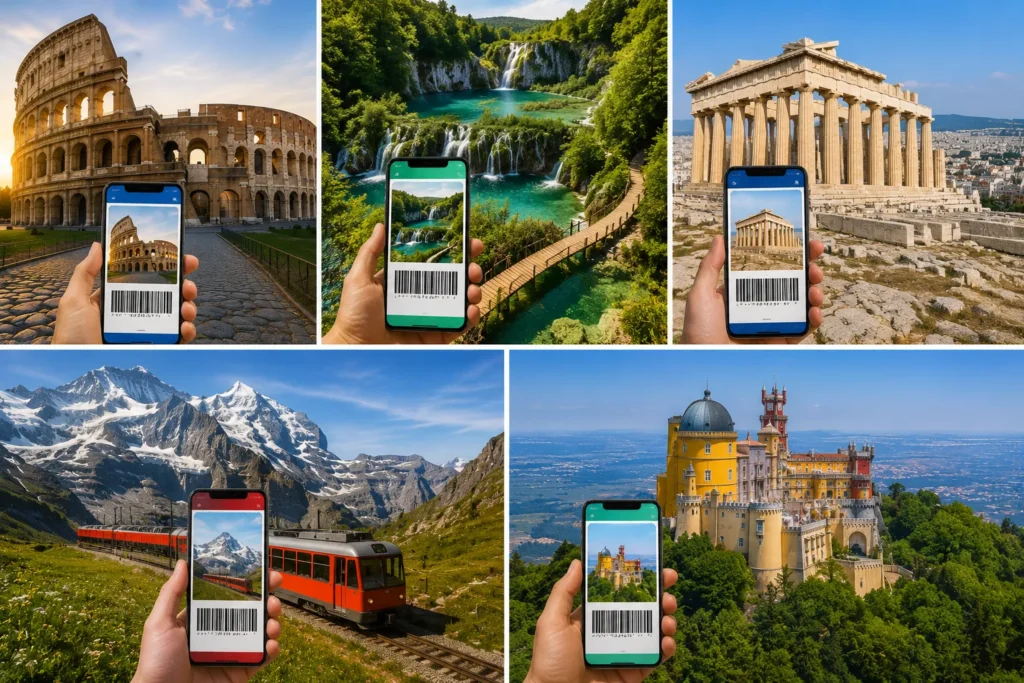
Book Colosseum and Vatican Museums tickets in Rome at least 30 days ahead, since same-day slots in Italy often sell out by 9 a.m. in peak season.
Book Plitvice Lakes National Park entry online for Croatia, since walk-up prices run higher and summer time slots fill by midday.
Book Acropolis tickets for a fixed entry-time slot in Greece, since Athens limits daily visitor numbers and popular slots disappear first.
Book Jungfraujoch train tickets for Switzerland at least a week ahead in July and August, since allocations run limited on clear-weather days.
Book Sintra palace tickets for Portugal before a 9 a.m. arrival, since day-trippers from Lisbon push wait times past 90 minutes by midday.
Where to Stay in Each Country
Stay in Trastevere or Monti in Rome, Italy, for cobblestone streets within walking distance of major sights and lower rates than hotels near the Colosseum. Stay in Dubrovnik’s Old Town, Croatia, for sea views and short walks to the city walls, or choose Lapad for lower prices and a 15-minute bus ride into the center. Stay in Plaka, Athens, Greece, for Acropolis views from rooftop bars and easy access to the metro. Stay in Lucerne or Interlaken, Switzerland, for lake views and direct train connections to mountain excursions. Stay in Alfama or Chiado in Lisbon, Portugal, for tram access to the center and short walks to the best viewpoints.
Getting Around Each Country
Italy runs on high-speed Trenitalia and Italo trains, which connect Rome, Florence, and Venice in under 3 hours per leg, so renting a car rarely helps inside the country. Croatia mixes coastal driving with high-speed catamaran ferries between Split, Dubrovnik, and the islands, since no rail line reaches the Dalmatian coast. Greece depends on ferries from the port of Piraeus near Athens to reach the islands, with domestic flights cutting travel time for trips beyond 2 islands. Switzerland’s SBB rail network reaches almost every town, and a Swiss Travel Pass covers trains, buses, and boats on one ticket. Portugal connects Lisbon and Porto by CP train in about 3 hours, while a rental car works best for exploring the Algarve’s smaller coastal towns.
Visa Requirements for US, UK, and Australian Travelers
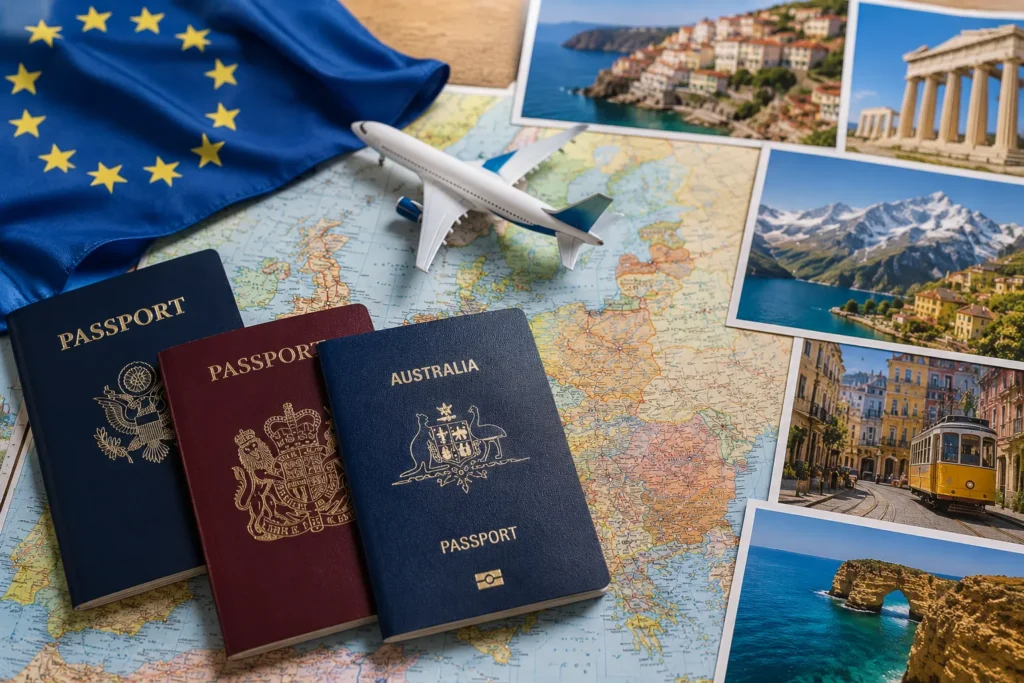
US, UK, and Australian passport holders can enter Italy, Croatia, Greece, Switzerland, and Portugal without a visa for stays up to 90 days within any 180-day period. This rule comes from the Schengen Area agreement, which removes passport checks between member countries and counts short-stay days the same way no matter which Schengen country you enter first. A passport must stay valid for at least three months past the planned departure date and must have been issued within the last 10 years.
Travelers who want to stay longer than 90 days, work, or study need a long-stay visa from the embassy of the specific country, applied for before departure. A standard 1- to 3-week trip across these five countries needs nothing beyond a valid passport today, though that changes slightly once ETIAS launches later in 2026.
New 2026 Entry Rule: ETIAS for US, UK, and Australian Travelers
Starting in the fourth quarter of 2026, travelers from the United States, United Kingdom, Australia, and Canada need an ETIAS (European Travel Information and Authorisation System) before entering any of these five countries. ETIAS is not a visa. It works as an online pre-travel screening, similar to the US ESTA (Electronic System for Travel Authorization) or Canada’s eTA (Electronic Travel Authorization).
The application takes about 10 minutes online, costs €7 ($8 USD, £6 GBP, AU$12), and stays valid for three years or until the passport expires, whichever comes first. Enforcement stays flexible for the first six months after launch, then becomes mandatory around April 2027. Renew any passport expiring before late 2027, since ETIAS requires at least three months of validity beyond the planned departure date.
No official application portal exists yet as of mid-2026. Any website charging more than €7 for ETIAS is not official.
How to Choose Between These 5 Countries
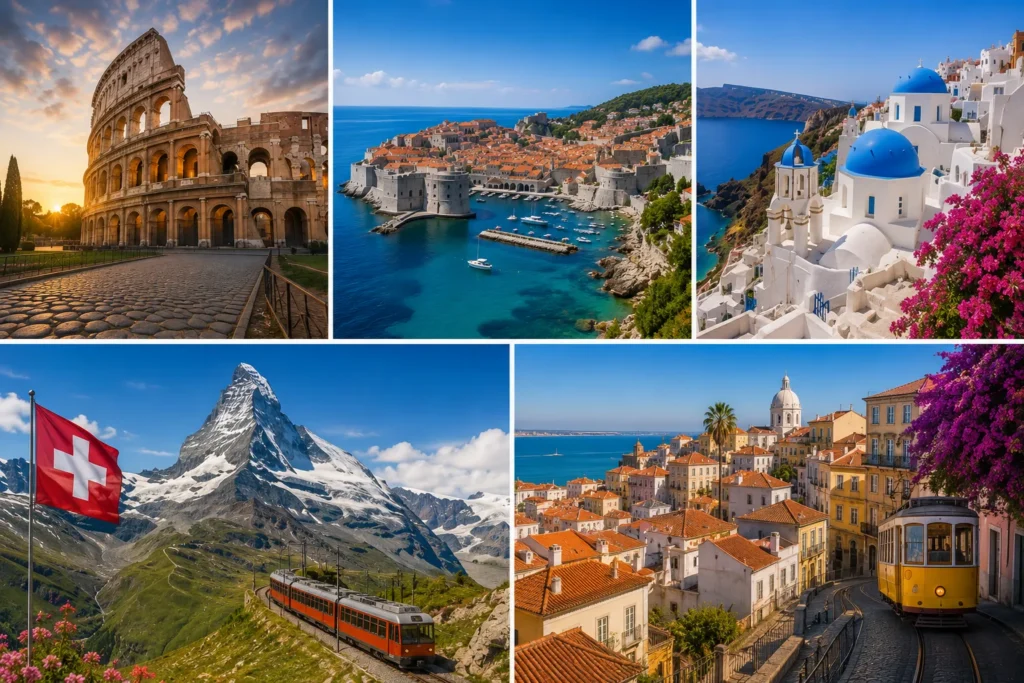
Pick Italy if you want art, food, and well-known landmarks on a first trip to Europe. Pick Croatia if you want Mediterranean beaches at the lowest cost on this list. Pick Greece if you want island-hopping combined with ancient ruins. Pick Switzerland if you want mountain views and don’t mind paying the highest prices here. Pick Portugal if you want warm coastal weather and the shortest flight from the US East Coast.
Frequently Asked Questions
Is Croatia cheaper than Italy for a European vacation?
Yes. Croatia costs around €95 ($110 USD) a day for a mid-range traveler, compared to Italy’s €160 ($186 USD), a difference of roughly 40%.
Which of these 5 countries works best for a first trip to Europe?
Italy works best for first-time visitors, since it combines globally recognized landmarks, direct flights from New York and London, and a reliable train network between cities.
Do US, UK, and Australian citizens need a visa for these 5 countries?
No visa is required for stays under 90 days, but starting in the fourth quarter of 2026, an ETIAS authorization replaces the old visa-free entry process. The online application costs €7 ($8 USD) and takes about 10 minutes.
What is the best month to visit all 5 countries without summer crowds?
May and September suit all five countries, since daytime temperatures stay between 18°C and 26°C (64°F and 79°F) in each location and peak-season prices haven’t started or have already dropped.
Which country on this list costs the most per day?
Switzerland costs the most, at around €250 ($290 USD) a day for a mid-range traveler, more than double Croatia’s daily average.
Conclusion
Italy, Croatia, Greece, Switzerland, and Portugal each solve a different travel priority, so the right pick depends on budget and interest, not popularity. Italy and Greece reward travelers who want history and culture packed into 7 to 10 days. Croatia and Portugal protect a tighter budget without cutting scenery or food quality. Switzerland charges the highest price on this list but delivers mountain access no other country here can match. The new ETIAS rule adds one extra step for US, UK, and Australian travelers starting in late 2026, but it costs €7 and takes 10 minutes, far less hassle than a traditional visa application. Choose one country for 2026, build the trip around its best months, and save the rest of this list for next year.