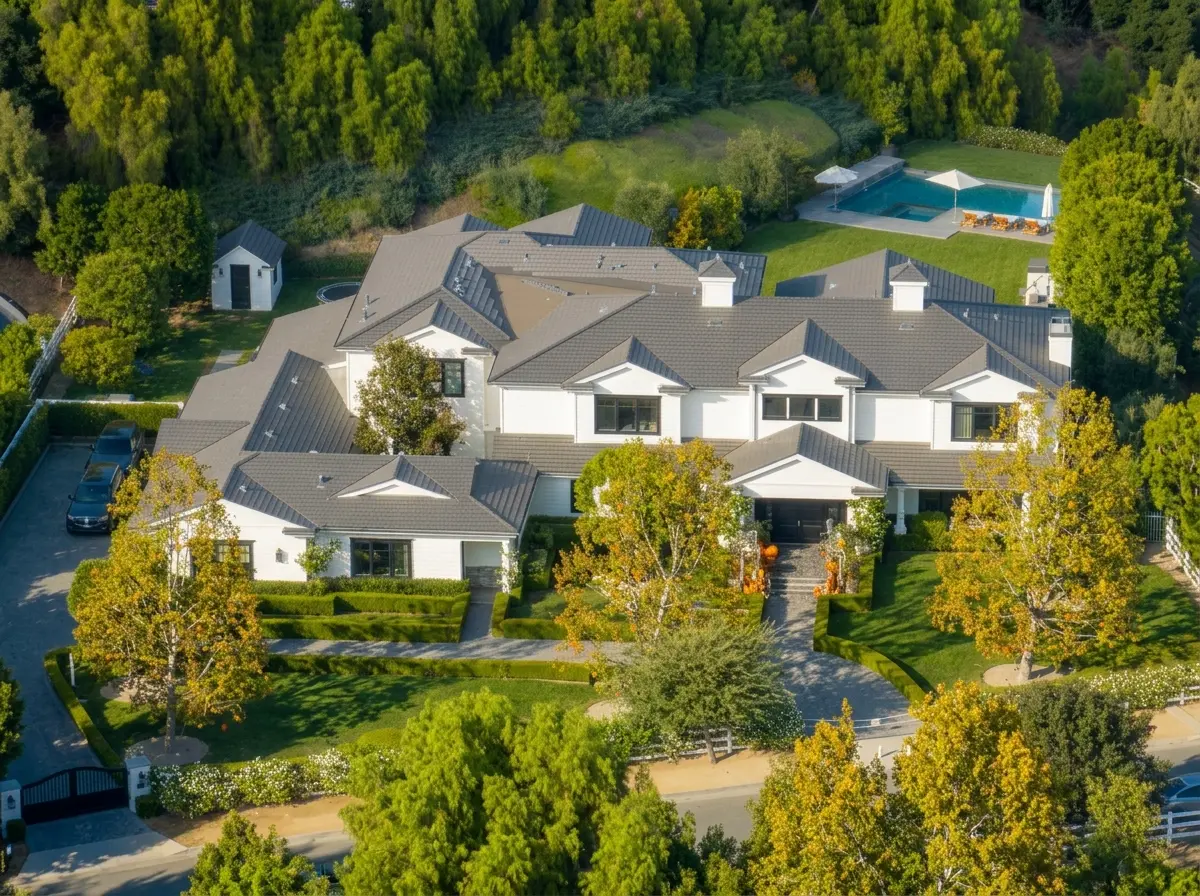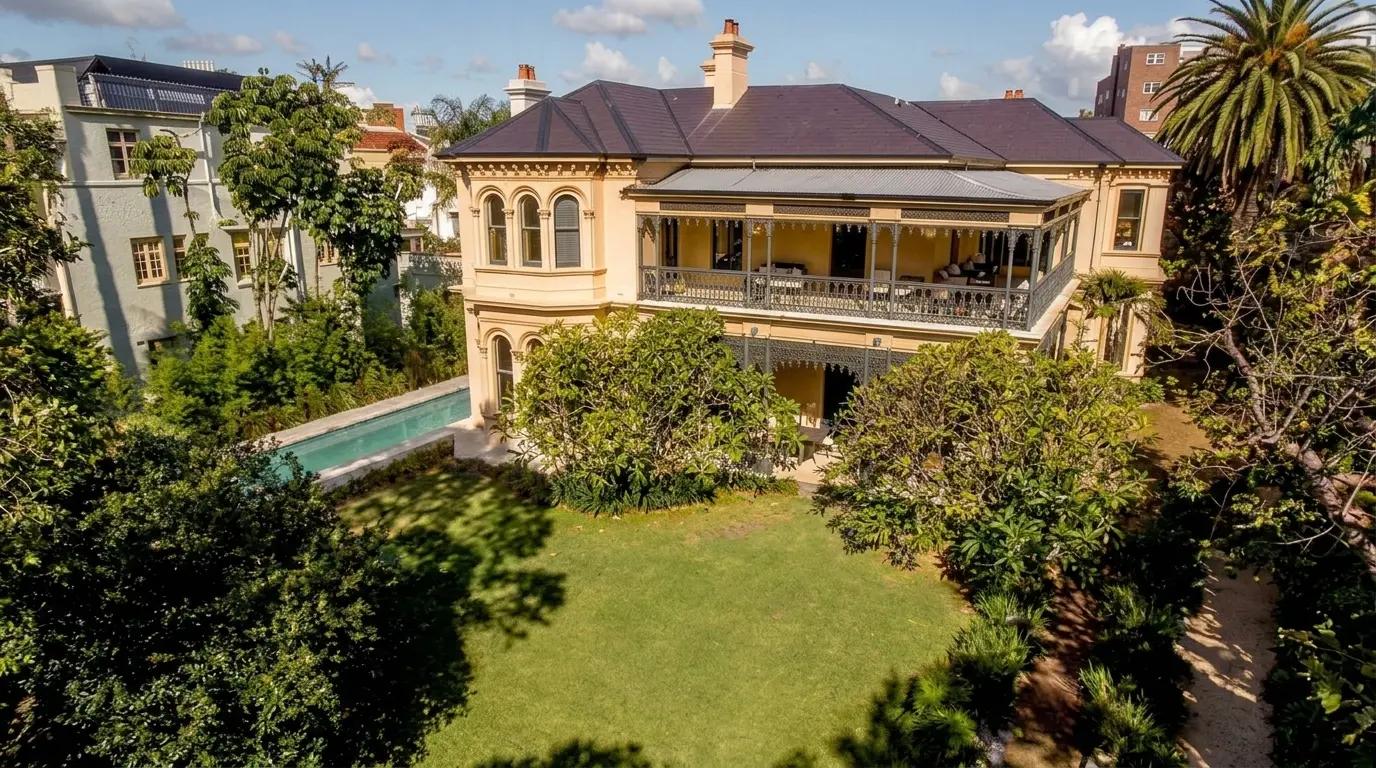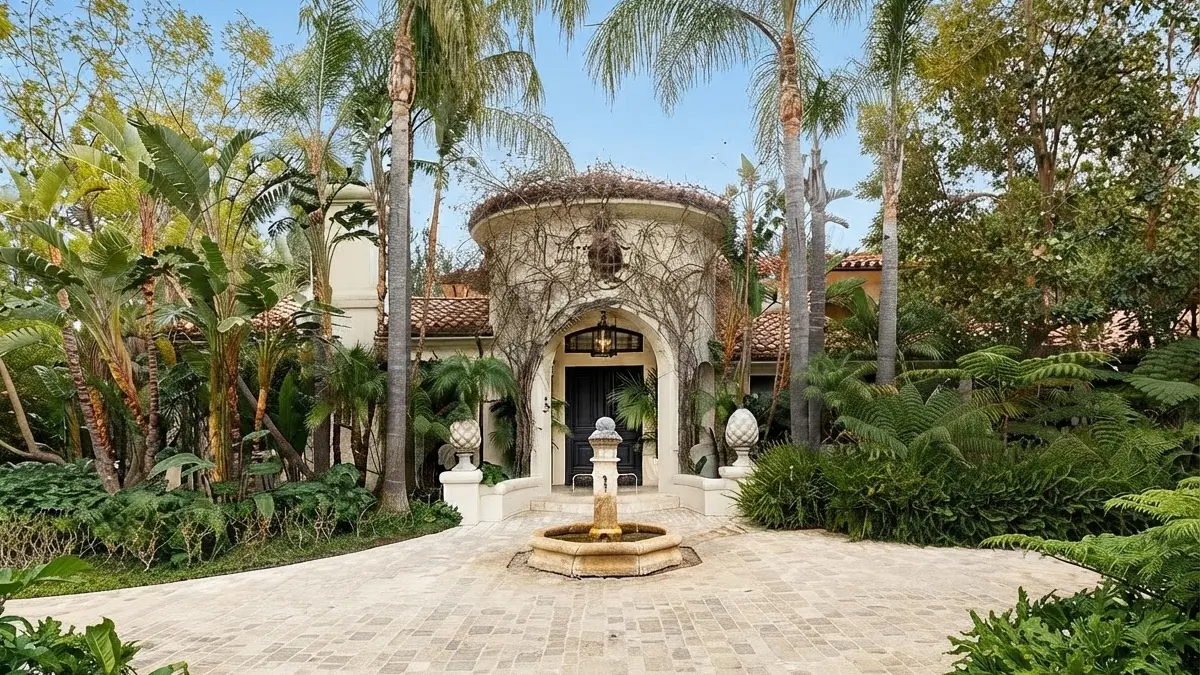

A penthouse is a top-floor apartment in a residential building. Penthouses sit above all other units, feature a setback layout that creates private outdoor space, and include finishes and amenities that standard units do not have. In most buildings, only 1 or 2 penthouse units exist — this scarcity drives their price premium of 10–20% above comparable lower-floor units.
Not every marketed penthouse sits on the very top floor. Developers apply the label to upper-floor units that share the same premium finishes, private outdoor access, and larger floor plans — even if one floor below the roof.
Penthouse ownership in the US falls into 3 legal structures:
- Condo: You own the unit and a share of common areas. Title deed transfers to your name. Easiest structure to finance and most accessible to foreign buyers.
- Co-op: You own shares in a building corporation, not the physical unit. No title deed on the unit itself. Requires co-op board approval, financial disclosure, and in-person board interviews.
- Freehold: You own both the unit and the land under the building outright. Rare in high-rises but more common in standalone luxury buildings and smaller boutique developments.
Condo vs Co-op vs Freehold: Which One Can You Actually Own?
The ownership structure changes your financing options, tax liability, resale rights, and how much control you have over the property. Here is how all 3 compare:
| Factor | Condo | Co-op | Freehold |
| What You Own | Unit + share of common areas | Shares in building corporation | Unit + land outright |
| Title Deed | Yes | No (share certificate) | Yes |
| Board Approval | No | Yes — interview + financials | No |
| Foreign Buyers | Allowed | Often rejected | Allowed |
| Financing | Standard + jumbo mortgage | Co-op loan (harder to get) | Standard + jumbo mortgage |
| HOA/Maintenance Fees | $1,500–$10,000+/month | Monthly maintenance charge | Low or none |
| Resale Flexibility | High | Low — board must approve buyer | High |
| Best For | Investors, foreign buyers | Long-term NYC residents | Standalone luxury buyers |
Co-ops represent roughly 70% of NYC’s private residential housing stock. Outside New York City, condos dominate the luxury penthouse market in cities like Miami, Los Angeles, Chicago, and Las Vegas.
How Much Does a Penthouse Cost in the US?
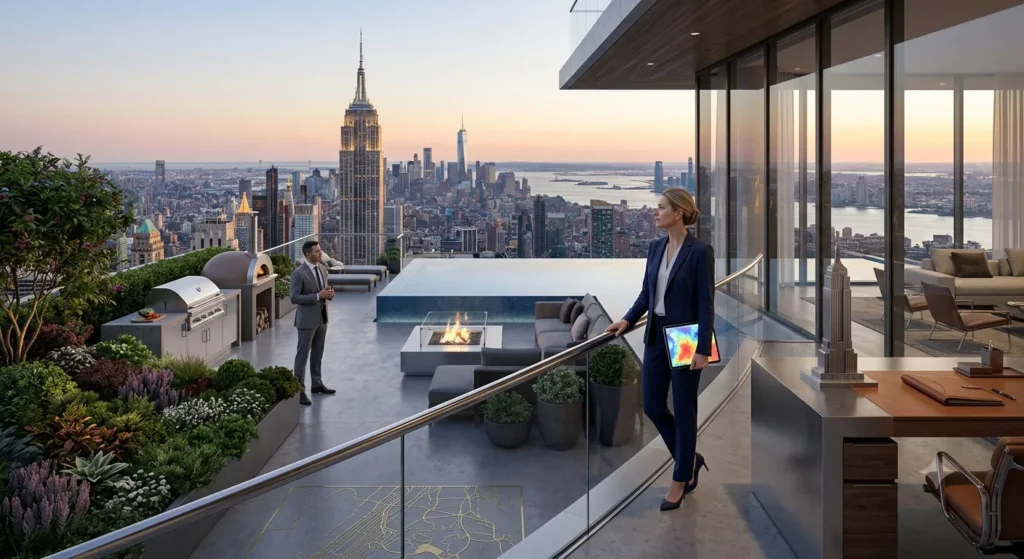
Penthouse prices vary widely by city, building age, floor height, square footage (sq ft / m²), and views. On average, penthouses sell for 10–20% above comparable units on lower floors in the same building. The table below shows entry-level and ultra-luxury price ranges in 6 major US markets for 2026:
| City | Entry-Level Price | Mid-Range | Ultra-Luxury |
| Manhattan, NYC | $2,000,000 | $5M–$30M | $30M–$100M+ |
| Miami / Miami Beach | $500,000 | $2M–$15M | $15M–$120M+ |
| Los Angeles | $1,000,000 | $3M–$20M | $20M–$50M+ |
| Chicago | $500,000 | $1.5M–$8M | $8M–$15M |
| Las Vegas | $300,000 | $800K–$5M | $5M–$15M |
| San Francisco | $1,500,000 | $4M–$15M | $15M–$30M+ |
3 factors move the price up faster than anything else:
- Floor height: Every 10 floors above street level typically adds 5–8% to the price in premium buildings.
- Private outdoor space: A rooftop terrace adds $500–$2,000+ per sq ft ($5,380–$21,528 per m²) to the property value in gateway cities.
- Unobstructed views: A guaranteed unobstructed panoramic view — verified through floor area ratio (FAR) zoning records — commands a 15–25% premium over units where future construction could block sightlines.
Penthouse HOA Fees Breakdown
HOA (Homeowners Association) fees for penthouses run significantly higher than standard units because fees scale with square footage. Below is a typical monthly HOA fee range across major US markets:
| City / Market | HOA Monthly Fee Range |
| Manhattan, NYC (luxury buildings) | $3,000 – $10,000+ |
| Miami (waterfront) | $2,000 – $8,000 |
| Los Angeles (West Hollywood / Century City) | $2,500 – $7,000 |
| Chicago (Gold Coast / River North) | $1,500 – $5,000 |
| Las Vegas (Strip-adjacent) | $800 – $3,000 |
HOA fees cover building staff, doorman service, amenity maintenance, facade upkeep, insurance on common areas, and shared utilities. Roof maintenance and private terrace landscaping are the penthouse owner’s personal responsibility.
What Are the Requirements to Buy a Penthouse?
Penthouse purchase prices almost always exceed the conforming loan limit of $766,550 (2024 figure for most US counties), which means standard mortgages do not apply. You need a jumbo mortgage — a loan above the conforming limit with stricter underwriting standards.
Here are the 5 financial requirements lenders enforce for penthouse jumbo loans:
- Credit score: 720 minimum. Most lenders prefer 740+ for ultra-luxury purchases above $5M.
- Down payment: 20–30% minimum. On a $3M penthouse, expect $600,000–$900,000 (approx. £473K–£709K) as a down payment.
- Debt-to-income (DTI) ratio: 43% maximum. Lenders calculate total monthly debt payments divided by gross monthly income.
- Cash reserves: 12–24 months of mortgage payments held in liquid assets after closing.
- Income documentation: 2 years of tax returns, W-2s or 1099s, and bank statements for the past 3–6 months.
Co-op Board Approval — Extra Requirements
Buying a co-op penthouse in NYC adds 3 additional hurdles that condo or freehold purchases do not require:
- Financial package: A detailed board package including tax returns, bank statements, reference letters (typically 2–4 personal and 2 professional), and a signed purchase application.
- Board interview: An in-person meeting with co-op board members. Boards ask about lifestyle, employment, financial plans, and intentions for the property. Duration is typically 30–60 minutes.
- Board vote: After the interview, the board votes to approve or reject. Rejection requires no explanation under New York law. Even wealthy buyers get rejected — co-op boards prioritize building culture and long-term residency over purchase price.
Step-by-Step Process to Buy a Penthouse
Buying a penthouse takes 60–120 days from offer to closing for a condo, and 90–180 days for a co-op due to the board approval process. Follow these 8 steps:
- Set your total budget: Include purchase price, closing costs (2–5% of purchase price), HOA fees, property taxes, insurance, and annual maintenance.
- Choose your ownership type: Decide between condo, co-op, or freehold based on your residency status, investment goals, and financing eligibility.
- Get pre-approved for a jumbo mortgage: Work with a jumbo loan specialist, not a standard mortgage broker. Pre-approval takes 5–15 business days and requires full financial documentation.
- Hire a luxury real estate attorney: Essential for title review, purchase contract negotiation, HOA bylaw review, and closing. Attorney fees run $2,500–$10,000+ depending on deal size.
- Research the building: Review HOA financials, reserve fund balance, pending special assessments, litigation history, and rules on short-term rentals and customization.
- Verify roof access and outdoor space rights: Confirm in writing whether your rooftop terrace is deeded private space or common area for exclusive use. Also check FAR zoning to assess whether neighboring buildings can grow taller and block your views.
- Make an offer and negotiate: Your agent submits the offer. Negotiate on price, closing timeline, and inclusions such as custom furniture, appliances, and smart home systems.
- Due diligence and closing: Inspect for roof leaks, water intrusion, HVAC systems directly above the ceiling, and facade damage. After inspection, finalize the jumbo loan, sign the title deed, and transfer ownership.
Penthouse Pros and Cons
5 Reasons to Buy a Penthouse
- Unobstructed panoramic views: Top-floor placement eliminates all risk of view blockage from within the building. FAR zoning verification adds an extra layer of protection.
- Private rooftop terrace: Private outdoor space in a dense urban market is genuinely rare. A penthouse terrace functions as a sky-high private backyard — suitable for dining, gardening, pools, and outdoor kitchens depending on building rules.
- No upstairs neighbors: Zero foot traffic noise from above. This alone is a significant quality-of-life advantage in buildings with 50–100+ units.
- Private elevator access: Most penthouses receive elevator access that opens directly into the unit or into a private landing shared with no other apartments.
- Lower market volatility: Penthouses sell for 5–20% above comparable lower-floor units and hold value better during market downturns because supply is always limited to 1–2 units per building.
5 Drawbacks to Know Before You Buy
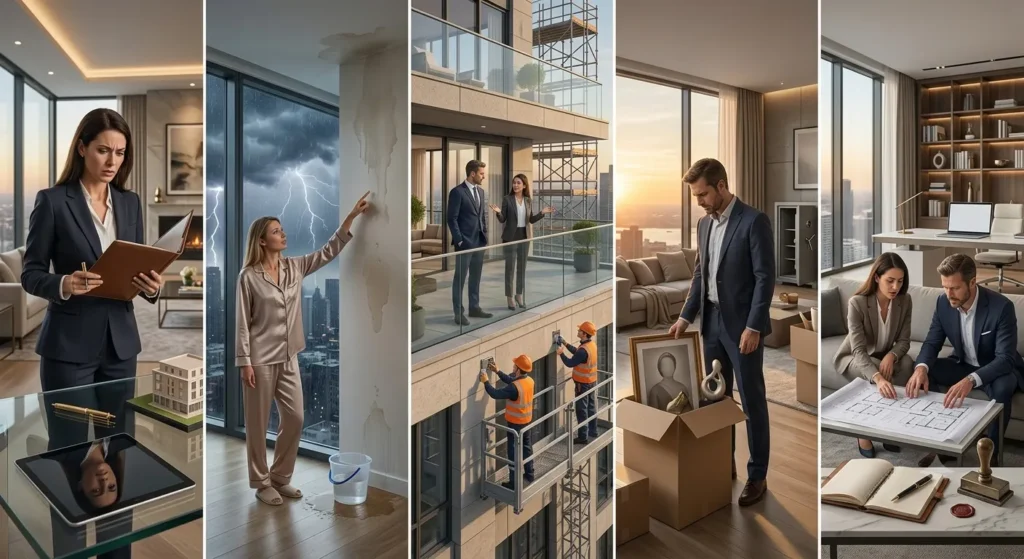
- High HOA fees: $1,500–$10,000+ per month depending on the city and building. These fees are non-negotiable and increase annually.
- Weather exposure: Roof proximity means higher risk of storm damage, ice damming, and heat absorption through the roof in summer. Roof leak liability varies by building — verify this in the proprietary lease before closing.
- Worker access requirements: NYC’s Facade Inspection and Safety Program (FISP), also called Local Law 11, requires building facade inspections every 5 years. Workers access the roof and may need to cross your terrace. Penthouse owners typically receive no compensation for this loss of access.
- Co-op board rejection risk: For co-op penthouses, the board can reject your application without giving a reason. This risk exists even after you reach contract stage.
- Jumbo loan complexity: The stricter underwriting, higher down payment, and larger cash reserve requirements of jumbo mortgages eliminate many buyers who qualify for standard loans.
Is a Penthouse a Good Investment in 2026?
Yes, penthouses are a good investment in 2026 for buyers who can absorb the upfront cost and ongoing carrying expenses. 3 factors make penthouses outperform the broader luxury condo market:
- Scarcity: A 500-unit building has 498 standard apartments but 1–2 penthouses. Demand from a specific buyer segment always exceeds supply.
- Premium appreciation: Penthouses in primary markets appreciated at 8–12% annually over the last decade, outpacing standard luxury units by 3–5 percentage points.
- Short-term rental income: Where building rules and local laws allow, penthouses list on Airbnb and VRBO for $1,000–$10,000+ per night. Miami and Las Vegas have the most permissive STR (short-term rental) environments.
Preconstruction vs Resale Penthouse — Which Is Better?
| Factor | Preconstruction | Resale |
| Price | 10–20% below final market value | Current market rate |
| Customization | High — finishes, layouts often customizable | Limited to renovation |
| Move-in Timeline | 1–3 years after purchase | 60–120 days |
| Risk | Developer delay or cancellation risk | Lower — building exists |
| Financing | Deposit structure (20–30% upfront) | Standard jumbo mortgage |
| Best For | Investors, long-term buyers | Buyers with immediate needs |
NYC buyers with non-primary residences face an additional pied-à-terre tax on properties valued above $5 million. This tax ranges from 0.5–4% annually and adds $25,000–$200,000+ per year to the cost of ownership for secondary-home penthouse buyers.
Can a Foreign National Own a Penthouse in the US?
Yes, foreign nationals can own a penthouse in the US through a condo or freehold structure. Co-ops frequently reject non-US residents due to board interview requirements and financing limitations. Here are the 4 key steps for foreign buyers:
- Apply for an ITIN: An ITIN (Individual Taxpayer Identification Number) is required for foreign buyers without a US Social Security Number. Apply through the IRS using Form W-7.
- Secure a foreign national mortgage: Foreign national mortgages require 25–30% down payment, higher interest rates (typically 0.5–1.5% above standard jumbo rates), and additional documentation including passport, visa, and foreign bank statements.
- Understand FIRPTA rules: FIRPTA (Foreign Investment in Real Property Tax Act) requires a 15% withholding on the sale proceeds when a foreign national sells US real estate. Work with a US tax attorney to structure this correctly.
- Choose the right city: Miami and Manhattan condo buildings are the most foreign-buyer-friendly markets. Many Miami luxury buildings have 50–70% international ownership. Las Vegas is also accessible with fewer restrictions.
True Cost of Penthouse Ownership: Full Annual Breakdown
The purchase price is one payment. Ownership costs continue every year. Below is a realistic annual cost breakdown for 2 markets:
| Cost Category | NYC Penthouse ($5M) | Miami Penthouse ($2M) |
| HOA / Maintenance Fees | $60,000 – $120,000/yr | $24,000 – $60,000/yr |
| Property Tax | $50,000 – $80,000/yr | $20,000 – $40,000/yr |
| Insurance (personal) | $5,000 – $15,000/yr | $4,000 – $12,000/yr |
| Utilities (large glass facade) | $8,000 – $20,000/yr | $6,000 – $15,000/yr |
| Terrace Maintenance | $5,000 – $30,000/yr | $3,000 – $15,000/yr |
| Jumbo Mortgage (30yr, 7%) | ~$398,000/yr | ~$159,000/yr |
| Total Annual Cost (est.) | $526,000 – $663,000 | $216,000 – $301,000 |
These figures exclude facade inspection costs (billed to buildings every 5 years but sometimes assessed to penthouse owners), emergency roof repairs, and co-op special assessments for building-wide capital improvements.
5 Questions to Ask Before Buying a Penthouse
Ask these 5 questions before signing any contract:

- Is this unit genuinely on the top floor?
Verify with the building’s certificate of occupancy. Some developers market upper-floor units as penthouses for higher pricing.
- Will the views stay unobstructed?
Ask a title company to pull FAR zoning records for all adjacent lots. FAR limits how tall neighboring buildings can grow — this protects your views.
- Who handles roof maintenance and worker access?
Get this in writing from the building. Confirm how much advance notice you receive before workers access your terrace, and what the compensation process is if access disrupts your use of outdoor space.
- Is the rooftop space private or shared?
In co-ops, terraces are for exclusive use of the penthouse but legally owned by the building. In condos, terrace space is typically deeded to the unit. This distinction affects your rights to build, install, and modify outdoor features.
- What are the STR and customization rules?
Check the HOA bylaws for short-term rental restrictions and renovation approval requirements before buying. Some buildings ban Airbnb entirely and require board approval for any structural change.
Conclusion
Owning a penthouse is achievable — it is not reserved for celebrities or billionaires. Entry-level options start at $300,000, and the financing path is clear if your credit score hits 720 and your DTI stays below 43%.
The biggest mistake buyers make is focusing only on purchase price. HOA fees, property taxes, roof maintenance, and jumbo loan requirements add $200,000–$663,000 per year in carrying costs depending on the market. Know the full number before you sign.
Choose a condo over a co-op if you want flexibility, faster closing, and no board interview risk. Verify FAR zoning before closing to protect your views. Get outdoor space rights in writing. Do those 3 things and a penthouse is one of the best-performing assets in US luxury real estate.