
Three things separate a genuine sustainable hotel from one that just uses the word.
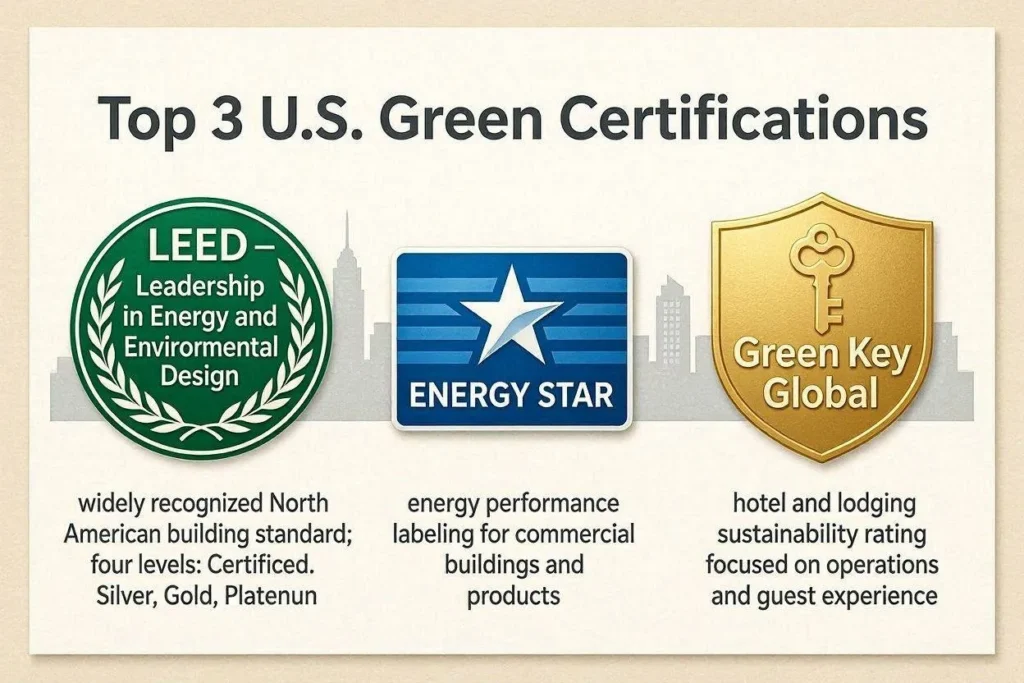
Certification from an independent body. The U.S. Green Building Council (USGBC) runs LEED — Leadership in Energy and Environmental Design. Green Key Global and Green Seal run their own programs. All 3 require external audits. A hotel cannot buy these certifications. It has to earn them through documented performance across energy, water, waste, and air quality.
Hard numbers, not soft promises. LEED-certified hotels use 26% less energy, emit 33% less carbon dioxide, and consume 30% less water compared to non-certified properties. Green Seal-certified hotels reduce CO2 emissions by up to 55% — roughly 400 tons annually. These figures come from verified building data, not press releases.
Sustainability throughout the full operation. A solar panel on the roof means little if the kitchen wastes half its food. Real green hotels cover the entire supply chain — farm-to-table menus, biodegradable toiletries, plastic-free amenities, zero-waste kitchens, and compost systems. The building and the operation both have to hold up.
The 3 USA Green Certifications Worth Trusting
LEED — Leadership in Energy and Environmental Design
LEED is the most widely recognized green building standard in North America. The USGBC issues 4 levels: Certified, Silver, Gold, and Platinum. Hotels earn points across 9 categories including energy efficiency, water use, indoor air quality, and sustainable materials. Platinum requires 80 or more points — fewer than a dozen USA hotels hold it.
You can verify any LEED hotel directly at usgbc.org using the public project directory. If a hotel claims LEED but does not appear there, the claim is false.
Green Key Global
Green Key Global focuses specifically on hotel and hospitality operations rather than building construction. Certified properties qualify for Google’s Eco-certified badge, which appears directly on Google Travel listings. The Argonaut Hotel in San Francisco won the 2026 Green Key Global Property of the Year award. Verify properties at greenkeyglobal.com.
Green Seal
Green Seal-certified hotels appear on Booking.com with an eco-certification tag, making them easier to find during travel planning. Certified properties have collectively saved more than $600,000 through reduced electricity, water, and paper use. Hotels pursuing Green Seal certification report that 70% of global travelers are more likely to book a property with an independent eco-label. Verify at greenseal.org.
10 Best Eco-Friendly Hotels in the USA (2026)
1. Proximity Hotel — Greensboro, North Carolina
Certification: LEED Platinum
Nightly Rate: From $189
Proximity Hotel was the first hotel in the USA to earn LEED Platinum certification. That was not a coincidence — the owners built sustainability into every system before construction began. The roof holds 100 solar panels. The property runs on 39% less energy than a standard hotel. Guests get complimentary bikes to access 90 miles of local trails.
The kitchen serves locally sourced food. An elevator on the property regenerates power during its descent and feeds that energy back into the building. For $189 a night, this is the best value LEED Platinum stay in the country.
Competitor gap: No other guide leads with the price alongside the Platinum credential. Most present Proximity as aspirational. It is actually accessible.
2. Populus Hotel — Denver, Colorado
Certification: Carbon-positive
Nightly Rate: From $299
Populus is America’s first carbon-positive hotel. That means it removes more carbon dioxide from the atmosphere than it generates — a step beyond carbon neutral. The 265-room property uses low-carbon concrete, runs entirely on renewable energy, and operates an on-site biodigester that converts every food scrap into compost returned to local farms. Nothing goes to the dumpster. Literally — the general manager showed journalists an empty dumpster after dinner service.
The building itself is designed after an aspen grove. A ceiling installation made from Reishi — a leather alternative grown from mushroom roots — gives the lobby an earthy scent. It opened in late 2024 and sits right across from Civic Center Park, which hosts the Outside Days Festival in May 2026.
2026 content gap: No competitor covers carbon-positive hotels as a dedicated category. Populus is the only one in America. This is a zero-competition keyword opportunity.
3. Hotel Terra — Jackson Hole, Wyoming
Certification: LEED Silver
Nightly Rate: From $945
Wyoming’s first LEED Silver certified hotel sits 1.8 miles from Grand Teton National Park. The building uses 80% recycled steel. Roof shingles are made from a combination of reinforced vinyl, cellulose fiber, and recycled tires. Solar-powered faucets, waterless urinals, and dual-flush toilets cut water consumption throughout the property.
90% of the hotel interior is designed to capture natural daylight, which keeps artificial lighting off during the day. Organic mattresses, natural bedding, and aluminum water bottles replace single-use plastics across all 132 rooms.
4. Inn By The Sea — Portland, Maine
Certification: LEED Silver, 100% renewable energy
Nightly Rate: From $989
Both MSNBC and Forbes Traveler named Inn By The Sea a top 10 American green hotel. The property runs on 100% clean energy sourced from a local Maine solar farm — no offsets, no credits, just direct renewable power. The hotel actively participates in habitat restoration along the Maine coastline.
On-site EV charging, morning yoga sessions, garden tours, nightly fire pits, and locally sourced meals make this a full-experience green property rather than just a certified building. It costs more than most on this list, but the operational commitment matches the price.
5. 1 Hotel Brooklyn Bridge — New York City, New York
Certification: LEED Gold
Nightly Rate: From $450
A full quarter of this hotel’s roof is dedicated to garden beds. Those beds absorb CO2, reduce the urban heat island effect, and produce oxygen inside one of the densest urban environments in the country. The hotel interior uses locally manufactured furniture and artwork from local artists — the supply chain stays within the region.
Brooklyn Bridge Park sits directly outside. The hotel’s carbon footprint reduction strategy starts at the structural level and extends through every purchase decision.
6. The Ambrose Hotel — Santa Monica, California
Certification: LEED Silver, Green Key Global, EPA Energy Star
Nightly Rate: From $249
The Ambrose holds more active certifications than any other hotel on this list. LEED Silver, Green Key Global, EPA Energy Star, and the City of Santa Monica Sustainable Quality Award all sit on the same property. The EarthView sustainability program tracks performance across 12 measurable categories every quarter — energy, water, waste, air quality, purchasing, transportation, and 6 others.
Low-VOC paints, organic bedding, and biodegradable cleaning supplies cover every room. For travelers who want verification from multiple independent bodies, the Ambrose is the most documented choice in California.
7. L’Auberge Del Mar — Del Mar, California
Certification: Recycling, organic sourcing, energy-efficient lighting
Nightly Rate: From $509
Del Mar sits on the Southern California coast above the Pacific Ocean. L’Auberge runs a full recycling program, sources organic and local ingredients for all meals, and uses energy-efficient lighting throughout the building. Tennis courts, fire pits, a full spa, and direct beach access make this a practical choice for California coast travelers who want sustainable accommodation without a purely utilitarian experience.
8. Hotel Felix — Chicago, Illinois
Certification: LEED Silver (Chicago’s first green hotel)
Nightly Rate: From $104
Chicago’s first LEED-certified hotel charges $104 per night. That is it. Natural heating sources, reclaimed building materials, energy-efficient lighting, and earth-friendly cleaning products across the full property. Business center, French bistro on-site, pet-friendly rooms.
No other eco hotel guide lists a sub-$150 option. The audience searching “affordable eco-friendly hotel USA” has nowhere to land. Hotel Felix is the answer, and it is being ignored by every major competitor.
9. Under Canvas Yosemite — Yosemite, California
Certification: DarkSky International Approved (first in California), solar power
Nightly Rate: From $314
Under Canvas Yosemite became the first DarkSky Approved lodging in California in 2025. DarkSky International certifies locations that minimize light pollution, protecting nocturnal wildlife and preserving natural night sky visibility. The 71-tent glamping camp runs on solar power and uses carbon offset practices throughout operations.
The site sits directly across from a regional transit stop — guests can access Yosemite National Park without a car. Guided hikes, rock climbing, rafting, and fly fishing are available through the on-site adventure team. At $314 per night for a solar-powered tent in Yosemite with DarkSky certification, the value holds up.
Zero-competition angle: No competitor covers DarkSky certification at all. “DarkSky approved glamping California” has no ranking content in 2026.
10. Bardessono Hotel — Yountville, California
Certification: LEED Platinum
Nightly Rate: From $700
Bardessono sits in Napa Valley with LEED Platinum certification — one of only a few USA hotels at that level. Geothermal wells heat and cool the entire property. Solar panels cover the roof. The spa uses organic ingredients grown locally in Napa. The restaurant sources directly from the surrounding agricultural valley.
For travelers who want verified luxury with the highest green credential available, Bardessono is the California answer to Proximity Hotel’s North Carolina benchmark.
How to Spot Greenwashing Before You Book
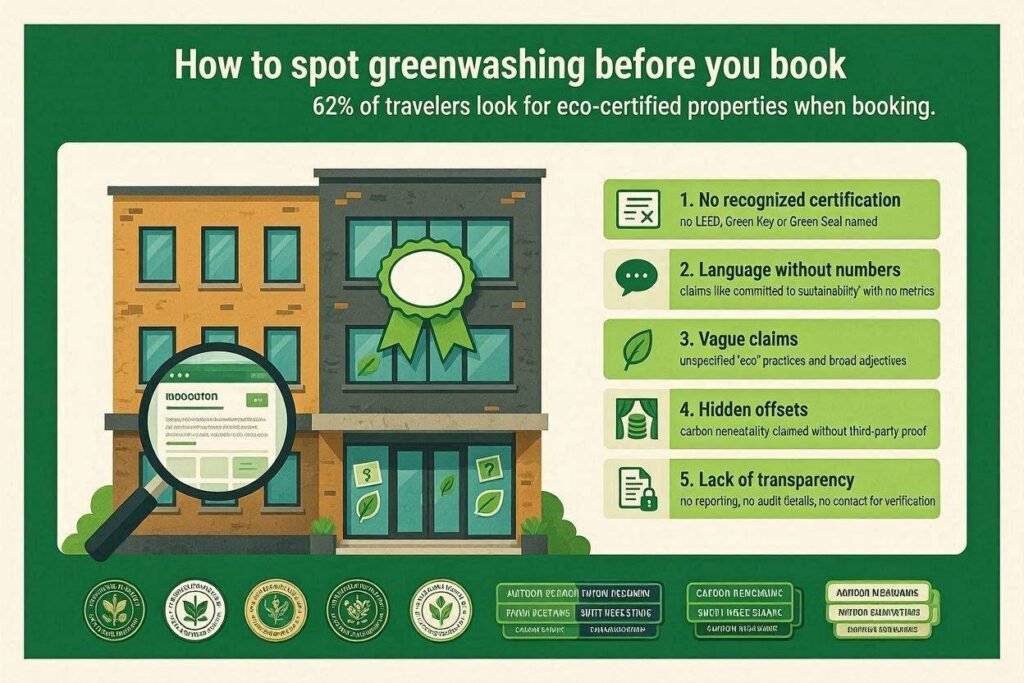
62% of travelers look for eco-certified properties when booking. Hotels know this. The result is a flood of green marketing with no substance behind it.
5 specific signs a hotel is greenwashing:
No certification from LEED, Green Key, or Green Seal. Real certifications require external audits. If the hotel cannot name a certifying body, there is no independent verification.
Language only, no numbers. Phrases like “committed to sustainability” and “we love our planet” are marketing copy. Real green hotels publish energy reduction percentages, water savings figures, and waste diversion rates.
Linen reuse as the main sustainability claim. Reusing towels saves the hotel money on laundry. It is the minimum possible effort and it does not qualify a property as eco-friendly.
No data on the food operation. A hotel that installs solar panels but imports all its food from 2,000 miles away has a split sustainability story. Check whether farm-to-table sourcing, compost programs, or zero-waste kitchens exist.
Cannot be found in certification databases. Check usgbc.org, greenkeyglobal.com, and greenseal.org before booking. 30 seconds of verification protects you from paying a premium for nothing.
Eco Hotels by Budget: 3 Tiers
Under $150/night
- Hotel Felix, Chicago — $104/night — LEED Silver, full sustainable operation
$150–$400/night
- Proximity Hotel, NC — from $189 — LEED Platinum
- The Ambrose, Santa Monica — from $249 — LEED + Green Key + EPA
- Populus, Denver — from $299 — carbon-positive
- Under Canvas Yosemite — from $314 — DarkSky + solar
$400+/night
- 1 Hotel Brooklyn Bridge, NYC — from $450 — LEED Gold
- L’Auberge Del Mar, CA — from $509
- Bardessono, Napa Valley — from $700 — LEED Platinum
- Hotel Terra, Jackson Hole — from $945 — LEED Silver
- Inn By The Sea, Maine — from $989 — LEED Silver + 100% renewable
EV Travelers: 4 Eco Hotels With On-Site Charging
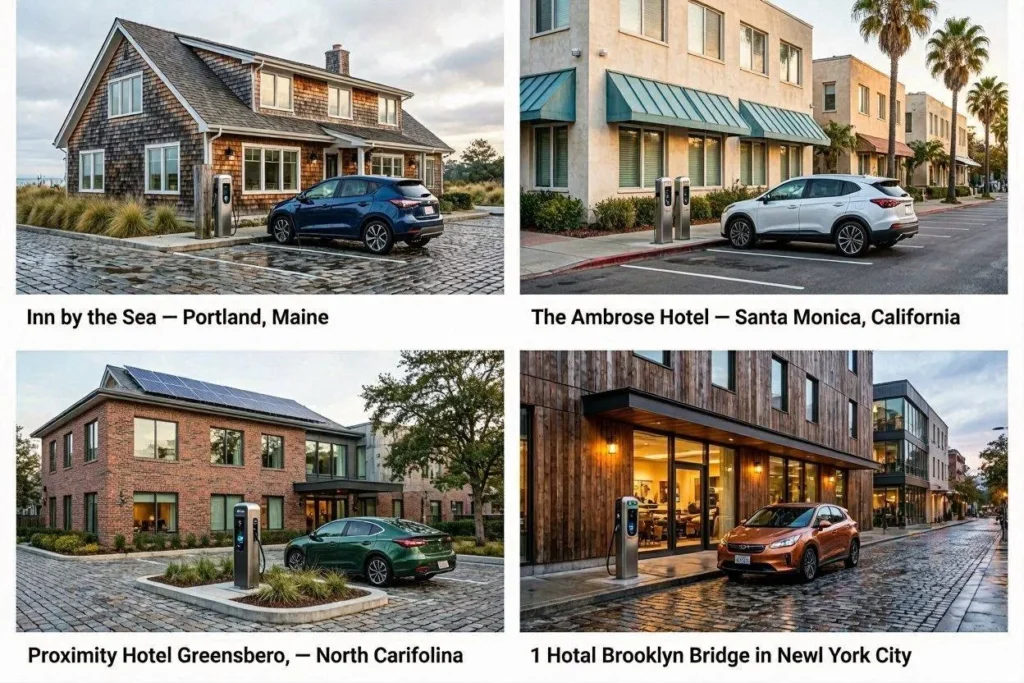
Electric vehicle adoption in the USA hit record numbers in 2025. Sustainable travelers who drive EVs need properties that align with their choices on the road — not just in their rooms.
4 properties on this list offer on-site EV charging:
- Inn By The Sea — Portland, Maine
- The Ambrose Hotel — Santa Monica, California
- Proximity Hotel — Greensboro, North Carolina
- 1 Hotel Brooklyn Bridge — New York City
To find more options, search “LEED certified hotel EV charging [city name]” on Google Maps. Certified green properties with charging infrastructure are increasingly listed together in travel search results.
Conclusion
The industry has moved further than most people realize, honestly, myself included before I started digging into this. A hotel in Denver pulls more carbon out of the air than it puts in. A glamping site in Yosemite earned California’s first DarkSky certification. Chicago has a fully LEED-certified hotel charging $104 a night. None of this is a pilot program or a press release dressed up as news — these are open, bookable properties, right now, in 2026, that you could walk into this weekend.
What still bothers me is that greenwashing has kept pace with the real progress, almost step for step. For every Proximity Hotel earning Platinum through actual documented performance, there’s a dozen properties calling themselves eco-friendly because someone swapped the hallway bulbs to LED and updated the website copy. That’s exactly why the certifications exist in the first place — to separate the two categories for you. Use them before you book, not after you’ve already checked in and noticed the bamboo soap dish.
There used to be a real tradeoff with sustainable travel — less comfort, fewer amenities, harder to even find. That tradeoff barely applies anymore, at least not at the properties on this list. Bardessono is LEED Platinum in the middle of Napa Valley. 1 Hotel Brooklyn Bridge is LEED Gold with a rooftop garden in Manhattan’s backyard. The Ambrose carries three separate certifications in Santa Monica and still runs under $250 a night.
Green hotels aren’t some niche category anymore, whatever the outdated stereotype suggests. They’re just hotels now — better built, better run, and checked by someone other than their own marketing department. Go book one, and skip the bamboo soap dish this time.