

A hotel suits short trips, solo travel, and city breaks where service comes first. A villa suits families, groups, and travelers who want space, privacy, and a kitchen. The hotel vs villa choice depends on your group size, your budget, and how long you stay.
This guide compares cost, privacy, amenities, and location side by side. You will see exact numbers, named examples, and a quick-reference table. By the end, you will know which option fits your next trip.
Both options can deliver a 5-star experience, but they serve different travel goals. A hotel removes every planning task from your hands, from breakfast to turndown service. A villa hands you full control of your schedule, your meals, and your guest list. The right pick for your hotel vs villa search depends on how much control you want versus how much service you want.
What Is the Main Difference Between a Hotel and a Villa?
A hotel offers individual rooms inside one shared building with staff-run services. A villa offers an entire standalone property with private bedrooms, a kitchen, and outdoor space. The hotel vs villa decision starts with this structural split: a shared building versus a private property.
Hotels stack guests across multiple floors, with rooms ranging from 300 square feet (28 square meters) to 600 square feet (56 square meters). Villas spread guests across one footprint, with sizes ranging from 1,200 square feet (111 square meters) for a 2-bedroom unit to 10,000 square feet (929 square meters) for a 10-bedroom estate.
How Hotel Rooms Are Structured

Hotel rooms follow a fixed layout that includes a bed, a bathroom, and a closet. Brands such as Four Seasons, Aman, and Ritz-Carlton add suites with a separate sitting area. Guests share hallways, elevators, and amenity spaces like the pool, gym, and restaurant with every other guest on the property.
How Villa Layouts Differ From Hotel Rooms
A villa includes multiple bedrooms, a full kitchen, a living room, and private outdoor space. Properties such as a 3-bedroom villa in Tuscany or a 6-bedroom estate in Bali show the size range available. To understand what defines a villa, see The Pinnacle List’s breakdown of (see link below) the category’s history and design.
Read what defines a villa for a full look at the category’s Roman origins, architectural styles, and modern luxury features.
Villas split naturally into 3 categories: classical estates with stone facades, modern builds with glass walls, and boutique cottages with 2 to 3 bedrooms. A classical villa often features colonnades, courtyards, and frescoed ceilings inspired by Renaissance architecture. A modern villa favors open-plan living, infinity pools, and cantilevered terraces over ornate detail. Each category changes the feel of your stay, even though all 3 fall under the same villa label.
How Do Hotel and Villa Costs Compare for Your Trip?
A villa typically costs more upfront but drops to a lower per-person rate for groups of 4 or more. A hotel charges per room, which multiplies fast for families needing 2 or 3 separate rooms. The hotel vs villa cost comparison shifts toward villas once your group passes 4 travelers.
Hidden Hotel Fees You Should Budget For
To budget for a hotel stay, add resort fees, parking charges, and minibar pricing to the listed room rate. Hotels in cities such as New York, Miami, and Dubai often add a resort fee between $25 and $75 per night. Breakfast alone can add $20 to $45 per person, per day, at many properties.
Villa Costs for Groups and Long Stays
A villa rental bundles your entire stay into a single price that often includes a private pool. For a 7-night stay, a 4-bedroom villa priced at $3,500 totals $125 per person across 4 couples. Cooking 2 of 3 daily meals at the villa can cut your food budget by 40%.
Bold fact: a villa booked for 8 guests over 7 nights frequently costs 30% less per person than 4 separate hotel rooms for the same dates.
Currency and season also shift the hotel vs villa math. A villa in the Algarve drops 35% in price during shoulder season months like May and October. A hotel in the same region holds firmer pricing year-round because demand spreads across solo guests, couples, and groups alike. Booking 60 to 90 days ahead typically secures the best villa rates, while hotel rates fluctuate daily based on occupancy.
Which Offers Better Privacy: A Hotel or a Villa?
A villa wins on privacy because no other guests share your walls, pool, or garden. A hotel limits privacy to your single room while every other amenity stays open to the whole property. The hotel vs villa privacy gap matters most for honeymooners, celebrities, and multi-generational families.
Hotels keep noise, foot traffic, and shared elevators as part of daily life, even inside 5-star properties. Villas remove that exposure entirely, since the gate, the pool, and the garden belong only to your group.
Security also differs between the 2 options. A hotel relies on key cards, a staffed lobby, and shared cameras covering common areas. A villa often adds a private gate, an alarm system, and in some developments, a dedicated security guard. Travelers seeking maximum discretion, such as executives or public figures, tend to choose a villa for this added layer of control.
How to Choose Between a Hotel and a Villa for Families
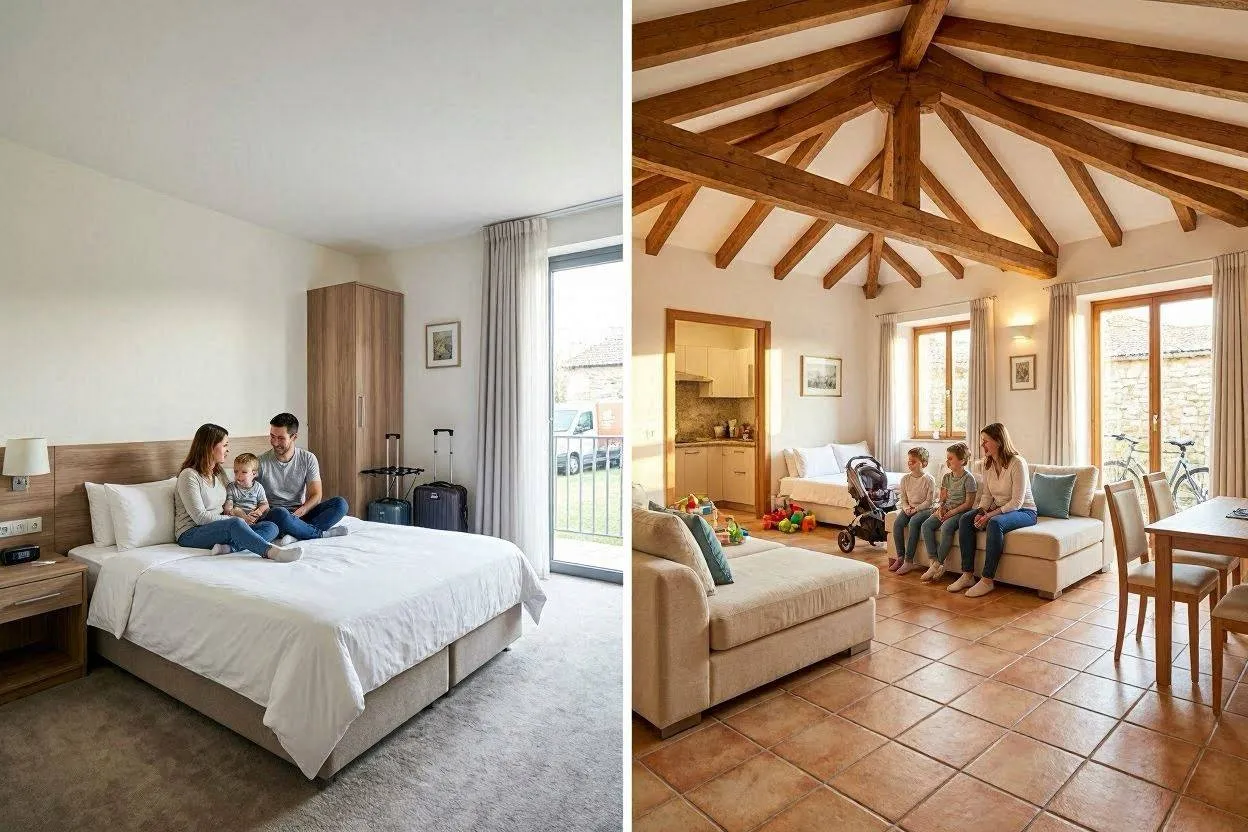
To choose between a hotel and a villa for families, count your travelers first, then match the space to that number. Groups under 3 people usually do better in a single hotel room. Groups of 4 or more save money and gain space inside a villa. The hotel vs villa choice for families almost always tracks headcount more than budget.
Families with young children benefit from a villa’s separate bedrooms, since kids can sleep early while adults stay up. A kitchen in a villa solves picky eating and dietary restrictions without relying on a restaurant menu. Multi-generational trips with grandparents, parents, and children fit better across 4 or 5 villa bedrooms than across 3 separate hotel rooms.
- Couples on a 3-night city break: choose a hotel
- Families of 5 or more on a 7-night trip: choose a villa
- Solo business travelers: choose a hotel
- Multi-generational reunions: choose a villa
Childcare options also separate the 2 choices. Hotels often offer a kids’ club, a babysitting referral, or a supervised pool area for 2 to 3 hours daily. Villas place childcare entirely in your hands unless you book a nanny through the property manager. Parents who want built-in supervision lean toward a hotel, while parents who want flexible nap and meal schedules lean toward a villa.
What Amenities Do Hotels Offer That Villas Don’t?
A hotel offers daily housekeeping, a 24-hour front desk, and on-site dining without booking ahead. A villa requires you to arrange cleaning, meals, and transport yourself, even with staff included. The hotel vs villa amenity gap favors hotels for guests who want zero planning.
Hotel guests get instant access to a gym, a spa, and a concierge desk at check-in. Room service can deliver food at 2 a.m. without a phone call to a private chef. Loyalty programs from brands such as Marriott, Hilton, and Hyatt also add point redemptions that villas cannot match.
On-site dining gives hotel guests 2 or 3 restaurant choices without leaving the building. A villa, by contrast, can hire a private chef for 1 or 2 meals per day, but you must arrange and pay for that service separately. Some villa management companies bundle a chef, a housekeeper, and a driver into 1 weekly package, closing part of the amenity gap with hotels.
How Do Hotel and Villa Booking Policies Differ?
A hotel offers same-day booking and free cancellation up to 24 or 48 hours before arrival at most brands. A villa often requires a 25% to 50% deposit at booking, with full payment due 30 to 60 days before arrival. The hotel vs villa booking process rewards spontaneity in hotels and rewards early planning in villas.
Travel insurance becomes more important for villa bookings because deposits rarely refund after the cancellation window closes. Hotels publish cancellation rules directly on the booking page, while villa rental agreements vary by owner or management company. Always read the contract terms for a villa before you submit payment, since policies differ between properties in Mexico, Greece, and Thailand.
- Hotel cancellation: typically free up to 24-48 hours before check-in
- Villa cancellation: typically locked after a 30 to 60-day window
- Hotel payment: charged at check-in or check-out
- Villa payment: deposit at booking, balance before arrival
When Should You Book a Villa Instead of a Hotel?
Book a villa instead of a hotel when your trip lasts 5 nights or longer with 4 or more travelers. A villa also suits remote workers who need a desk, fast Wi-Fi, and a quiet room for calls. The hotel vs villa decision favors villas for destination weddings, family reunions, and milestone celebrations.
To research a high-end villa rental, check the staff included, the pool type, and the distance to the nearest beach or town.
A luxury home guide also helps you compare property standards, finishes, and amenities before you book a stay.
How Do Hotel and Villa Locations Affect Your Trip?
Hotels claim the best city-center and beachfront locations, cutting your travel time to landmarks. Villas sit in quieter neighborhoods, hillsides, or countryside settings away from foot traffic. The hotel vs villa location trade-off comes down to access versus seclusion.
A hotel near Times Square, the Champs-Elysees, or Shibuya Crossing puts you steps from dining and shopping. A villa in Tuscany, the Cotswolds, or Costa Rica’s Nicoya Peninsula trades that access for mountain views and silence. Renting a car becomes more important for villa stays outside major cities.
Public transport access also splits along these lines. A hotel in a downtown district sits within walking distance of a subway, tram, or bus stop in most major cities. A villa located 20 to 40 minutes outside town center requires a rental car, a private driver, or a pre-arranged transfer. Factor this transport cost into your hotel vs villa budget before you finalize a booking.
Hotel vs Villa Quick-Reference Comparison Table
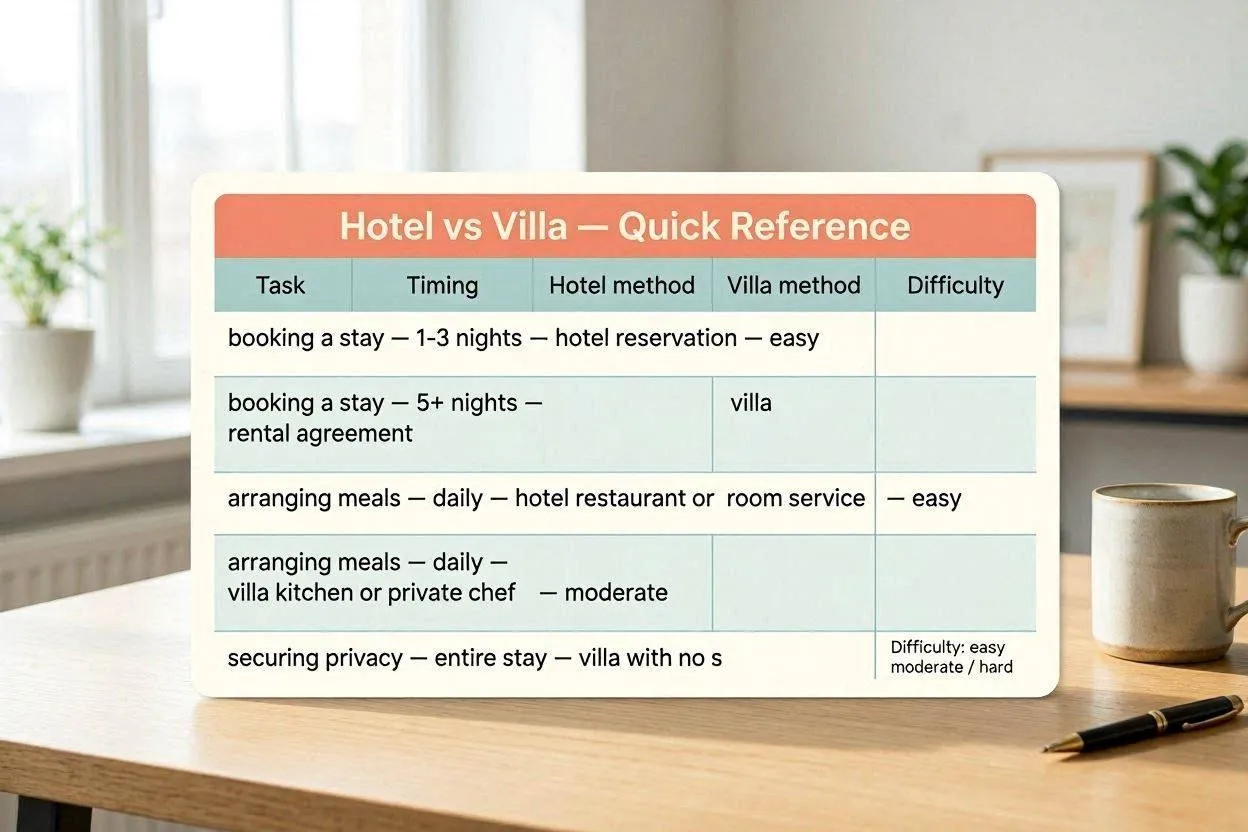
The table below lists 9 common travel tasks, when each applies, the method tied to a hotel or a villa, and the difficulty level.
| Task | Timing | Method | Difficulty |
|---|---|---|---|
| Booking a stay | 1-3 nights | Hotel reservation | Easy |
| Booking a stay | 5+ nights | Villa rental agreement | Moderate |
| Arranging meals | Daily | Hotel restaurant or room service | Easy |
| Arranging meals | Daily | Villa kitchen or private chef | Moderate |
| Securing privacy | Entire stay | Villa with no shared walls | Easy |
| Reaching attractions | Daily | Hotel central location | Easy |
| Hosting large groups | Entire stay | Villa with multiple bedrooms | Moderate |
| Managing housekeeping | Daily | Hotel daily service | Easy |
| Managing housekeeping | 2-3 times weekly | Villa scheduled cleaning | Moderate |
Final Verdict on Hotel vs Villa for Your Next Trip
The hotel vs villa decision comes down to 3 factors: group size, trip length, and your need for service versus space. Solo travelers and couples on short trips gain more from a hotel’s convenience. Families, groups, and travelers planning 5 nights or longer gain more from a villa’s privacy and savings.
Review your travel dates, your headcount, and your budget against the table above before booking either option. A 3-night trip for 2 people almost always favors a hotel’s convenience and central location. A 7-night trip for 6 or more people almost always favors a villa’s space and per-person value.
Explore The Pinnacle List’s full collection of luxury villas, estates, and real estate features to plan your next stay with confidence. Visit thepinnaclelist.com to browse current villa listings and start planning your trip today.
Whichever side of the hotel vs villa question fits your trip, book early for peak months like July, August, and December. The hotel vs villa choice changes with every season, every destination, and every group size, so revisit this comparison before each new trip you plan.