Booking luxury travel sounds simple. It isn’t. A five-star label means different things in New York, London, and Sydney. Rates have climbed sharply since 2023, yet service quality at many top-tier properties has not kept pace. Knowing what genuinely signals luxury — versus what is clever marketing — saves money and prevents ruined trips for the discerning traveler.
This guide covers the full luxury travel landscape: how star ratings work, what amenities separate ultra-luxury from merely upscale, which destinations lead the luxury travel market in 2026, when to use a luxury travel advisor, and how to spot a hotel that charges five-star prices while delivering three-star results.
How Hotel Star Ratings Actually Work in 2026
Star ratings measure service standards and amenities, not just aesthetics. The system is older than most travelers realize. Forbes Travel Guide launched the first five-star rating system in 1958, originally as Mobil Travel Guide. Today, Forbes evaluates properties against up to 900 objective criteria — covering everything from how quickly staff greet arriving guests (within 60 seconds, per Forbes standards) to whether phone hold times exceed 30 seconds.
3 main rating bodies matter for USA, UK, Europe, Australia, and Canada travelers:
Forbes Travel Guide operates globally and carries the most weight. Anonymous inspectors pay their own way and stay a minimum of two nights. A property must meet 90% of standards to earn five stars, 82% for four stars. No property can buy a rating. The 2026 Star Awards covered 2,422 properties across more than 100 countries — the widest reach in the guide’s 68-year history.
AAA (American Automobile Association) Five Diamond applies primarily across North America. Of the roughly 26,000 hotel properties AAA inspects across North America, fewer than 0.5% earn five diamonds — making it statistically rarer than a Forbes five-star designation.
Hotelstars Union (HSU) covers 22 European member states as of 2026, following Slovakia’s admission in April 2026. HSU sets minimum criteria for each star level. A five-star HSU property must provide 24-hour reception, evening turndown, valet parking, concierge service, luggage assistance, bathrobes and slippers, international TV channels, and an in-room safe.
One thing travelers consistently miss: there is no universal global standard. The same hotel rated differently on Booking.com and TripAdvisor is not a contradiction — those platforms use separate systems. Always check which rating body assigned the stars before you book.
The 7 Things That Separate a True Five-Star Hotel from a Fake One
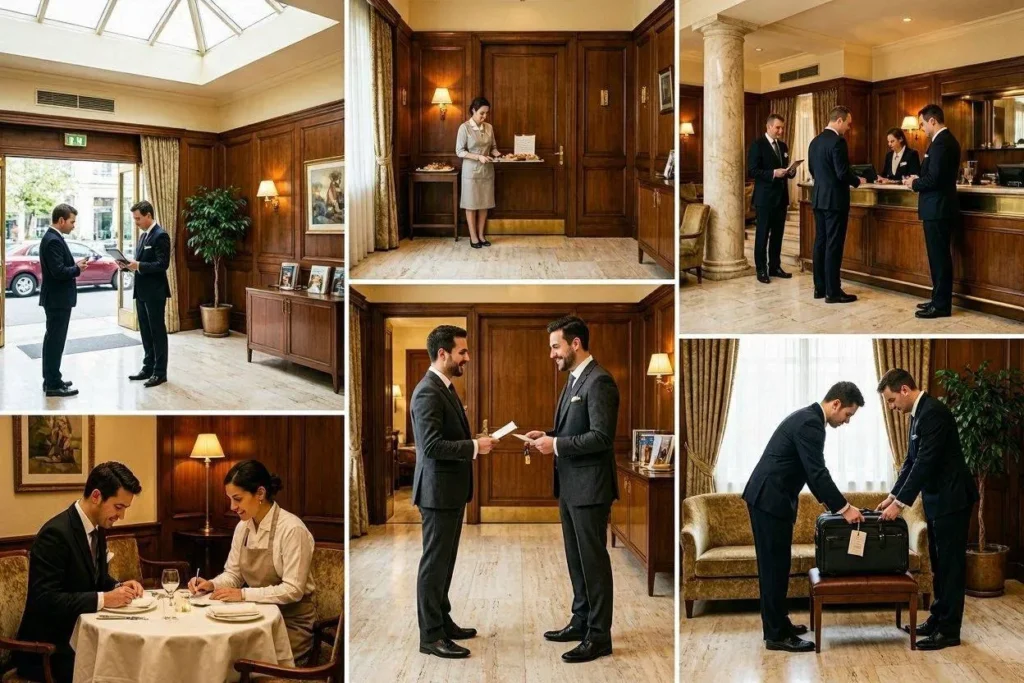
Service is the dividing line — not marble floors or high thread counts. A hotel can install the most expensive fittings money can buy and still deliver a four-star experience. Some independently owned properties with modest décor run circles around branded luxury chains.
Here are the 7 markers that distinguish genuine five-star hotels:
- Staff remember your name without prompting. Front desk staff, restaurant servers, and housekeeping all use your name during your stay. This happens through staff briefings, not coincidence.
- Problems disappear before you escalate them. True five-star service is anticipatory. Staff notice issues and resolve them before guests report them. If you have to ask more than once for anything standard, the property is not operating at five-star level.
- Check-in takes under five minutes. Many top properties now bypass the desk entirely. Aman New York, for example, routes guests directly to their rooms from the lobby on arrival, completing check-in in the suite.
- The room functions as a private retreat. Five-star rooms start at a minimum of 200 square feet (19 square meters) excluding the bathroom — but the benchmark properties in New York and London typically offer 350 to 500 square feet (32 to 46 square meters) for standard rooms. Blackout curtains, soundproofed walls, and smart room controls are standard, not optional.
- Dining is a destination in itself. The best properties carry their own Michelin stars or Forbes restaurant ratings. The St. Regis Atlanta earned both a five-star hotel and five-star restaurant designation in the 2026 Forbes awards — Atlanta’s first double five-star recognition.
- Wellness facilities go beyond a gym. Five-star spas offer individualized treatment programs, not just a menu of standard massages. Mii Amo in Sedona, Arizona — a 2026 Forbes five-star winner — tailors every wellness program to the surrounding red rock landscape and each guest’s specific goals.
- The hotel reflects where it is. Cookie-cutter luxury is the enemy of genuine five-star status. The best properties draw on their location — architecture, food sourcing, design details, and staff expertise all reference the destination. A five-star hotel in Edinburgh feels nothing like a five-star hotel in Miami, and that is exactly the point.
Types of Luxury Travel: Which Category Matches Your Trip
Choose the luxury travel category before choosing the brand. The wrong category ruins the trip regardless of star count. High-net-worth travelers and first-time luxury bookers alike benefit from matching trip type to property type before comparing individual hotels.
Grand luxury hotels suit business travel, milestone celebrations, and travelers who want every amenity under one roof. Think Waldorf Astoria, Four Seasons, Ritz-Carlton. These properties run 200 to 800+ rooms and operate at institutional scale — service is consistent but rarely personal.
Boutique luxury hotels work best for couples, solo travelers, and anyone who finds large hotel lobbies exhausting. Boutique properties typically run 10 to 80 rooms. Staff-to-guest ratios are higher than at chains. Small Luxury Hotels of the World (SLH) represents 500+ independently inspected boutique properties across 90 countries — none owned by major chains.
Luxury resorts center the experience on location — beach, mountain, desert, or jungle. Amenities are self-contained: guests rarely need to leave the property. Beach resorts in the Maldives, Bali, and the Caribbean account for the largest concentration of private-pool villas globally.
Wellness retreats target health and recovery rather than general leisure. Properties like Brenners Park-Hotel in Baden-Baden, Germany operate a full-service medical clinic alongside traditional spa facilities — a model that separates serious wellness hotels from resorts with a yoga class.
Adults-only resorts eliminate noise, child-focused programming, and the compromises that come with family travel. This segment ranks among the fastest-growing categories in luxury travel search demand.
Top Luxury Hotel Destinations in 2026
These 10 destinations produce the highest concentration of Forbes-rated five-star properties globally.
New York, USA holds more five-star hotels per square mile than any other American city. The Aman New York, Waldorf Astoria New York, and The Plaza lead the market.
London, UK anchors European luxury travel. Claridge’s, The Connaught, and The Dorchester form the core of the Mayfair luxury corridor.
Paris, France gained a new Forbes five-star in 2026: The Maybourne Riviera. The city’s luxury hotel corridor runs from the 1st arrondissement through the 8th, anchored by Hôtel Le Bristol and Le Meurice.
Sydney, Australia operates as the luxury gateway for the Asia-Pacific region. Park Hyatt Sydney and The Langham lead the market. Sydney represents one of the largest gaps between traveler demand and luxury hotel supply in the English-speaking world — a direct opportunity for boutique properties.
Barcelona, Spain gained its first Forbes five-star hotel in 2026, awarded to Mandarin Oriental, Barcelona — adding European credibility to a destination that already attracted 7.9 million international tourists annually.
Edinburgh, Scotland earned a Forbes four-star for 100 Princes Street in 2026 — the first time a property on Princes Street achieved that distinction. The city is developing rapidly as a luxury destination outside London.
Maldives leads globally for overwater villa and private island experiences. Waldorf Astoria Maldives Ithaafushi appeared prominently in Forbes’s 2026 award coverage.
Toronto, Canada and Vancouver, Canada are among the most underserved major English-speaking luxury markets in 2026. Neither city has a single Forbes five-star hotel currently — giving incoming boutique and independent properties a clear path to category leadership.
Melbourne, Australia mirrors Toronto’s position: strong corporate travel demand, high average household income, and no Forbes five-star designation as of mid-2026.
New Five-Star Hotels Opening in 2026 — The Freshest Options
343 Forbes five-star hotels now exist globally as of the 2026 Star Awards — the highest total in the rating system’s history. The USA gained 5 new five-star hotels: The Chateau at Nemacolin in Farmington, Pennsylvania; Mii Amo in Sedona, Arizona; The Ritz-Carlton Orlando, Grande Lakes; The St. Regis Atlanta; and Yacht Club at The Boca Raton.
Europe added five-stars in France (The Maybourne Riviera), Montenegro (One&Only Portonovi), Spain (Mandarin Oriental, Barcelona), and Switzerland (Mandarin Oriental Savoy, Zurich).
The pipeline for five-star hotels hit record levels heading into 2026 — more than 1,300 projects were in development in Q4 2025, an 8% increase year over year according to data tracker Lodging Econometrics.
3 new openings worth tracking for USA, UK, AUS, and Canada travelers:
Orient Express La Minerva, Rome — The reborn Orient Express brand’s first hotel. A 17th-century palazzo that operated as a hotel from 1811, now relaunched as a five-star property with the original building’s architectural details intact.
Brenners Park-Hotel, Baden-Baden, Germany — A Belle Epoque five-star fully restored after a two-year renovation. The standalone spa annex, Brenners Spa & Wellbeing, operates a full-service medical clinic alongside 15 wellness suites.
Ritz-Carlton Yacht Collection: Ilma — The world’s first Forbes five-star cruise ship. For travelers who want five-star standards at sea rather than on land, Ilma represents a category that did not exist before 2026.
How to Book a Luxury Hotel Without Overpaying
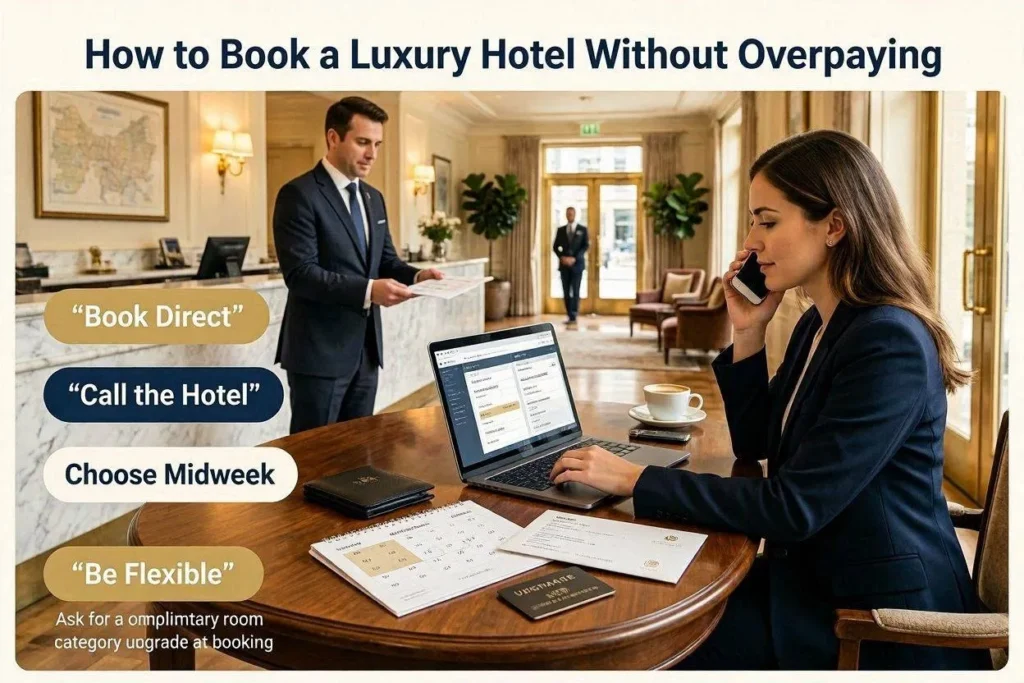
Book direct for the best rate in most cases — but not always. Here are 4 specific strategies:
- Contact the property directly after booking online. Hotels routinely upgrade guests who call the front desk directly. The upgrade costs the hotel nothing if higher-category rooms sit empty. Ask for a complimentary room category upgrade at time of booking, not at check-in.
- Book midweek arrivals. Luxury business hotels in New York and London drop rates 25 to 40% on Tuesday and Wednesday nights compared to weekend peaks. Resort properties operate the reverse — weekends hold peak pricing.
- Use hotel loyalty programs before third-party platforms. Leading Hotels of the World (LHW) runs the Leaders Club loyalty program, which provides exclusive rates and perks unavailable on Booking.com or Expedia. SLH’s equivalent program activates immediately at enrollment with no minimum spend requirement.
- Book shoulder season. Paris in November, London in February, and Sydney in June all offer the same five-star experience at 30 to 50% lower rates than peak season. The hotels are identical — only the crowds and prices change.
When to Use a Luxury Travel Advisor Instead
A luxury travel advisor earns their fee on complex, high-value trips rather than a single hotel booking. Advisors affiliated with Virtuoso or American Express Fine Hotels + Resorts hold negotiated relationships with individual properties, which routinely convert into complimentary breakfast, room upgrades at check-in, and early check-in or late checkout guarantees that the property does not publish anywhere. For a multi-stop itinerary — a private villa in Bali followed by an overwater villa in the Maldives, for example — an advisor coordinates transfers, dining reservations, and airport lounge access in a single call. Affluent travelers booking five or more nights at ultra-luxury properties typically recover an advisor’s value in perks alone, even before accounting for the time saved on planning.
Red Flags: 5 Signs a Hotel Is Faking Its Luxury Status
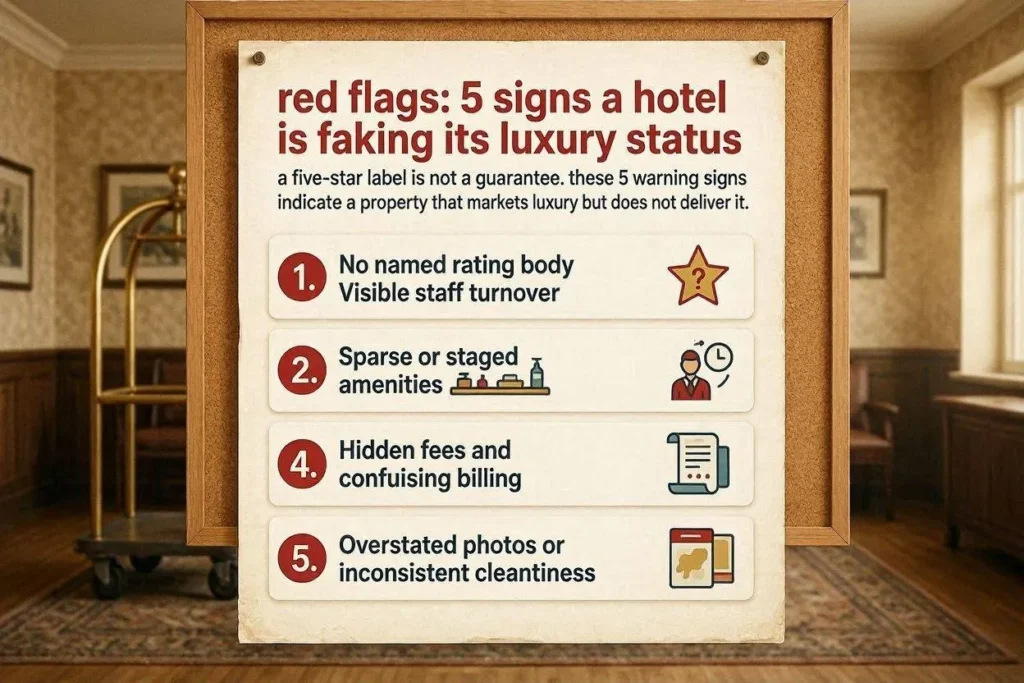
A five-star label is not a guarantee. These 5 warning signs indicate a property that markets luxury but does not deliver it.
- No named rating body. A hotel that describes itself as “five-star” without referencing Forbes, AAA, Hotelstars Union, or a national equivalent has self-awarded the designation. These terms carry no legal weight.
- Staff turnover is visible. New staff who do not know the property cannot deliver personalized service. If your server cannot answer basic questions about the menu or the hotel’s history, that reflects a staffing problem that runs deeper than one shift.
- The spa is outsourced. Several properties label themselves five-star while operating a spa run by a third-party franchise. Genuine five-star spas employ their own therapists, set their own treatment protocols, and integrate wellness into the hotel’s broader guest experience.
- Rooms vary significantly by floor. Consistent standards across all room categories are a Forbes inspection criterion. A five-star property cannot justify placing premium rooms on upper floors while standard rooms show wear and dated fittings on lower floors.
- Reviews mention noise. Soundproofing is a structural investment — it cannot be fixed with complaints management. Multiple reviews mentioning street noise, corridor noise, or thin walls indicate a property that missed a five-star baseline during construction.
Luxury Travel Amenities Worth Paying For (And 3 That Aren’t)
Genuine luxury travel amenities deliver white-glove, anticipatory service. Pay for these 4 — they directly improve the experience:
Butler service provides the clearest dividing line between four-star and five-star experiences. A butler unpacks luggage, manages restaurant reservations, arranges airport transfers, and handles requests before guests need to ask twice. Properties like St. Regis, Rosewood, and Aman assign dedicated butlers rather than sharing one across multiple rooms.
In-room dining at five-star quality — not every property delivers this. A five-star room service kitchen operates the same menu as the main restaurant, with the same chef oversight. If the room service menu is a reduced version of the main menu, the property treats in-room dining as an afterthought.
Concierge access to sold-out experiences separates genuine luxury from standard comfort. The best hotel concierges hold reservations at Michelin-starred restaurants, access tickets to sold-out events, and arrange private tours of museums before public opening. This is a relationship-based service that compounds over time — guests who build a relationship with a concierge get better results with each stay.
Private pool access adds genuine privacy in coastal and resort settings. Shared pools at luxury resorts can hold 200 or more guests during peak season. A private plunge pool or villa pool turns a shared amenity into an exclusive one.
Skip paying extra for these 3:
In-room technology packages — voice assistants, smart room controls, and tablet-based concierge apps are now standard rather than premium at five-star properties. Do not pay a room upgrade premium specifically for technology features.
Branded toiletry packages — Aesop, Bamford, and Le Labo toiletries appear in hundreds of five-star properties globally. The brand does not guarantee product quality relative to what you could buy at a pharmacy.
Pillow menus — hotels that market pillow selection as a premium differentiator are compensating for something else. A five-star bed should not require a menu to feel right.
Bottom Line
Luxury travel is not built the same everywhere. The gap between a property with a five-star rating and one that genuinely delivers an ultra-luxury experience is wide — and getting wider as rates climb faster than service standards.
The safest approach for the discerning traveler: cross-check any property against a recognized rating body, look past the amenity list to the service indicators, and prioritize destinations where competition among luxury properties is high. New York, London, and Paris compete hard for affluent travelers. Toronto, Melbourne, and Edinburgh are emerging luxury travel markets with properties that work harder to earn loyalty. Whether booked directly or through a luxury travel advisor, the trip should deliver bespoke, white-glove service from arrival to departure.